Canadians distrust refugees more than other new arrivals, poll shows
Trust in refugees was lower among immigrants than non-immigrants and lower among non-white respondents than white
Author of the article:
P
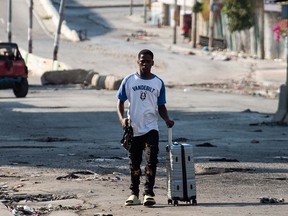
More Canadian residents distrust refugees than trust them, with the lowest levels of trust in refugees expressed by immigrants and non-whites, according to a new national public opinion poll.
The polling data comes as recent changes in the federal government’s immigration policies designed to reduce new arrivals in Canada seems to be hitting refugee claimants the hardest.
Among all respondents to the poll, conducted by Leger Marketing for the Association for Canadian Studies, 43 per cent said they distrusted refugees and 36 per cent said they trusted refugees. Another 21 per cent said they didn’t know or declined to answer.
The poll also found that more respondents trusted immigrants than distrusted them, a result suggesting Canadians have distinct views of different types of new arrivals to the country: 46 per cent of respondents said they trusted immigrants and 37 per cent said they distrusted them, while 17 per cent didn’t know or didn’t answer.
A refugee is someone who is fleeing their home country seeking protection from war, violence or persecution. An immigrant is someone who moves to another country to settle permanently.
The poll indicating lower trust in those arriving as refugee claimants over those arriving as immigrant applicants reflects a disproportionate drop in those seeking asylum in Canada, according to an analysis of Immigration, Refugees and Citizenship Canada data by the Association for Canadian Studies that accompanies the poll results.
A
In the first eight months of 2025, compared to the same period in 2024, refugee claimants to Canada plummeted by 32.7 per cent while economic immigrants dropped by 18.6 per cent and family sponsorship immigrants dropped by 8.1 per cent, the analysis says.
Article content
Those percentages correspond to a decline in the number of immigrants entering the system of 16,700 refugee claimants, 39,245 economic immigrants, and 5,635 family sponsorship immigrants.
“The numbers of asylum claimants has gone into a veritable free fall,” the analysis says.
The drop in asylum claims from migrants seeking refugee protection is distributed among all countries, except for Haiti.
Asylum claims by people arriving from Haiti — which is experiencing significant gang violence, civil unrest, and poverty — increased by 130 per cent. At the same time, asylum claims dropped, for example, by people from Bangladesh (82 per cent), Sri Lanka (79 per cent), Ghana (68 per cent), and India (59 per cent).
The analysis also shows a massive drop in airport asylum claims of 76 per cent in the first eight months of this year over the same period last year. There was a 27 per cent drop in inland claims and 62 per cent increase in land border claims.
Jack Jedwab, president of the Montreal-based Association for Canadian Studies, sees a connection between dropping refugee claims and the poll’s finding of distrust for refugees.
“There was considerable asymmetry to the cuts to overall immigration that saw much larger percentages in reductions to refugees over the 2024 to 2025 period,” Jedwab said. “It seems as though many Canadians believe that there are many asylum claims that are not legitimate, thus fuelling greater distrust in refugees.
“In previous surveys we’ve done there was much less dissonance and lesser distinction in either trust or positive sentiment towards immigrants and refugees, but we’re now seeing a widening gap between the two, owing, in my view, to a growing perception that many claims are not valid and thus raising questions about the admission process.”
Perhaps counterintuitively, trust in refugees was lower among respondents who identified themselves as immigrants (28 per cent) than non-immigrants (38 per cent). Trust for refugees was also lower among non-white respondents (26 per cent) than whites (39 per cent).
Immigrant respondents had only slightly more trust in other immigrants (47 per cent) than non-immigrants did (45 per cent).
On the survey question about trusting refugees: More men than women said they distrust refugees (49 per cent versus 36 per cent, with a higher percentage of women declining to answer). The youngest (ages 18 to 24) and the oldest (age 65 and over) tended to trust refugees the most, but, overall, age divisions didn’t show wide variation.
On the question about trusting immigrants, demographic patterns of respondents were similar: More men than women said they distrust immigrants (41 per cent versus 34 per cent, and, again, a higher percentage of women declined to answer). The youngest and oldest showed the highest levels of trust in immigrants.
t
Geographically, trust in refugees was lowest in Manitoba and Saskatchewan, which are pooled together by the pollsters, at 31 per cent, and Ontario at 33 per cent; trust in refugees was highest in Quebec and Alberta, both at 42 per cent.
Trust in immigrants was lowest in Manitoba and Saskatchewan (37 per cent) and in Quebec (41 per cent), and highest in Atlantic Canada (53 per cent) and Alberta (50 per cent).
It seems as though many Canadians believe that there are many asylum claims that are not legitimate, thus fuelling greater distrust in refugees
International students were trusted by 44 per cent of respondents while distrusted by 35 per cent. Distrust was again higher among men (41 per cent) than among women (29 per cent) with more women not providing an answer.
Refugee advocates said polling data should be approached with caution.
“We regularly see that polls produce different results depending on how the question is framed, and people’s answers are also impacted by the narratives they see being replicated in the media and by political leaders,” said Gauri Sreenivasan, a co-executive director of the Canadian Council for Refugees, a long-time refugee advocacy organization.
“Canadians consistently place a high value on welcoming newcomers and a culture of inclusion,” Sreenivasan said. “We call on our political leaders not to divide us through messages that pit communities against each other. We need to work together to secure a future where every family has safety.”
Adam Sadinsky, an advocacy co-chair for the Canadian Association of Refugee Lawyers and a Toronto-are lawyer at Silcoff Shacter, said a robust refugee determination system protecting those in need is important to meet Canada’s international and constitutional obligations.
“In recent years we have seen politicians and others use untrue or misleading rhetoric to divide and confuse the public on the issue of immigration. Canada’s immigration system has multiple equal objectives, including economic immigration, family reunification, and refugee protection.”
The online poll questioned 1,537 adults in Canada from Oct. 24 to 26. As a non-probability sample in a panel survey traditional margins of error do not apply. For comparison purposes, a probability sample of the same size would have a margin of error of plus or minus 2.5 per cent, 19 times out of 20. (NATIONAL POST, November 18, 2025)