
Jamie Sarkonak: He was killed by Sikh extremists for serving Canada, and a tax-funded film is celebrating it
Propaganda piece ‘Guru Nanak Jahaz’ whitewashes the assassination of a Canadian official, twists the story of the Komagata Maru
[ We’ve criticized the guiltmongering of successive governments, Liberal and Conservative, apologizing to Sikhs for the Dominion Government decision in 1914 to send the Komagata Maru packing when radical Sikhs sought to defy Canadian immigration laws. No apology needed,
On May 18, 2016, Trudeau issued an apology to the Sikhs for the Komagata Maru incident. The Canada First Immigration Reform Committee organized rallies in Toronto, Vancouver and Ottawa on May 18 to protest Prime Minister Justin Trudeau announced plan to make yet another apology to Canada’s Sikhs for the expulsion of the Komagata Maru in 1914. “Prime Minister Trudeau’s apology to Sikhs for the Dominion Government’s decision 102 years ago to turn back the Komagata Maru, a ship carrying 376 Indians, mostly Sikhs, is humiliating and wrong,” the group contended. They planned to hold a press conference that day in the Parliamentary Press Gallery just half an hour before the apology would be delivered in the House of Commons to an audience of Sikh worthies. At the last minute, the press conference was cancelled and forbidden by the Parliamentary Protective Service for “security” reasons.
[For further information on the Komagata Maru incident, the Sikh schemers who planned this incursion and the brave Canadian undercover agent William Hopkinson who blew the whistle on the scam, order Bob Jarvis’s The Komagata Maru Incident: A Canadian Immigration Battle Revisited. — $8.00 postpaid, from C-FAR Books, P.O. Box 332, Rexdale, ON., M9W 5L3.]
Jamie Sarkonak: He was killed by Sikh extremists for serving Canada, and a tax-funded film is celebrating it
Published Nov 24, 2025
Last updated Nov 24, 2025
6 minute read
62 Comments
Article content
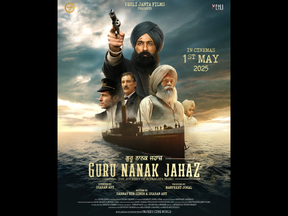
If you can find a way to watch the recently released Khalistani propaganda film Guru Nanak Jahaz, you might as well watch it. You paid for it, after all.
Article content
The film, which depicts the assassination of a Canadian civil servant by a Sikh terrorist as a heroic act of justice, has a “Funded by the Government of Canada” credit at the end. It was also supported by the B.C. government and gives special thanks to Conservative MP Tim Uppal and Liberal MP Sukh Dhaliwal. While the Liberals didn’t return a request for comment, a spokesperson for Uppal told me that he was not involved in the film and that the filmmakers did not communicate with him about the credit at any point.
Article content
Article content
Article content
Set in 1914, the plot follows the assassin, who you likely never heard about, and the voyage of the more familiar Komagata Maru, a ship which carried nearly 400 Indian passengers from Hong Kong to Vancouver, only to be denied entry to Canada. It was screened in some Cineplex theatres earlier this year.
Article content
The official narrative that you’ll find on government websites explains that this was purely a matter of baseless Canadian racism, and it’s been wholeheartedly adopted by politicians today: as prime minister, Justin Trudeau apologized for the incident in 2016, and the Conservative party releases annualstatements commemorating the event, praising the bravery of the passengers and their craving for freedom.
That’s the whitewashed version, however. It leaves out that the Komagata Maru voyage was organized by the Indian Ghadar movement — the word literally means “revolution” — which advocated for violent resistance against the British Empire. (India was a British possession at that time and would continue to be until 1947). Its members were primarily Sikhs who lived in North America. And while they did experience racism, and while changes to Canada’s immigration laws in 1908 indirectly restricted Indian immigration, there were also reasons for the Canadian government to be apprehensive.
Ghadar members dreamed of a return to India, but wanted to rid that land of the British first. They remembered the Indian Mutiny of 1857 with regret — that bloody event saw many British-Indian regiments unsuccessfully take up arms against the Empire; Sikh Punjabis were among the exceptions, largely siding with the British. Decades later, the mostly Sikh Punjabi Ghadarites proposed another 1857-like uprising while applauding anti-British terrorism.
When rumblings of war with Germany began to brew in 1914, the Ghadarites grew excited — now was the time to strike. In August 1914, after the war broke out, the movement’s newspaper advocated, “Go to India and incite the native troops. Preach mutiny openly. Take arms from the troops of the native states and wherever you see the British, kill them…. There is hope that Germany will help you.” Expats in the Orient organized ships to return home and revolt.
The Komagata Maru was part of this movement. Organized by Ghadarites before the breakout of the First World War, it attempted to bring more movement adherents into Vancouver to settle. Canada was right not to let it dock because the entire envoy was a security threat.
Their fears were well-founded. Among the Sikhs already in Vancouver was one Mewa Singh, an immigrant of nine or so years, who was involved in an unsuccessful plot to smuggle weapons to the Komagata Maru. After the incident, Singh went on to murder Canadian immigration official William Hopkinson in a courthouse. According to a report at the time, Hopkinson had recently busted an Indian nationalist bomb-making operation in Victoria which infuriated adherents. Additionally, in the weeks before he was murdered, one of his informants shot and killed two Sikhs at a funeral, creating more animosity.
That is the story that Guru Nanak Jahaz recounts through rose-coloured glasses. Singh is the protagonist of the film, a loyal member of his wholesome community who just wants his people to be treated fairly. White Vancouverites — officials and regular folk alike — are all comic book villains, harassing the protagonists throughout the plot.
At one point, a roving band of white men barge into a Sikh building to trash the place; one member declares, “This is a white man’s country!” before being fended off by the protagonist. Later, we’re introduced to the Big Bad — Hopkinson — who hears about the incoming Komagata Maru and warns his boss that “there’s a ship full of Indians heading for Canada” and that “we can’t afford any more Indians spilling over here.” It’s an over-the-top caricature that would have worked better as clumsy satire.
But that’s how the movie goes: Singh and the Ghadarites fighting for equality as the schemey, racist Hopkinson sabotages their reputation in the press and masterminds the deteriorating conditions on the ship.
In the film, Hopkinson’s sadistic ways ultimately lead to the ship being returned to India, where menacing white British guards at the port fire into the crowd of disembarked Komagata Maru passengers. While there was a riot at this point in real life that resulted in 19 individuals being killed by police, the Indian culture department’s recollection of these events says that the riot was initiated by passengers who resisted arrest.
By the way, Canada’s official story is that a massacre occurred and it was motivated by “British perceptions that the passengers were revolutionaries.” Never mind that the passengers were mutinous members of a group literally named “Revolution” who courted German ships on the way home. Never mind that a year later, seditious Indian troops in Singapore, influenced by the Ghadar movement and enamoured with Germany, led a rampage that killed more than 40 people, mostly British military but some British, Chinese and Malay civilians as well.
Guru Nanak Jahaz hits its climax with Singh’s point-blank shooting of Hopkinson, which is portrayed approvingly as a moment of justice. Singh, as in real life, goes on to be tried and executed for his crime.
What’s striking about the film is its complete lack of self-awareness. It’s as if the filmmakers didn’t even blink at the thought of championing political violence. Neither did the intended audience — the handful of reviews that exist online rave at this tale of social justice.
The Ghadar movement, which got the Indian independence it supposedly wanted in the mid-20th century, isn’t just a footnote of history in this film. It’s also a stand-in for today’s Khalistani movement, which campaigns for an independent Sikh state of Punjab.
The modern Sikh nationalists are responsible for some of the worst political violence Canada has ever seen: the 1985 bombing of Air India Flight 182, which killed 329 people, mostly Canadian; the 1998 assassination of journalist Tara Singh Hayer (a witness in the Air India case) in front of his Surrey home. No one was ever charged for the latter. Concerningly, Khalistani protesters have even portrayed Liberal MP Anita Anand with Indira Gandhi, alongside depictions of the latter being shot. Gandhi was the prime minister of India until her Sikh nationalist bodyguards assassinated her.
Films like Guru Nanak Jahaz draw a straight line from past to present, legitimizing political violence across time. Making matters worse, they perpetuate the cannibalizing narrative that Canada and the bulk of its population back then were fundamentally cruel and immoral entities whose exclusionary border policies were motivated only by hate — ignoring, of course, the historical context. Fears of violent nationalist movements were valid, especially in wartime.
Hopkinson ultimately gave his life in the course of serving his country. What a shame that one century later, he would be turned into a villainous caricature in a government-supported propaganda piece (NATIONAL POST, November 24, 2025)