While the British Columbia provincial NDP divides Canadians between indigenous and non-indigenous, OneBC believes in unity. We’re ALL Canadian and only Canadian, with equal rights and no special privileges.
This NDP government has been stopping economic development with the justification of First Nations people when their own policies are hurting the First Nations community.
We need prosperity for all not poverty for all, but the NDP thinks that everything will be better if we are all equally poor.
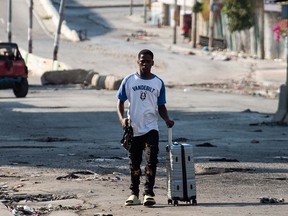
In the first eight months of 2025, Canada experienced a drop in asylum claims from from all countries, except for those from Haiti, which went up by 130 per cent. Photo by Clarens Siffroy/AFP via Getty Images
More Canadian residents distrust refugees than trust them, with the lowest levels of trust in refugees expressed by immigrants and non-whites, according to a new national public opinion poll.
The polling data comes as recent changes in the federal government’s immigration policies designed to reduce new arrivals in Canada seems to be hitting refugee claimants the hardest.
Among all respondents to the poll, conducted by Leger Marketing for the Association for Canadian Studies, 43 per cent said they distrusted refugees and 36 per cent said they trusted refugees. Another 21 per cent said they didn’t know or declined to answer.
The poll also found that more respondents trusted immigrants than distrusted them, a result suggesting Canadians have distinct views of different types of new arrivals to the country: 46 per cent of respondents said they trusted immigrants and 37 per cent said they distrusted them, while 17 per cent didn’t know or didn’t answer.
A refugee is someone who is fleeing their home country seeking protection from war, violence or persecution. An immigrant is someone who moves to another country to settle permanently.
The poll indicating lower trust in those arriving as refugee claimants over those arriving as immigrant applicants reflects a disproportionate drop in those seeking asylum in Canada, according to an analysis of Immigration, Refugees and Citizenship Canada data by the Association for Canadian Studies that accompanies the poll results.
A
In the first eight months of 2025, compared to the same period in 2024, refugee claimants to Canada plummeted by 32.7 per cent while economic immigrants dropped by 18.6 per cent and family sponsorship immigrants dropped by 8.1 per cent, the analysis says.
Article content
Those percentages correspond to a decline in the number of immigrants entering the system of 16,700 refugee claimants, 39,245 economic immigrants, and 5,635 family sponsorship immigrants.
“The numbers of asylum claimants has gone into a veritable free fall,” the analysis says.
The drop in asylum claims from migrants seeking refugee protection is distributed among all countries, except for Haiti.
Asylum claims by people arriving from Haiti — which is experiencing significant gang violence, civil unrest, and poverty — increased by 130 per cent. At the same time, asylum claims dropped, for example, by people from Bangladesh (82 per cent), Sri Lanka (79 per cent), Ghana (68 per cent), and India (59 per cent).
The analysis also shows a massive drop in airport asylum claims of 76 per cent in the first eight months of this year over the same period last year. There was a 27 per cent drop in inland claims and 62 per cent increase in land border claims.
Jack Jedwab, president of the Montreal-based Association for Canadian Studies, sees a connection between dropping refugee claims and the poll’s finding of distrust for refugees.
“There was considerable asymmetry to the cuts to overall immigration that saw much larger percentages in reductions to refugees over the 2024 to 2025 period,” Jedwab said. “It seems as though many Canadians believe that there are many asylum claims that are not legitimate, thus fuelling greater distrust in refugees.
“In previous surveys we’ve done there was much less dissonance and lesser distinction in either trust or positive sentiment towards immigrants and refugees, but we’re now seeing a widening gap between the two, owing, in my view, to a growing perception that many claims are not valid and thus raising questions about the admission process.”
Perhaps counterintuitively, trust in refugees was lower among respondents who identified themselves as immigrants (28 per cent) than non-immigrants (38 per cent). Trust for refugees was also lower among non-white respondents (26 per cent) than whites (39 per cent).
Immigrant respondents had only slightly more trust in other immigrants (47 per cent) than non-immigrants did (45 per cent).
On the survey question about trusting refugees: More men than women said they distrust refugees (49 per cent versus 36 per cent, with a higher percentage of women declining to answer). The youngest (ages 18 to 24) and the oldest (age 65 and over) tended to trust refugees the most, but, overall, age divisions didn’t show wide variation.
On the question about trusting immigrants, demographic patterns of respondents were similar: More men than women said they distrust immigrants (41 per cent versus 34 per cent, and, again, a higher percentage of women declined to answer). The youngest and oldest showed the highest levels of trust in immigrants.
t
Geographically, trust in refugees was lowest in Manitoba and Saskatchewan, which are pooled together by the pollsters, at 31 per cent, and Ontario at 33 per cent; trust in refugees was highest in Quebec and Alberta, both at 42 per cent.
Trust in immigrants was lowest in Manitoba and Saskatchewan (37 per cent) and in Quebec (41 per cent), and highest in Atlantic Canada (53 per cent) and Alberta (50 per cent).
It seems as though many Canadians believe that there are many asylum claims that are not legitimate, thus fuelling greater distrust in refugees
International students were trusted by 44 per cent of respondents while distrusted by 35 per cent. Distrust was again higher among men (41 per cent) than among women (29 per cent) with more women not providing an answer.
Refugee advocates said polling data should be approached with caution.
“We regularly see that polls produce different results depending on how the question is framed, and people’s answers are also impacted by the narratives they see being replicated in the media and by political leaders,” said Gauri Sreenivasan, a co-executive director of the Canadian Council for Refugees, a long-time refugee advocacy organization.
“Canadians consistently place a high value on welcoming newcomers and a culture of inclusion,” Sreenivasan said. “We call on our political leaders not to divide us through messages that pit communities against each other. We need to work together to secure a future where every family has safety.”
Adam Sadinsky, an advocacy co-chair for the Canadian Association of Refugee Lawyers and a Toronto-are lawyer at Silcoff Shacter, said a robust refugee determination system protecting those in need is important to meet Canada’s international and constitutional obligations.
“In recent years we have seen politicians and others use untrue or misleading rhetoric to divide and confuse the public on the issue of immigration. Canada’s immigration system has multiple equal objectives, including economic immigration, family reunification, and refugee protection.”
The online poll questioned 1,537 adults in Canada from Oct. 24 to 26. As a non-probability sample in a panel survey traditional margins of error do not apply. For comparison purposes, a probability sample of the same size would have a margin of error of plus or minus 2.5 per cent, 19 times out of 20. (NATIONAL POST, November 18, 2025)
U.S. Vice President JD Vance says Canada’s declining living standards stem from its own immigration policies and leadership choices — not from President Trump or American politics.
U.S. Vice President JD Vance is warning Canadians not to blame Donald Trump or American politics for Canada’s declining living standards. Responding to new economic data, Vance says Canada’s stagnation is the result of its own leadership choices and decades of uncontrolled immigration, noting that Canada now has the highest foreign-born population share in the G7.
The taxpayer-funded legacy media will continue to carry water for the Liberals. Support strong, fearless, truly independent journalism. Become a Juno News premium subscriber today.
Meanwhile, the fight over a potential Alberta–Ottawa pipeline agreement is intensifying. B.C. Premier David Eby claims Alberta, Saskatchewan, and the Carney government are holding talks “behind his back,” warning that lifting the northern tanker ban would undercut coastal First Nations support and threaten B.C.’s project approvals.
Despite the political headwinds, Alberta Premier Danielle Smith says she is still optimistic, though more technical work is needed before her government can formally submit a proposal to Ottawa’s Major Projects Office.
Former Royal Canadian Air Force public affairs officer and journalist David Krayden weighs in on Vance’s comments, the political pressure building around Canada’s immigration and economic policies, and the growing controversy over Ottawa’s fighter-jet procurement — including concerns that splitting the fleet between U.S. F-35s and Sweden’s Gripen could fracture NORAD interoperability and provoke a major clash with Washington.
Immigration Minister Lena Metlege Diab has permanently eliminated the requirement for refugee claimants to pay for a second medical exam when applying for permanent residency.
Source: Facebook
Author: Clayton DeMaine
Immigration Minister Lena Metlege Diab has permanently eliminated the requirement for refugee claimants to pay for a second medical exam when applying for permanent residency, a move she says will remove barriers to status.
As first reported by Blacklock’s Reporter, Immigration, Refugees and Citizenship Canada (IRCC) released a Regulatory Impact Analysis Statement explaining its decision to scrap the medical exam requirement for asylum seekers by amending the Immigration and Refugee Protection Act.
Taxpayers will still pay for each refugee applicant and their family to receive medical examinations when they first enter Canada and submit asylum claims, but the exemption permanently removes the requirement for a second medical exam when applying for permanent residency, the statement reads.
“The vulnerability of a protected person in Canada can be exacerbated by financial instability, particularly when fees associated with making a permanent residence application delay their application,” the analysis statement reads. “On average…a complete immigration medical examination costs approximately $400 per person, including doctor fees, blood work, exams and X-rays. “
The exemption was in place as a temporary measure since September 10, 2020. It was implemented to “ensure that the cost associated with this examination does not act as a barrier to protected persons in Canada” and to “streamline the permanent residence application process,” the statement notes.
“IRCC conducted a risk assessment, reviewing factors related to public health, public safety, and the potential impact on Canada’s publicly funded health-care system,” the statement reads. “Based on this assessment, it was determined that eliminating the subsequent immigration medical examination requirement for eligible protected persons in Canada is low risk.”
Neither the IRCC nor Diab were immediately available when asked to comment and provide the data they used to determine that the risk to public health was worth helping refugees save money and gain permanent residency.
The amendments exempt protected persons in Canada and their accompanying family members who meet several criteria: they have completed an initial taxpayer-funded medical exam, are applying for permanent residency, and have not spent “six or more months” in a “tuberculosis-designated country or territory,” since their last medical examination.
“Applicants who are required to submit to medical surveillance after their initial immigration medical examination and are found to be non-compliant cannot benefit from this exemption,” the IRCC said in its statement. “They must complete their subsequent immigration medical examination when they apply for permanent residency.”
From the time the temporary public policy came into effect in September 2020 until May 14, 2024, 36,022 “subsequent immigration medical examinations” have been exempted. The IRCC estimates this saved protected persons a collective $3,928,000 annually.
According to Public Health Canada and medical studies, several viruses and diseases are being introduced or reintroduced into Canada through travel and foreign-born individuals.
According to Public Health Canada, 70 per cent of tuberculosis cases in 2019 were among foreign-born individuals. In the same year, 113 measles cases were reported in Canada, of which 37 per cent were imported and 29 per cent “resulted in further transmission.”
The COVID virus and its variants, such as the Omicron variant, arrived in Canada through international travel, even amid vaccine mandates banning “unvaccinated” people from travelling on airplanes and other modes of transport.
Public Health Canada and Public Health Ontario have also linked a resurgence of sexually transmitted diseases such as syphilis, gonorrhea, and HIV to “travel-related sexual networks and exposure outside of Canada.”
The Many Pronged Campaign to Replace Euro-Canadians -Your Internet Freedom is on the Chopping Block by Paul Fromm
The Many Pronged Campaign to Replace Euro-Canadians -Your Internet Freedom is on the Chopping Block by Paul Fromm.
The Many Pronged Campaign to Replace Euro-Canadians -Your Internet Freedom is on the Chopping Block by Paul Fromm. Talk given to Truth Seekers Anonymous. Vancouver, November 6. 2025. The establishment enabled Third World immigration, Anti-White discrimination in employment.. Bills C-8 & C-9 Carney’s Orwellian programme to gag dissent on the Internet. A scorcher. https://www.bitchute.com/video/gr25EgQFgSW3
CRIME WATCH: Man avoids deportation, sentenced to jail time in machete attack
Anil Ramdas sentenced to just under six months in jail, narrowly avoiding potential immigration consequences in relation to August 2023 incident downtown
City police released this surveillance image in relation to an attack in downtown Barrie on Aug. 13, 2023.Image supplied by the Barrie Police Service
BARRIE – The man who attacked two others with a machete on Dunlop Street in Barrie two years ago has been sentenced to six months less a day in jail, avoiding a crucial threshold that could have triggered immigration repercussions associated with offenders who receive custodial sentences of more than 180 days.
Anil Ramdas, 51, was found guilty in February by Justice Nancy Dawson, who had rejected his defence that he was protecting his son. The four charges included two counts of assault with a weapon, assault causing bodily harm and possession of a dangerous weapon.
Amidst the chaotic atmosphere of downtown bars letting out, Ramdas’s son had become embroiled with two men in the wee hours of Aug. 13, 2023, as revellers were pouring into the street, court heard.
The case served as a prime example of how matters can take several months to resolve even after a finding of guilt.
“Long in the tooth” was how Dawson summed up the case before granting an adjournment in August to allow Ramdas, who was representing himself by that point, to seek immigration advice.
Anil Ramdas is shown outside the Barrie courthouse in this file photo. | Peter Robinson/BarrieToday
In addition to a delay in securing a pre-sentence report, Ramdas fired his lawyer and then requested other adjournments to explore legal remedies, including his immigration status, despite the Crown already agreeing to a sentence of less than six months.
Offenders who are not Canadian citizens can be subject to deportation if they have a criminal record that results in a jail term of six months or more.
Ramdas moved to Canada from Guyana decades ago. He has raised a family in his adopted country, but has not secured citizenship, which added another wrinkle to the case after he was found guilty of four assault and weapons offences on Feb. 28.
Barrie police issued a public notice the day after the downtown attack, which was captured on both security video from establishments located nearby and on citizen cellphones.
Police said at the time, and through evidence presented at trial, confirmed that after striking two men the attacker fled toward Meridian Place.
Court heard evidence that Ramdas, who claimed he fled because he feared for his and his son’s safety as crowds began to gather, discarded the machete in Kempenfelt Bay.
“There were a lot of people around, I didn’t know what they were going to do,” Ramdas told BarrieToday after he was convicted. “I just wanted to get my young son home safe.”
Trial heard evidence that Ramdas went to his vehicle to retrieve the machete.
Ramdas, who operates a restaurant nearby, said he sought the weapon from his van because he witnessed his son jostling with the two men over what was alternatively described as a metal pole or a crowbar.
Dawson said Ramdas had other more reasonable options available to him.
“He should not have had that weapon in his van,” Dawson said in handing down judgment almost nine months ago.
One of the men struck by the machete suffered injuries that required treatment at hospital, while the other man was uninjured.
Syrian refugee Anas Modamani shows a selfie taken with then German chancellor Angela Merkel outside a refugee centre in Berlin in 2015. That year, writes Anthony Koch, Merkel opened the floodgates to more than a million migrants.
For years, conservatives have comforted themselves with the illusion that the destruction of the West was entirely the doing of the left. They have blamed progressive ideologues, globalists, and utopians for the failed experiment of multiculturalism, the open borders that reshaped their nations, and the cultural relativism that hollowed out the moral foundations of their societies. But this is self-deception. The truth is that the so-called right, the respectable suit-and-tie centre-right parties that governed most of the West for the better part of the last half-century, are just as responsible for the decay of our civilization as their left-wing counterparts. They were not innocent observers. They were in power, and they made the choices that brought us here.
For years, conservatives have comforted themselves with the illusion that the destruction of the West was entirely the doing of the left. They have blamed progressive ideologues, globalists, and utopians for the failed experiment of multiculturalism, the open borders that reshaped their nations, and the cultural relativism that hollowed out the moral foundations of their societies. But this is self-deception. The truth is that the socalled right, the respectable suit-and-tie centre-right parties that governed most of the West for the better part of the last half-century, are just as responsible for the decay of our civilization as their left-wing counterparts. They were not innocent observers. They were in power, and they made the choices that brought us here.
In France, the Gaullists and their successors ruled for decades under various names: the RPR, the UMP, and now Les Républicains. For much of the Fifth Republic’s history, the right, or what passed for it, held the presidency, the legislature, or both. And yet what did they conserve? Immigration surged but assimilation collapsed. Multiculturalism became orthodoxy not because the French right was defeated in battle, but because it surrendered without a fight. The men who claimed to guard the Republic’s identity replaced conviction with caution, sovereignty with symbolism, and principle with polling. They preached integration but allowed the parallel societies of the banlieues to fester, all the while insisting that national unity could survive as a slogan even as it disappeared as a lived reality. They spoke of secularism and French values yet abandoned the expectation that newcomers — like generations of successful immigrants before them — must adopt and uphold the shared civic and cultural values that made France what it is.
In France, the Gaullists and their successors ruled for decades under various names: the RPR, the UMP, and now Les Républicains. For much of the Fifth Republic’s history, the right, or what passed for it, held the presidency, the legislature, or both. And yet what did they conserve? Immigration surged but assimilation collapsed. Multiculturalism became orthodoxy not because the French right was defeated in battle, but because it surrendered without a fight. The men who claimed to guard the Republic’s identity replaced conviction with caution, sovereignty with symbolism, and principle with polling. They preached integration but allowed the parallel societies of the banlieues to fester, all the while insisting that national unity could survive as a slogan even as it disappeared as a lived reality. They spoke of secularism and French values yet abandoned the expectation that newcomers — like generations of successful immigrants before them — must adopt and uphold the shared civic and cultural values that made France what it is.
Germany tells the same story. The Christian Democrats, the CDU and its Bavarian sister party, the CSU, have been the dominant force of postwar German politics. Their rule has been nearly continuous, their influence immense. Yet it was under Angela Merkel, the embodiment of moderation, that Germany’s identity was most radically transformed. Her 2015 decision to open Germany’s doors to over a million migrants was not an act of the left. It was an act of the conservative establishment. It was done not in the name of ideology but of morality, and therein lies the irony: the moralism of the centre-right has been no less destructive than the utopianism of the left. Merkel’s gesture, however well-intentioned, fractured the European consensus, destabilized domestic politics, and sent an unmistakable signal to the world that Europe’s borders were optional. She governed as if sentiment could substitute for sovereignty, and Germany is still paying the price.
Germany tells the same story. The Christian Democrats, the CDU and its Bavarian sister party, the CSU, have been the dominant force of postwar German politics. Their rule has been nearly continuous, their influence immense. Yet it was under Angela Merkel, the embodiment of moderation, that Germany’s identity was most radically transformed. Her 2015 decision to open Germany’s doors to over a million migrants was not an act of the left. It was an act of the conservative establishment. It was done not in the name of ideology but of morality, and therein lies the irony: the moralism of the centre-right has been no less destructive than the utopianism of the left. Merkel’s gesture, however well-intentioned, fractured the European consensus, destabilized domestic politics, and sent an unmistakable signal to the world that Europe’s borders were optional. She governed as if sentiment could substitute for sovereignty, and Germany is still paying the price.
Across Europe, similar patterns repeat. The so-called conservative parties in Britain, Spain, Italy, and Scandinavia have all held office for long stretches of time. They could have reversed course, tightened unfettered immigration, restored national pride, and reasserted the cultural norms that bind a people together. Instead, they chose cowardice cloaked in civility. They courted respectability and the approval of editorial boards, terrified of being called cruel or reactionary. Their guiding principle became “not to be hated,” as if a society could be saved without confrontation. They governed as managers, not as leaders, as administrators of decline and custodians of decay. They inherited institutions built by stronger leaders and allowed them to crumble out of fear that renewal might offend.
Across Europe, similar patterns repeat. The so-called conservative parties in Britain, Spain, Italy, and Scandinavia have all held office for long stretches of time. They could have reversed course, tightened unfettered immigration, restored national pride, and reasserted the cultural norms that bind a people together. Instead, they chose cowardice cloaked in civility. They courted respectability and the approval of editorial boards, terrified of being called cruel or reactionary. Their guiding principle became “not to be hated,” as if a society could be saved without confrontation. They governed as managers, not as leaders, as administrators of decline and custodians of decay. They inherited institutions built by stronger leaders and allowed them to crumble out of fear that renewal might offend.
Canada and the United States have not been immune to the same disease. In Canada, the Progressive Conservatives and later the federal Conservative Party presided over the codification and expansion of official multiculturalism, a policy that, under successive Liberal and Conservative governments alike, transformed national identity from something shared into something merely managed. Brian Mulroney enshrined multiculturalism as a cornerstone of Canadian political consensus. Stephen Harper, though more cautious, did little to challenge its assumptions. The Conservatives spoke of integration but funded the same bureaucracies of fragmentation. Even in opposition, they supported the immigration policies advanced by Liberal governments, even when evidence showed integration was faltering and housing, health care, and wages were suffering. And let it be said plainly: this is not a rejection of immigration itself — immigration has built and enriched Canada — but a rejection of immigration without expectation, without integration, and without the insistence that newcomers join a common civic nation rather than reside in parallel ones.
Canada and the United States have not been immune to the same disease. In Canada, the Progressive Conservatives and later the federal Conservative Party presided over the codification and expansion of official multiculturalism, a policy that, under successive Liberal and Conservative governments alike, transformed national identity from something shared into something merely managed. Brian Mulroney enshrined multiculturalism as a cornerstone of Canadian political consensus. Stephen Harper, though more cautious, did little to challenge its assumptions. The Conservatives spoke of integration but funded the same bureaucracies of fragmentation. Even in opposition, they supported the immigration policies advanced by Liberal governments, even when evidence showed integration was faltering and housing, health care, and wages were suffering. And let it be said plainly: this is not a rejection of immigration itself — immigration has built and enriched Canada — but a rejection of immigration without expectation, without integration, and without the insistence that newcomers join a common civic nation rather than reside in parallel ones.
South of the border, the Republican party tells a similar story. For decades, it has thundered about illegal immigration while quietly enabling legal migration on a massive scale. Ronald Reagan, the icon of modern American conservatism, granted amnesty to millions in 1986 under the Immigration Reform and Control Act, declaring it a one-time correction that would fix the problem forever. It did not. The border remained porous, and the precedent was set. Later Republican administrations promised toughness but delivered managerialism: walls half-built, enforcement half-hearted, rhetoric disconnected from results. Even when they controlled Congress and the White House, Republicans flinched from using power to reform a system that rewards chaos. They were terrified of the media, of corporate donors, of their own moral uncertainty.
South of the border, the Republican party tells a similar story. For decades, it has thundered about illegal immigration while quietly enabling legal migration on a massive scale. Ronald Reagan, the icon of modern American conservatism, granted amnesty to millions in 1986 under the Immigration Reform and Control Act, declaring it a one-time correction that would fix the problem forever. It did not. The border remained porous, and the precedent was set. Later Republican administrations promised toughness but delivered managerialism: walls half-built, enforcement half-hearted, rhetoric disconnected from results. Even when they controlled Congress and the White House, Republicans flinched from using power to reform a system that rewards chaos. They were terrified of the media, of corporate donors, of their own moral uncertainty.
They governed as if the question of who enters and who belongs were a matter of economics, not of identity. The result has been a steady erosion of social cohesion and the rise of populism as the only force willing to name what the establishment right refused to confront.
The great tragedy is that the right once understood the moral dimension of civilization. It understood that a nation is not just a collection of individuals but a covenant between generations, bound by memory and duty, by a shared story and shared obligations. But over time, the conservative parties of the West became liberal parties with slower reflexes. They adopted the language of compassion, the theology of globalism, the logic of markets, and the esthetics of restraint. They preached prudence while practising abdication. Their idea of stability was to manage the revolution rather than resist it. Every time they were given power, they promised to correct the excesses of the left, and every time, they merely administered them more efficiently.
The great tragedy is that the right once understood the moral dimension of civilization. It understood that a nation is not just a collection of individuals but a covenant between generations, bound by memory and duty, by a shared story and shared obligations. But over time, the conservative parties of the West became liberal parties with slower reflexes. They adopted the language of compassion, the theology of globalism, the logic of markets, and the esthetics of restraint. They preached prudence while practising abdication. Their idea of stability was to manage the revolution rather than resist it. Every time they were given power, they promised to correct the excesses of the left, and every time, they merely administered them more efficiently.
It is no accident that populism has risen from the ruins of this betrayal. People were not seduced by extremism; they were abandoned by moderation. When citizens looked to the mainstream right for protection from mass migration, from cultural dissolution, from the erosion of meaning, they found bureaucrats instead of believers. They found a politics of hesitation, a cowardly centrism that worshipped process and feared conviction. And so the right’s greatest sin was not malice but weakness. It mistook compromise for virtue, consensus for peace, and delay for wisdom. In the end, it was the polite right that gave the left its victories, one concession at a time.
Conservatives must face this truth without evasion. The West is not being undermined by its enemies alone. Blame its caretakers, those who thought they could preserve civilization by yielding its substance while keeping its name. The crisis of the West is therefore not only moral or cultural but political. It is the collapse of a conservative tradition that lost the courage to conserve. Until the right admits its complicity and rediscovers the virtue of defiance — rooted not in exclusion, but in the defence of the shared civic and cultural inheritance that newcomers are welcome to join and strengthen — it will remain unfit to lead. For repentance must precede redemption, and only when the right stops excusing its own failures can it begin the work of renewal.
CONSERVATIVES UNWITTINGLY HELPED THE LEFT UNDERMINE THE WEST
National Post
15 Nov 2025
ANTHONY KOCH
Syrian refugee Anas Modamani shows a selfie taken with then German chancellor Angela Merkel outside a refugee centre in Berlin in 2015. That year, writes Anthony Koch, Merkel opened the floodgates to more than a million migrants.
For years, conservatives have comforted themselves with the illusion that the destruction of the West was entirely the doing of the left. They have blamed progressive ideologues, globalists, and utopians for the failed experiment of multiculturalism, the open borders that reshaped their nations, and the cultural relativism that hollowed out the moral foundations of their societies. But this is self-deception. The truth is that the socalled right, the respectable suit-and-tie centre-right parties that governed most of the West for the better part of the last half-century, are just as responsible for the decay of our civilization as their left-wing counterparts. They were not innocent observers. They were in power, and they made the choices that brought us here.
In France, the Gaullists and their successors ruled for decades under various names: the RPR, the UMP, and now Les Républicains. For much of the Fifth Republic’s history, the right, or what passed for it, held the presidency, the legislature, or both. And yet what did they conserve? Immigration surged but assimilation collapsed. Multiculturalism became orthodoxy not because the French right was defeated in battle, but because it surrendered without a fight. The men who claimed to guard the Republic’s identity replaced conviction with caution, sovereignty with symbolism, and principle with polling. They preached integration but allowed the parallel societies of the banlieues to fester, all the while insisting that national unity could survive as a slogan even as it disappeared as a lived reality. They spoke of secularism and French values yet abandoned the expectation that newcomers — like generations of successful immigrants before them — must adopt and uphold the shared civic and cultural values that made France what it is.
Germany tells the same story. The Christian Democrats, the CDU and its Bavarian sister party, the CSU, have been the dominant force of postwar German politics. Their rule has been nearly continuous, their influence immense. Yet it was under Angela Merkel, the embodiment of moderation, that Germany’s identity was most radically transformed. Her 2015 decision to open Germany’s doors to over a million migrants was not an act of the left. It was an act of the conservative establishment. It was done not in the name of ideology but of morality, and therein lies the irony: the moralism of the centre-right has been no less destructive than the utopianism of the left. Merkel’s gesture, however well-intentioned, fractured the European consensus, destabilized domestic politics, and sent an unmistakable signal to the world that Europe’s borders were optional. She governed as if sentiment could substitute for sovereignty, and Germany is still paying the price.
Across Europe, similar patterns repeat. The so-called conservative parties in Britain, Spain, Italy, and Scandinavia have all held office for long stretches of time. They could have reversed course, tightened unfettered immigration, restored national pride, and reasserted the cultural norms that bind a people together. Instead, they chose cowardice cloaked in civility. They courted respectability and the approval of editorial boards, terrified of being called cruel or reactionary. Their guiding principle became “not to be hated,” as if a society could be saved without confrontation. They governed as managers, not as leaders, as administrators of decline and custodians of decay. They inherited institutions built by stronger leaders and allowed them to crumble out of fear that renewal might offend.
Canada and the United States have not been immune to the same disease. In Canada, the Progressive Conservatives and later the federal Conservative Party presided over the codification and expansion of official multiculturalism, a policy that, under successive Liberal and Conservative governments alike, transformed national identity from something shared into something merely managed. Brian Mulroney enshrined multiculturalism as a cornerstone of Canadian political consensus. Stephen Harper, though more cautious, did little to challenge its assumptions. The Conservatives spoke of integration but funded the same bureaucracies of fragmentation. Even in opposition, they supported the immigration policies advanced by Liberal governments, even when evidence showed integration was faltering and housing, health care, and wages were suffering. And let it be said plainly: this is not a rejection of immigration itself — immigration has built and enriched Canada — but a rejection of immigration without expectation, without integration, and without the insistence that newcomers join a common civic nation rather than reside in parallel ones.
South of the border, the Republican party tells a similar story. For decades, it has thundered about illegal immigration while quietly enabling legal migration on a massive scale. Ronald Reagan, the icon of modern American conservatism, granted amnesty to millions in 1986 under the Immigration Reform and Control Act, declaring it a one-time correction that would fix the problem forever. It did not. The border remained porous, and the precedent was set. Later Republican administrations promised toughness but delivered managerialism: walls half-built, enforcement half-hearted, rhetoric disconnected from results. Even when they controlled Congress and the White House, Republicans flinched from using power to reform a system that rewards chaos. They were terrified of the media, of corporate donors, of their own moral uncertainty.
They governed as if the question of who enters and who belongs were a matter of economics, not of identity. The result has been a steady erosion of social cohesion and the rise of populism as the only force willing to name what the establishment right refused to confront.
The great tragedy is that the right once understood the moral dimension of civilization. It understood that a nation is not just a collection of individuals but a covenant between generations, bound by memory and duty, by a shared story and shared obligations. But over time, the conservative parties of the West became liberal parties with slower reflexes. They adopted the language of compassion, the theology of globalism, the logic of markets, and the esthetics of restraint. They preached prudence while practising abdication. Their idea of stability was to manage the revolution rather than resist it. Every time they were given power, they promised to correct the excesses of the left, and every time, they merely administered them more efficiently.
It is no accident that populism has risen from the ruins of this betrayal. People were not seduced by extremism; they were abandoned by moderation. When citizens looked to the mainstream right for protection from mass migration, from cultural dissolution, from the erosion of meaning, they found bureaucrats instead of believers. They found a politics of hesitation, a cowardly centrism that worshipped process and feared conviction. And so the right’s greatest sin was not malice but weakness. It mistook compromise for virtue, consensus for peace, and delay for wisdom. In the end, it was the polite right that gave the left its victories, one concession at a time.
Conservatives must face this truth without evasion. The West is not being undermined by its enemies alone. Blame its caretakers, those who thought they could preserve civilization by yielding its substance while keeping its name. The crisis of the West is therefore not only moral or cultural but political. It is the collapse of a conservative tradition that lost the courage to conserve. Until the right admits its complicity and rediscovers the virtue of defiance — rooted not in exclusion, but in the defence of the shared civic and cultural inheritance that newcomers are welcome to join and strengthen — it will remain unfit to lead. For repentance must precede redemption, and only when the right stops excusing its own failures can it begin the work of renewal.