Tag Archives: illegals

Canadians Face 18 Month Wait for Hip Replacement While Illegals Go to the Head of the Line: $772M FOR ASYLUM SEEKERS’ HEALTH CARE

Posted on by

Canadians Face 18 Month Wait for Hip Replacement While Illegals Go to the Head of the Line: $772M FOR ASYLUM SEEKERS’ HEALTH CARE

A big portion goes to ‘failed refugee claimants’: PBO

Canada spent more than $722 million providing extensive health care to tens of thousands of asylum seekers in the last fiscal year, including a considerable portion on “failed refugee claimants” who are either languishing in the system or avoiding removal orders, according to a new report from the Parliamentary Budget Office.

The review of the Interim Federal Health Program (IFHP) also found that its costs continue to climb because of “backlogs” in Canada’s asylum system that keep claimants waiting, in some cases for up to three years.

The IFHP was created to provide limited and temporary health-care coverage to foreign nationals deemed vulnerable and disadvantaged.

Conservative health critic Dan Mazier and immigration critic Michelle Rempel Garner said the report shows that the Liberals’ temporary program “has turned into a multi-year, taxpayer-funded entitlement where tens of thousands of bogus asylum claimants are provided health benefits that Canadians are not eligible for.

“The Liberals must explain to Canadians why asylum seekers who have had their refugee claims rejected, are facing enforceable removal orders, and in some cases fail to appear for removal, continue to receive deluxe, taxpayer-funded health benefits while they avoid leaving Canada,” they said in a statement.

The total spending across all health care categories and beneficiary groups for 202425 was closer to $822 million when resettled refugees are accounted for. Unlike those seeking asylum, they “are selected and assessed abroad, with admission targets set in the Government’s Immigration Levels Plan, resulting in relatively predictable intake and processing timelines.”

The PBO noted that whereas asylum seekers claimed an average of $724 per beneficiary per year on basic care — doctor visits, hospital care, ambulances, labs, diagnostic testing and immigration medical examinations — resettled refugees averaged $97. They’re also typically off IFHP within three months and no longer than a year.

Per-person spending on basic care has increased consistently, PBO found, but spending on supplementary health products and services — urgent dental treatment, prescription drug coverage, vision care, counselling services, assistive devices and others — has grown at a much faster rate.

In 2019-20, Canada spent $94 million on supplementary benefits across all groups. By 2023-24, expenses nearly tripled to $285 million and they reached $457 million in 202425.

Two categories in particular accounted for 80 per cent of the spending: prescription drugs and urgent dental care.

The latter represents 56 per cent of program expenses.

According to PBO, the number of dental claims exploded by 43 per cent between 2019 and 2025 (240,000 to 1.4 million). Combined with a higher average cost per claim, it drove dental costs from $30 million to $257 million over that time.

PBO also found that spending on counselling services increased from less than one per cent of total supplementary spending in 2016 to 11 per cent in 2025. In 2024-25, the bill came in at $38.7 million.

“These are benefits that Canadians who have paid into the system their entire lives can’t access,” Mazier said on X.

And while those rising expenses are increasing the overall cost of the IFHP, “elevated intakes” and the resulting “persistent backlogs” are also major drivers.

Officials who managed 64,150 asylum claims in 2019 had more than 173,000 in 2024.

In line with the new Liberal government’s immigration policies, that number decreased to just over 100,000 in 2025.

“As of December 2025, over 300,000 asylum claims were pending adjudication and roughly 65 per cent of these pending claims have been in the system for longer than a year,” PBO wrote.

“This represents a five-fold increase since 2021 and is anticipated to increase in the near-term due to an influx of claims made between 2023 and 2025.”

At present, almost half (47 per cent) of the claimants have been in the system between one and two years, but the PBO estimates that the number waiting between two and three years “will notably rise by 2026-27, reflecting elevated past intake and constrained exit rates.”

And considering the backlog, PBO calculates that each additional month in processing time could drive the program costs up by $72 million in the upcoming fiscal year.

To attain asylum refugee status in Canada, applicants must pass through several layers of review and have several avenues to appeal if rejected. For instance, 79 per cent of claimants rejected by the Immigration Refugee Board filed at least one appeal, during which time they are still eligible for IFHP.

So, too, are the “nearly 74,000 failed refugee claimants” among the CBSA’S removals inventory, which consists of 23,429 people whose removals are in process and 27,797 who failed to show up for removal and are being sought by border authorities.

“It is undeniable that as the backlog grows, rejected asylum claimants continue adding pressure to a health care system where Canadians are already facing long wait times for care,” Mazier wrote on X.

It should be noted that CBSA removals have increased, climbing from 5,714 in 2021 to 19,579 last year.(National Post, May 27, 2026)\
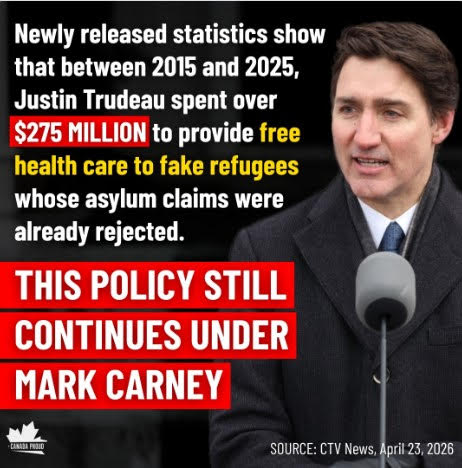
Six Million Canadians Have No Doctor but Trudeau/Carney Spent $275-million on Healthcare for Illegals

Posted on by
Category: Uncategorized | Tags: ,

Turning Back the Invasion

Posted on by

Turning Back the Invasion

Flood of Trudeau/Carney Illegals May Cause Toronto to Hike Property Taxes

Posted on by

Chow Warns Toronto Faces 2% Tax Hike Without Federal Support for Asylum Seeker Housing

Mayor Olivia Chow is warning that Toronto residents could face an “at least two per cent” property tax increase unless the federal government steps up funding to cover the city’s mounting costs for housing asylum seekers.

Speaking at City Hall ahead of an executive committee meeting, Chow said Toronto has already depleted its reserve funds to keep refugee housing and shelter programs running.

“Because the federal government hasn’t been paying their bills, we’ve been taking money from the reserve funds in order to continue the services to shelter these refugee claimants,” Chow said. “We can either stop sheltering refugee claimants, leaving them on the street, or Torontonians will have to pay for it through their property taxes. Neither is fair.”

$107M Shortfall

A city staff report projects a $105.4 million year-end deficit, largely due to shortfalls in the federal Interim Housing Assistance Program (IHAP). Chow is urging council to request $107 million for 2025–2026 to support housing costs for refugees and asylum seekers already in Toronto’s shelter system.

The mayor warned that without new funding by October, the city will no longer be able to transition people out of shelters and into permanent housing—just as colder weather sets in.

Provincial Cuts Add Pressure

The situation is compounded by cuts to the Canada-Ontario Housing Benefit (COHB). Toronto’s allocation will fall to $7.95 million in 2026, down from $19.75 million this year and $38 million in 2024. The COHB provides rent supplements that Chow called “the single most effective tool we have for freeing up shelter beds.”

National Responsibility

Since 2017, Ottawa has provided municipalities with $1.5 billion to help offset refugee housing costs, including $670 million for Toronto. But Chow argued this is no longer sufficient, given the number of claimants arriving in the city.

“Toronto and Canada have a history of settling newcomers, and we’ve done well because of it,” Chow said. “But now, the federal government must fulfill its responsibility.”

Advocates Call Cuts a “Recipe for Disaster”

Local advocacy group Progress Toronto, which held a protest outside City Hall Monday, echoed Chow’s warning.

“The Canadian government must acknowledge its responsibility to cities and take immediate action to address the growing crisis of homelessness — a national human rights issue,” the group said, urging Ottawa to cover 95 per cent of refugee housing costs, lift the 90-day shelter stay limit, and establish a coordinated resettlement response.

The funding fight mirrors a 2023 crisis, when Toronto briefly stopped admitting asylum seekers to shelters, leaving many sleeping on sidewalks until federal funding was restored.

Dangerous Countries: Ask Your MP

Posted on by

Dangerous Countries: Ask Your MP

Sorry, Canada is Closed

Posted on by
Category: Uncategorized | Tags: , ,

Poilievre Calls For Immigration Reduction to 200,000 -250,00 Annually: Still Too Many — We Need A Five Year Moratorium!

Posted on by

EXCLUSIVE: Poilievre suggests capping immigration at Harper-era levels, deportations for wrongdoers

Poilievre has confirmed his plans to reduce immigration levels to Stephen Harper-era levels and deport those who break Canada’s laws while on temporary visas, in an exclusive interview with Juno News

Feb 13, 2025

Source: Juno News

Author: Cosmin Dzsurdzsa

Conservative Leader Pierre Poilievre has confirmed his plans to reduce immigration levels to Stephen Harper-era levels and deport those who break Canada’s laws while on temporary visas, in an exclusive interview with Juno News co-founder Candice Malcolm.

Juno News is a reader-supported publication. To receive new posts and support my work, consider becoming a free or paid subscriber.

On the broader issue of immigration levels, Poilievre stated that the current annual intake of permanent residents — set to reach 500,000 in 2025 — is unsustainable and has contributed to Canada’s housing crisis.

He proposed a return to the levels of previous Conservative governments, which were around 200,000 to 250,000 per year, aligning population growth with the number of new homes being built.

“It would be a lot more like the Harper numbers that were basically the same for 40 years before Trudeau took office — we were bringing in about 200,000 to 250,000 a year,” said Poilievre.

“We were building about the same number of homes as we were adding people, so we had a housing surplus. I would bring in a simple mathematical formula: we cannot bring in people faster than we add houses.”

According to Poilievre, the formula would be based on the homebuilding numbers from the prior year as well as population growth targets.

“I would actually make sure that we’re building housing surpluses over the next four years because that’s how we close the gap that has built up,” said Poilievre.

Poilievre also made it clear that his government would swiftly deport non-citizens who commit crimes while in Canada on temporary status. He emphasized that those engaging in violent acts, such as firebombing businesses or places of worship, should be immediately arrested and deported.

“I don’t know how anybody can disagree with that. If someone shows up in our country claiming to be a student or a temporary worker and they start firebombing coffee shops, bakeries, synagogues, or any other place, then they need to be immediately arrested and deported,” said Poilievre in reference to recent pro-Hamas protests rocking Canada.

“If someone is obviously a citizen, they should be prosecuted through our legal system and put in prison here in Canada for those sorts of crimes.”

Poilievre added the federal government also has to take the issue of illegal immigration seriously and expedite deportations for those found to be in Canada under false pretences.

“If someone comes in, makes a false asylum claim, and it gets rejected, they’re supposed to leave today,” said Poilievre.

“The challenge we’re going to face is that under nine years of the Carney-Trudeau Liberals’ open border policies, we now have millions of people whose permits are going to expire over the next two years. If they don’t leave, we have a very hard time even knowing they’re still here, finding them, and then carrying out a deportation.”

The Conservative leader, however, did indicate that among illegal immigrants there were “some among them that we do want to keep.”

“They could be a master’s graduate in computer engineering with a six-figure job in Kitchener-Waterloo, someone who has started a family, integrated, speaks the language. This is someone we want to keep,” said Poilievre.

“But we need to be able to make that decision ourselves through selection based on these criteria — not just by accident because people who are not eligible to stay decide they’re not going to leave.”

According to Poilievre, the Canadian government should implement further refugee reviews for claims, including what he calls a “last in, first out” approach.

“This is how it works: if you’re the last person to enter the country, your claim is immediately heard. Within a couple of weeks, if your claim is false, you’re sent back. What that does is send the signal to everyone who might come in the future that they’re going to be sent home automatically,” said Poilievre.

“The problem right now is that if someone gets in illegally — even if they’re not a real refugee, they’re not fleeing danger — they have seven or eight years of appeals, during which we’re paying for their hotels, lawyers, food, and healthcare, above and beyond what Canadians get.”

Tough Talk Needed on Border Issues

Posted on by

Tough talk needed on border issues

“Lay low for 14 days and you’re in as an illegal”

  • National Post
  • 14 Nov 2024
  • JAMIE SARKONAK
With the threat of mass deportations from the U.S., and a policy in Canada that allows unauthorized residents to claim asylum should they lay low for 14 days, it’s only rational for would-be claimants to try, Jamie Sarkonak says.

Currently, as the rules stand, migrants from the United States can cross into Canada, wait two weeks, and become eligible to file a refugee claim here. The northern border sure must be looking like a home-free line, now that Donald Trump has been elected on a promise to carry out mass deportations of illegal migrants.

So, if there was ever a time Canada needed to send a very loud, very public, “no more Mr. Nice Guy” message to economically motivated asylum seekers — firm messaging backed up by policy changes to ward their numbers off — it’s right now.

The numbers are already too high. Last year, nearly 150,000 people staked refugee claims here, rendering us the fifth-largest destination for asylum seekers that year. Two years’ worth of asylum claims are inching their way through the immigration system, many of these from friendly not-at-war countries that have no business sending us thousands of refugees.

India, Nigeria, and Mexico are where the largest number of claims come from, but there are many others that shouldn’t be sending refugees our way. Each successful applicant — from friendly, at-peace countries — is a potential online advertisement for immigration services online; that is, potential inspiration for others looking to claim refugee status. Of course, many of these claimants aren’t actually in danger, as required by law, and are willing to travel home, prompting immigration consultants to make warnings against doing so.

With the threat of mass deportations from the U.S., and a policy in Canada that allows unauthorized residents to claim asylum should they lay low for 14 days, it’s only rational for would-be claimants to try. It could very well be a painful squeeze — the U.S. received 1.2 million asylum claims last year alone, and some fraction of that number can be expected to divert to the north come 2025.

The trek to Canada will be a rational one for many. To observers on the outside, we’re the country that welcomes everyone, hands out bags of free food, offers free care, has loads of jobs to fill along with land, oh so much land. We know this isn’t actually how Canada works, but they don’t.

Seriously. Extensive immigration influencer videos have advertised Canadian “free food” to those abroad, which have no doubt made this country a more attractive place to attempt asylum. Rent is often covered by the Canadian tax base as the wait for claim adjudication drags on — which ultimately puts low-income Canadians in competition with migrants for housing. Some also end up competing with homeless Canadians, taking up critical space in shelters from Vancouver to Toronto.

MANY OF THESE CLAIMANTS AREN’T ACTUALLY IN DANGER.

In health care, it’s a similar problem. These populations strain the health-care system: the Star reported last week that “Midwives and physicians in emergency departments said they’re seeing significantly more uninsured clients accessing care at later stages of a complicated pregnancy or an already developed cancer or AIDS.” The uninsured being, in part, migrants who are in Canada illegally. Bad deal for us, good deal for them.

Between rosy influencer advertising and borders-open messaging from our own Prime Minister Justin Trudeau, a lot more needs to be done to reverse the perception that Canada is a welcome home for economic “refugees.”

The incoming Trump administration has been strong out of the gate in turning around the perception of the United States as a bottomless bread basket of free amenities. Federal and state governments have rolled out unauthorized-friendly initiatives for a while now: feds have done their best to soften deportation rules, and some state governments have offered perks like pre-paid debit cards for migrants, as well as free rent. But Trump’s messaging has been clear that deportations are coming, and his border-enforcer-to-be, Tom Homan, is just as forceful: “You better start packing now, cause you’re going home,” Homan told a crowd earlier this year.

We haven’t been so firm. Visitor visa rules were tightened this week, but the home-free-in-twoweeks line remains in place.

Most of our country’s messaging includes tepid inward-facing assurances that everything is under control. The faceless blob that is the Canadian administrative state says there’s nothing to worry about: the RCMP learned from post-2016 migration which “provided us with the tools and insight necessary to address similar types of occurrences.” The Canada Border Services Agency (CBSA) says, “we are ready to respond and adapt as needed.”

Homan, meanwhile, isn’t raving about our competency, stating in a recent TV interview that the northern border is an “extreme national security vulnerability” and that “tough conversations” are soon to be had with Canada.

Meanwhile, Immigration Minister Marc Miller is nonchalant, telling the Globe and Mail: “We will always be acting in the national interest and those measures that we move to undertake, regardless of what decision is taken by the new administration, to make sure that our borders are secure, that people that are coming to Canada do so in a regular pathway, and the reality that not everyone is welcome here.”

Well, that sure sends a message. “Not everyone is welcome here.”

Each statement from Canadian officials has the same bland, inoffensive lack of substance that could only come from either a comms department trained to generate few words of meaning or an AI text generator. None are backed by the force of strong, loophole-closing policy change.

Miller’s job right now isn’t just to soothe Canadians with words as bland as beige walls. He has to dispel years of false impressions of Canadian life inspired by a multitude of enthusiastic foreign-language Youtube and Tiktok howto vlogs about immigration, with rhetoric and hard policy. Right now, he’s falling short.

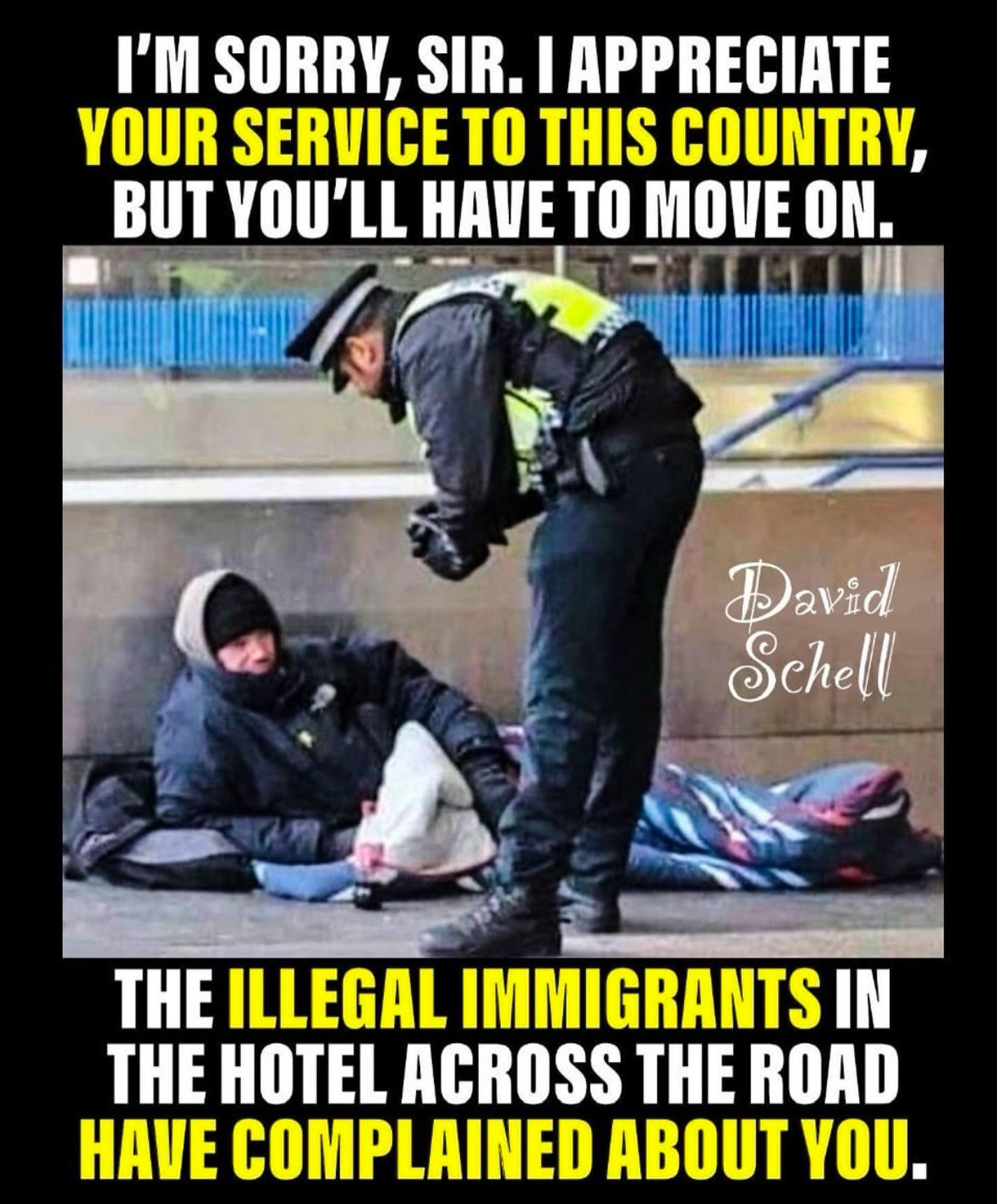
How We Treat Veterans & Illegals

Posted on by

How We Treat Veterans & Illegals

Category: Uncategorized | Tags: ,

Elite Hypocrisy: The Forced Vax & Illegals

Posted on by
,