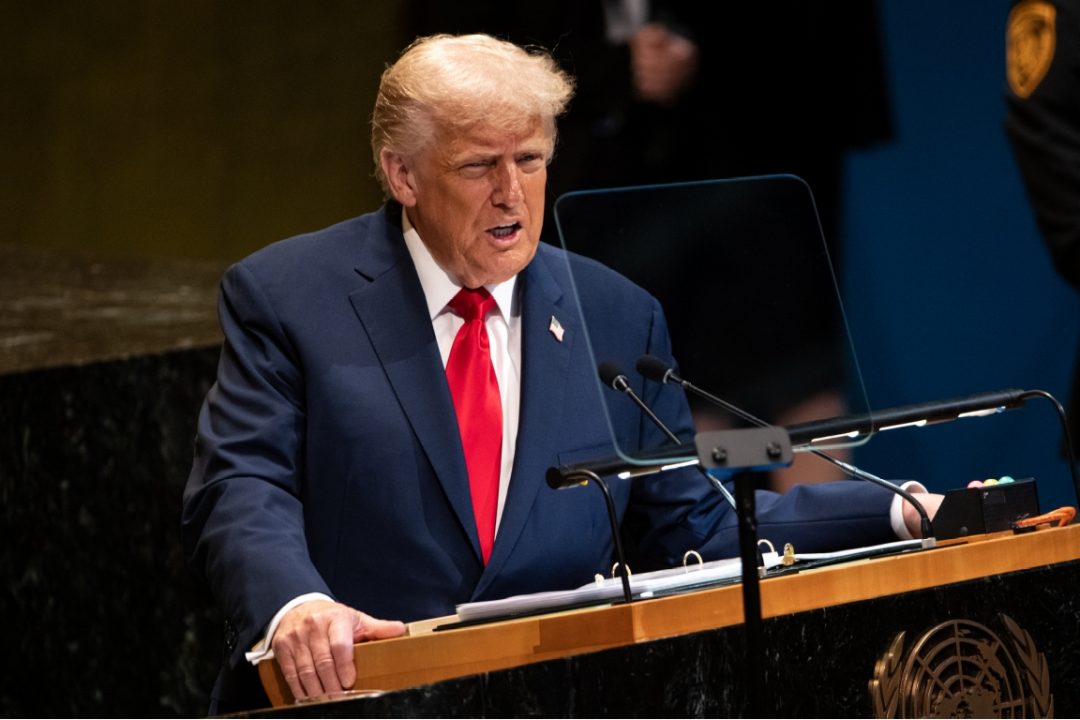
President Donald Trump skewered the United Nations General Assembly on Tuesday for its refusal to support peace negotiations, its financing of disastrous open-border policies, and the litany of erroneous climate doomsday predictions the organization has made over the decades.
“What is the purpose of the United Nations?” Trump asked after lambasting the globalist organization for not helping him negotiate peace between nations. This was one of many digs he took at the UN in his nearly one-hour scold fest.
The UN is meeting for its 80th annual conference in New York City. The organization’s influence has been dropping precipitously, and so have its resources. Dwindling American support has played a major role in that decline. And on Tuesday, Trump showed no remorse.
Peace President
In typical Trumpian fashion, the president bragged about his peace negotiations. He mentioned his mediation role in a series of conflicts: the ones between Cambodia and Thailand, Kosovo and Serbia, the Congo and Rwanda, Pakistan and India, Israel and Iran, Egypt and Ethiopia, and Armenia and Azerbaijan.
However, he said on Tuesday, it’s “too bad I had to do these things instead of the United Nations doing them.” He piled on:
And, sadly, in all cases, the United Nations did not even try to help — in any of them.… I never even received a phone call from the United Nations. I realized the United Nations wasn’t there for us.
The president then mistakenly said the UN was not living up to its “great potential.” That suggests he may not understand the real reason a cohort of certified communists created the UN, i.e., to serve as the foundation of a world government. A world at peace is not fertile ground for global government. A chaotic world, however, is. It’s in a world at war, a world ravaged by a pandemic, that global governance comes about. Many people within the UN’s agencies have openly admitted the reason for the organization is to bring about world government. You can read more about that in our previous report here.
https://platform.twitter.com/embed/Tweet.html?
Migration Mayhem
Trump got back on the right track when he said the only thing the UN is good for is “creating new problems for us to solve.” He then segued into one of the largest crises the organization created. “The United Nations is funding an assault on Western countries and their borders,” Trump said, adding, “The UN is supposed to stop invasions, not create them — and not finance them.” The UN, he pointed out, gave food, shelter, transportation, and debit cards to illegal aliens. “Can you believe that?” he said. He was referring to the organizations’ role in the open-borders policies of the Joe Biden years. Trump took swing after swing in this vein:
You’re destroying your countries. They’re being destroyed. Europe is in serious trouble. They’ve been invaded by a force of illegal aliens like nobody has ever seen before.… And nobody is doing anything to change it, to get them out. It’s not sustainable.… Your countries are going to hell.
Trump also detailed the carnage the “globalist migration agenda” brought not only to host nations, but to the migrants making dangerous journey to Europe or America. Open borders has facilitated human trafficking, which he dubbed “inherently evil.” Over 300,000 people were kidnapped and taken into slavery or ended up dead. “They’re lost or they’re dead because of the animals that did this,” Trump said.
Control Your Borders
Every sovereign nation must have the right to control their own borders. He said migrants should immediately be sent home, especially those who’ve broken the law and claimed asylum under false pretenses. Citing the Council of Europe, he said almost 50 percent of people in German prisons were foreign nationals. In Austria, that number is 53 percent. In Greece it’s 54 percent. And in “beautiful Switzerland,” a whopping 72 percent of prisoners are foreign nationals.
Common sense policies are the answer. Trump:
Proud nations must be allowed to protect their communities and prevent their societies from being overwhelmed by people they have never seen before with different customs, religions, with different everything.
What makes the world beautiful is that each country is unique, he said, a sentiment that flies in the face of the anti-West, pro immigration narrative that’s forced down the throats of Western nations.
Populist Uprising
The immigration crisis has created momentum among nationalistic political coalitions in England, France, Germany, and other nations. Just last week, Tommy Robinson’s Unite the Kingdom rally drew at least 100,000 people to London to protest, first and foremost, the open border policies ruining the once-mighty United Kingdom. In France, Marine Le Penn’s party has gained significant influence because of its anti-immigration stance. And same goes for Germany’s AfD party.
https://platform.
Climate Con Job
Immigration and suicidal energy policies will be the death of Western Europe if something is not done, Trump reiterated, before transitioning into another destructive policy pushed by the UN, what he referred to as the “the greatest con job” — the “green scam.” He rightly pointed out that the alarmists have for more than a half century screeched about incoming climate catastrophes:
It used to be global cooling. If you look back years ago … they said, “global cooling will kill the world, we have to do something.” Then they said global warming will kill the world. But then it started getting cooler, so now they just call it climate change. Because that way they can’t miss.… It’s the greatest con job ever perpetrated on the world, in my opinion.
In 1982, the executive director of the UN environmental program predicted that by 2000 “climate change will cause a global catastrophe,” Trump said. It would be as irreversible as any nuclear holocaust. “This is what they said at the United Nations. What happened? Here we are.” He brought up another failed climate prediction. Trump:
Another UN official stated in 1989 that within a decade entire nations could be wiped off the map by global warming. Not happening.
He pointed out how absurd it is for some nations to deindustrialize their economies in the name of reducing their carbon footprint while their efforts are offset by countries that don’t implement the same policies. Trump mentioned how countries such as China have more than made up for the carbon emissions Europe has reduced. He pointed out that green policies have spiked energy prices for the Europeans, mentioning Germany by name.
Western Greatness
In his speech, Trump also reminded his audience about the greatness of Western Civilization and the blood and sweat it took to build such a mighty society. It was a stark contrast from years of self-hate from Western leaders. He made many comments praising European culture and the beauty of cultural distinctiveness.
It’s good that the United States has a president who recognizes that Western Civilization ought to be preserved and that the United Nations has been a threat to that. For too long, Democratic and Republican administrations have ignored the malign impact of this malevolent organization. But the most important step is action.
Stop the UN
Here in the United States, The John Birch Society, the parent company of this magazine, began warning about the UN all the way back in 1962. Knowing that the UN was a root of many problems, JBS founder Robert Welch launched the Get US Out! Of the United Nations action project. Birchers embarked on a comprehensive, nationwide campaign with the goal of severing ties between the United States and the UN. Many people still remember the billboards and the pamphlets. The JBS has persistently chipped away at UN support in this country from the 1960s until today. And now it appears that mainstream sentiment has finally caught up with the Birchers.
Every country in the world needs to get out of the UN. It’s not enough for the Trump White House to point out how much disaster the UN has caused. Congress needs to push through already-existing legislation withdrawing the United States from this globalist organization, and Trump needs to sign it. That is the only remedy to curtailing the disastrous impact of the UN. Check out this page for more on what you can do.
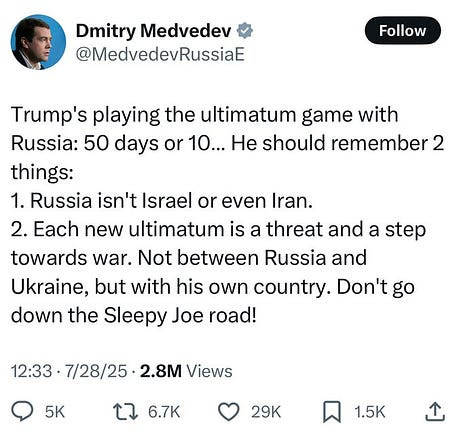
The Russians—Putin, Lavrov, and other senior officials—have been extremely patient, not to say long suffering, when it has come to reckless military provocations and over the top rhetoric from the Anglo-Zionists. Now Trump is making it extremely obvious that when he told the SCOTUS that he needed to slap tariffs on the world because of a deficit emergency, he was totally gaslighting them. The tariffs are only peripherally about deficits. My guess is that there are three guaranteed votes on the SCOTUS against allowing a POTUS to simply lie to them in this way, and that when the tariff cases land in the SCOTUS it’s entirely possible that that three will be joined by at least two more who will recognize that tariffs need to be voted on by Congress.
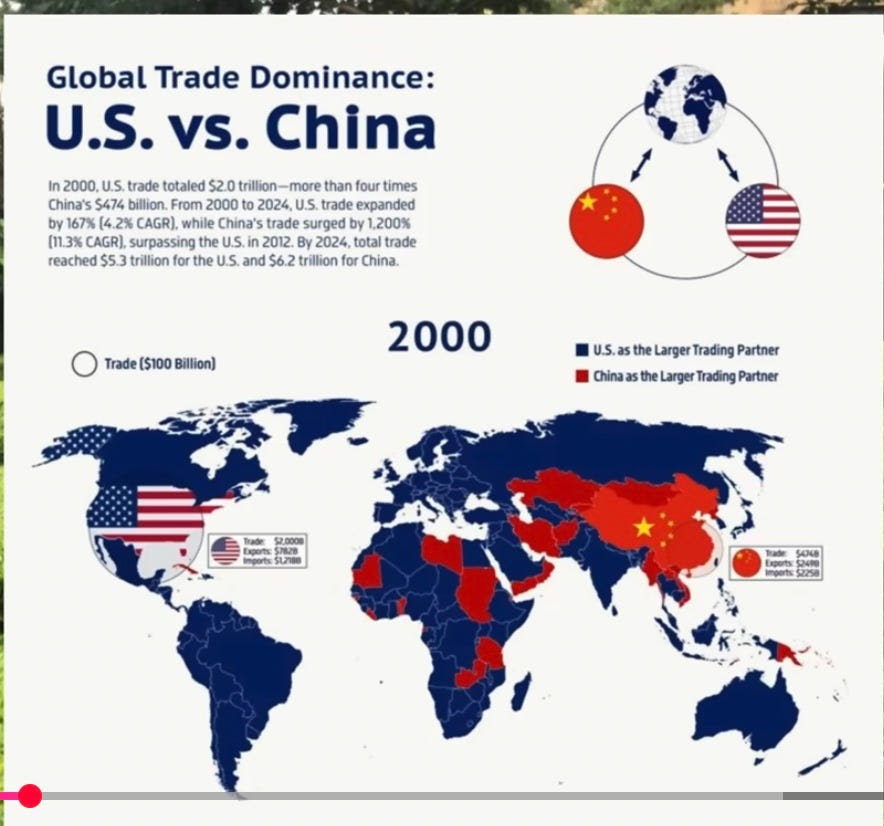
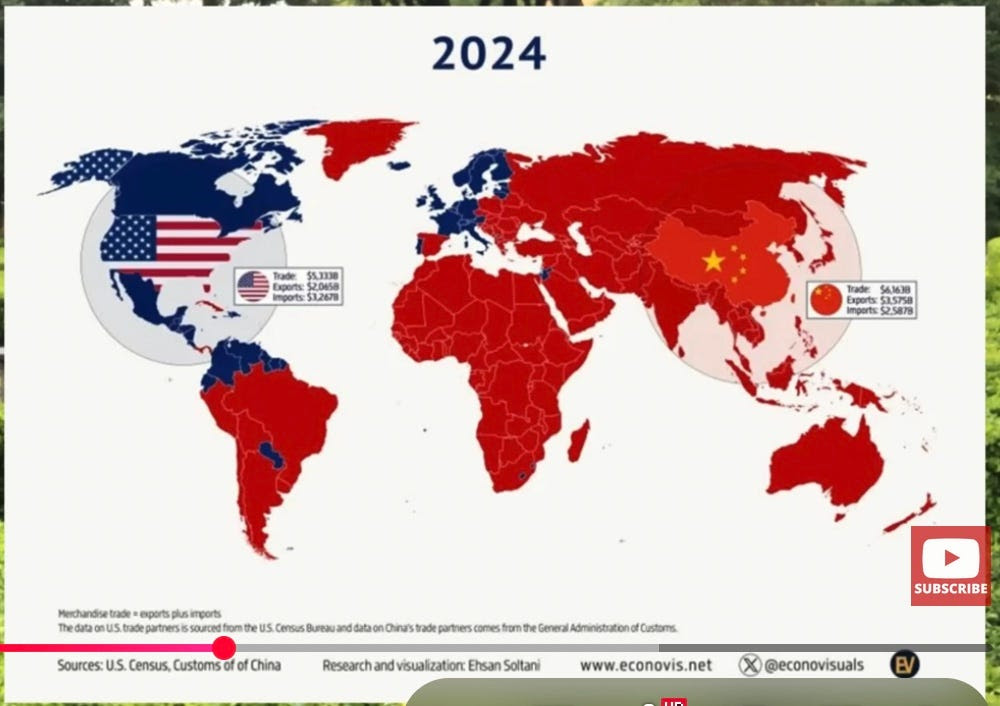
The tariffs are clearly intended for use as a bludgeon to break up BRICS, thus forcing the rest of the world to kiss the ass of King Dollar for always. That’s the meaning of shortening the sanctions/tariff “deadline” from 50 to 10 days. In the middle of negotiations with China and India, Trump announced sanctions on them if they don’t abandon Russia—i.e., if they don’t participate in the breakup of BRICS. Both China and India, joined by Brazil, are telling Trump to take a hike—and they have strong cards to play.
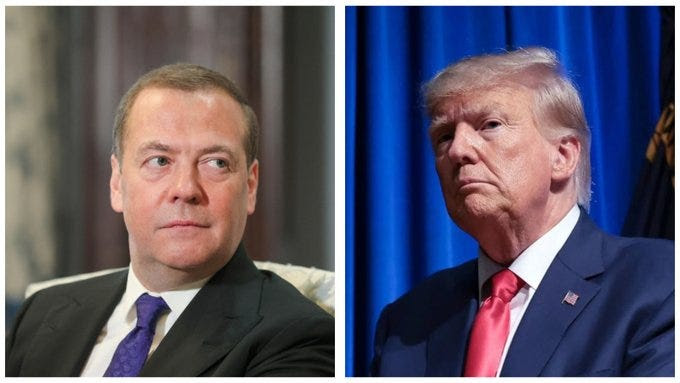
This, combined with Trump’s looming big defeat in Ukraine, has put Trump in a bad humor, and that—as if anything was needed—has led him to engage in some very ill considered verbal sparring with Dmitry Medvedev (Putin is simply ignoring Trump’s statements at this point). The upshot seems to be a signal from the Russian side that they’re finally losing patience.
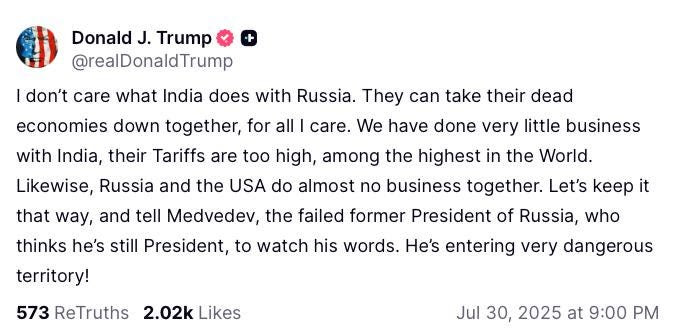
DD Geopolitics @DD_Geopolitics
Trump slams India and Russia, saying he “doesn’t care what India does with Russia” and calls their economies “dead.”
Then he threatens Medvedev and warns he’s “entering very dangerous territory.”
11:28 PM · Jul 30, 2025
Which prompted this response from Medvedev:
DD Geopolitics @DD_Geopolitics
Dmitry Medvedev responded to Donald Trump:
“About Trump’s threats against me on his personal network Truth Social, which he banned from operating in our country:
If a few words from a former Russian president provoke such a nervous reaction from the supposedly mighty President of the United States, then it means Russia is absolutely right — and will continue on its chosen path.
And as for the talk about the “dead economies” of India and Russia or “entering dangerous territory” — let him recall his favorite movies about the “walking dead,” and also how dangerous the mythical “Dead Hand” can be .”
2:00 AM · Jul 31, 2025
Scott Ritter explains what Medvedev is talking about—the Dead Hand:
As the rhetoric heats up, we must remain cognizant of the consequences.
The sharp exchange of words between President Trump and former President Medvedev underscores just how dangerous the deteriorating relations between the US and Russia have become.
The threats being promulgated are not idle ones.
President Trump has become enthralled with the Israeli “Nasrallah” solution—leadership decapitation and middle management disruption designed to bring about the rapid collapse of a government/system.
It was tried—and failed—in Iran.
But Trump is being advised by Russophobes who believe that the US can successfully implement such a plan against Russia.
This plan begins with sanctions, as all such plans do.
It ends with a decapitation strike on Moscow.
I believe Scott is absolutely correct that this conversation between Trump and Putin that supposedly occurred during Trump and Putin during Trump 1.0 is a complete fabrication, an utter fantasy. But revealing such fantasies to one’s geopolitical opposite numbers is unwise and dangerous:
Trump’s imagined conversation with Putin, where he threatened to “bomb the sh*t out of Moscow”, is indicative of the President’s thinking in this regard.
The preferred decapitation strike is done using B-52 bombers launching cruise missiles, accompanied by Trident missiles launched from Ohio-class submarines operating off the coast of Russia, allowing for a flatter trajectory flight and shorter flight time.
Medvedev’s comment about the “Dead Hand” indicates that Russia is well aware of Trump’s plans.
The “Dead Hand”, or Perimeter system, is a long-standing fail-safe mechanism/plan which guarantees a full-scale nuclear retaliation in case any nation is foolish enough to try a decapitation strike.
It dates back to Soviet times, when a special regiment of SS-20 missiles was equipped with radio transmission devices instead of warheads. These missiles would be launched, broadcasting launch codes that would send all strategic nuclear force weapons to their targets, even if Moscow was taken out.
This wasn’t theoretical—in my book Disarmament in the Time of Perestroika, I write about how the Soviets transitioned this capability to the SS-25 system once the SS-20 was eliminated under the INF treaty.
Today this mission is being handled by special regiment of SS-27 missiles.
There are other components of the “Dead Hand”.
Medvedev’s mentioning of it is a not-to-gentle reminder to Trump and his planners that it is suicide to think of a preemptive decapitation strike against Russia.
Hopefully this message gets through.
Otherwise, the “Walking Dead” allusion made by Medvedev will be the future of the United States and the world.
6:44 AM · Jul 31, 2025
Seven months into Trump 2.0 it certainly appears that the Russia side is becoming fed up with Trump. That’s not a good thing. It’’s a dangerous thing, because it’s pushing Russia to the conclusion that Anglo-Zionist aggression can only be stopped by the administration of a serious bloody nose.
Larry Johnson published two images that say a lot about the position Trump is in, because he continues to listen to fanatics and idiots. The images speak for themselves:
Paul Fromm on “The Political Cesspool” March 1: Donald Trump Has Done More for White Americans Than Any President Since Calvin Coolidge”
Paul Fromm, Director of the Canadian Association for Free Expression, offers his take on the first month of Donald Trump’s second presidency and plenty of other headlines involving the Great White North.
The second of February is the fortieth day after Christmas and therefore the day on which the Church commemorates the Presentation of Jesus Christ in the Temple and the Purification of the Blessed Virgin Mary. This commemoration is popularly known as Candlemas from the tradition of blessing candles in Church on this day. There is an ancient folk tradition that says that if it is a clear day on Candlemas it will be a long winter. A tradition derived from this one says that a hibernating animal – which depends on where you live – will temporarily awaken on Candlemas to predict the remaining length of winter by whether or not he sees his shadow. In North America, the hibernating animal is the groundhog or woodchuck.
This year Candlemas fell on a Sunday. On most Sunday evenings a friend comes over to watch movies and the obvious choice was “Groundhog Day” the 1993 film by Harold Ramis in which Bill Murray plays a weatherman who goes to Punxsutawney, the small community in Pennsylvania where Groundhog Day is a much bigger deal than elsewhere, and becomes trapped in a personal time loop that forces him to relive the day over and over again. The way in which Phil, Murray’s character who shares a name with the famous groundhog, responds to this dilemma evolves over the course of the movie. At one point, fairly early in the plot, his response is gross self-indulgence since there are no consequences due to the slate constantly being wiped clean. In this phase, the character of Rita portrayed by Andie MacDowell, watching him engage in reckless gluttony in the local diner, quotes Sir Walter Scott to him:
The wretch, concentered all in self,
Living, shall forfeit fair renown,
And, doubly dying, shall go down
To the vile dust, from whence he’s sprung
Unwept, unhonour’d, and unsung.
In the movie, Phil’s response is to laugh and make a joke about having misheard Walter Scott as Willard Scott. Watching the movie with my friend, my response was to point out that Rita had misapplied the lines she quoted. The lines are from Canto VI of the Lay of the Last Minstrel and refer not to a hedonist but to the person lacking patriotism. The first part of the Canto goes:
Breathes there the man, with soul so dead, Who never to himself hath said,
This is my own, my native land! Whose heart hath ne’er within him burn’d, As home his footsteps he hath turn’d From wandering on a foreign strand! If such there breathe, go, mark him well; For him no Minstrel raptures swell; High though his titles, proud his name, Boundless his wealth as wish can claim;— Despite those titles, power, and pelf,
After this comes the lines quoted in the movie.
Clearly Sir Walter Scott shared the opinion of Scottish-American, neo-Thomist philosopher Alasdair MacIntyre that patriotism is a virtue as well he ought for that opinion is correct. Note, however, that the correctness of the opinion depends on the definition of patriotism. Nationalism, which is frequently confused with patriotism, is not a virtue. It is not the opposite of a virtue, a vice, either, but this is only because it does not belong to the same general category, the habits of behaviour that make up character, of which virtue and vice are the good and bad subcategories. Nationalism is an ideology. An ideology is a formulaic substitute for a living tradition of thought (see the title essay in Michael Oakeshott’s Rationalism in Politics And Other Essays). Shortcuts of this type are always bad.
In a recent column Brian Lilley spoke of “national pride” and criticized those who have only recently started to display national pride as Canadians in response to Donald the Orange. While Lilley’s argument is related to my main topic in this essay, I bring it up here to make the point that “national pride” is not a good way of describing the patriotism that is a virtue. To be fair, Lilley did not equate patriotism with “national pride” but this is because the word patriotism does not appear in his column. Pride appears four times and the adjective proud appears nine times. While it is easy to see why Lilley would use these terms, since much of the column is appropriately critical of the attacks on Canada and her history, identity, and traditions that have been coming from the current Liberal government for the duration of the near-decade they have been in power, pride is not the right word. It is the name of a vice, indeed, the very worst of the Seven Deadly Sins, rather than a virtue.
Fortunately, we do not have to look far and wide to find the right term. Patriotism, correctly defined, is neither the ideology of nationalism that values one’s country for its perceived superiority to all others requiring that all others be insulted and subjugated nor the deadly sin of pride as directed towards one’s country, but simply love of one’s country.
Love of one’s country is indeed a virtue. Whereas pride is the worst of all sins, love is the highest of all virtues. Of course, the love that is the highest of all virtues is a specific kind of love. The Seven Heavenly Virtues include the Four Cardinal Virtues of Prudence, Justice, Temperance, and Fortitude and the Three Theological Virtues of Faith, Hope and Love. The Cardinal Virtues are habits that anyone can cultivate and so make up the best moral character that man can attain in his natural or unregenerate state. While faith, hope, and love in a more general sense can be similarly cultivated, the Faith, Hope, and Love that make up the essence of Christian character must be imparted by the grace of God although the Christian is also expected to cultivate them. Love is the greatest of the three as St. Paul declares in 1 Corinthians 13:13, and therefore as Henry Drummond called it, “the greatest thing in the world”. It incorporates the other two since they are built upon each other. Natural loves are lesser than Christian Love or Charity, but they are still virtuous insomuch as they resemble, albeit imperfectly, the Theological Virtue. Patriotism, the love of country, is such a love. Edmund Burke famously described how it develops “To be attached to the subdivision, to love the little platoon we belong to in society, is the first principle … of public affections. It is the first link in the series by which we proceed towards a love of our country and to mankind.” The “little platoons” include one’s family and local community and is Burke had wanted to belabour the point he could have said that the first principle is love of one’s family, which develops into love of one’s local community, and then outward.
It has been heartwarming to see Canadians display their love of country over the last month or so in response to the repeated threats of Anschluss coming from America’s Fuhrer. While not all of these displays have been in good taste they do all demonstrate that Captain Airhead’s efforts to kill Canadian patriotism by endlessly apologizing for past events that need no apologies, cancelling Canada’s founders and historical leaders such as Sir John A. Macdonald, and other such nonsense have failed. This resurgence in Canadian public patriotism ought, therefore, to be welcomed by the “conservatives” who rightly despise Captain Airhead. Oddly, however, it has not been so welcomed by many of them.
In part this is due to the fact that Captain Airhead, the Liberals, the NDP, and their media supporters who were all on the “cancel Canada” bandwagon until yesterday are now wrapping themselves in the flag and these do deserve to be called out for this. The right way to do so, however, is to say something to the effect of “you are rather late to the party, but thanks for showing up.” To Brian Lilley’s credit, that is the gist of what he says in the column alluded to earlier. Many other “conservatives”, however, have responded quite differently. In his 2006 book, In Defence of Hypocrisy: Picking Sides in the War on Virtue, Jeremy Lott pointed out the difference between Jesus’ condemnation of hypocrisy and Modern condemnation of hypocrisy. In condemning the hypocrisy of the Pharisees, Jesus did not condemn them for the high moral standards they taught, but for falling short of those standards by sinning. Moderns, however, when they condemn hypocrisy, condemn the moral standards rather than the sin. The response of many “conservatives” to the newly discovered Canadian patriotism of progressives resembles this in that they seem to be criticizing the progressives more for their expression of patriotism today than for their lack of it yesterday. One even quoted Samuel Johnson’s “patriotism is the last refuge of the scoundrel.” I refer him to the comments of James Boswell, whose record of the remark is the reason we are familiar with it today, as to what it means. Dr. Johnson was not impugning love of country, but a kind of pseudo-patriotism which interestingly enough was associated with the founding of America.
It can hardly be a coincidence that these same “conservatives” have been rather less than patriotic in their response to the threats from south of the border. The founder of one “conservative” independent online media company first responded to these threats by saying they should be treated as a joke and a funny one at that. Then, when Donald the Orange said last weekend that it was no joke, she flip-flopped and criticized Captain Airhead for having initially done exactly that and said the Anschluss threat was a joke. In between she conducted and published an interview with an immigrant from America who twelve years ago proved herself to be exactly the kind of immigrant we don’t need when she published a book proposing the merger of our country with her country of birth.
The general response to these threats in this organization’s commentary has been to treat the American dictator as a reasonable man, with legitimate grievances, who can be negotiated with and to propose an economic merger between the two countries that falls short of a political merger. Ironically, their website is promoting a children’s book they just published on the life of Sir John A. Macdonald intended to counter the negative propaganda about the Father of Confederation that progressives have been spewing based on their skewed narrative about the Indian Residential Schools. The book was a good and patriotic response to this blood libel of our country. Sir John must be spinning in his grave, however, at the thought that the defence of his memory could be merged with the idea of an economic union with the United States. Sir John spent his entire career as Prime Minister promoting internal east-west trade within the Dominion and fighting the siren call of north-south trade because he knew that this was the greatest threat to the success of the Confederation Project.
Free trade is a good idea from an economic perspective, but each of the “free trade” agreements we have signed with the United States has been a terrible idea from a political perspective. The kind of economic union these “conservatives” are promoting would be worse than all of the other “free trade” agreements, since the United State is currently led by a lawless megalomaniac, who respects neither the limits placed on his powers by his country’s constitution nor the agreements he has signed and cannot be trusted to keep his own word – the “free trade” agreement he is currently, and deceitfully, claiming is so “unfair” to his country is the one he himself negotiated – and who looks at tariffs and economic measures in general as weapons to accomplish what his predecessors accomplished by bullets and bombs. By his predecessors I do not mean previous American presidents, but Napoleon, Hitler and Stalin. I recognized that this was what we were dealing with the moment he made his first “51st state” remark and was confirmed in this when he doubled down on this talk after Captain Airhead announced his intention to resign. No Canadian patriot could fail to recognize it today after he has continued to escalate his lies and rhetoric and threats for the last month. Yes, the Left’s endless likeness of everyone they don’t like to Hitler has desensitized us to these comparisons, but let us not be like the villagers in Aesop’s story about the boy who cried wolf. This time the wolf is real. The sort of things the Left objects to in Donald the Orange, his immigration policies, his termination of the racist, anti-white, policy of DEI, do not warrant a comparison with Hitler, but his threatening us with Anschluss, his demand for Lebensraum from Denmark, his intent to take back his “Danzig Corridor” from Panama, his finding his Sudetenland in Gaza, most certainly do, as does the insane personality cult his followers have developed into.
Canadian conservatives ought to be leading the renaissance of Canadian patriotism, and yes, Brian Lilley, you are right that it should not have taken something like Trump’s threats to bring that renaissance about. Liberals have always been the party of Americanization in Canada. Sadly, today’s conservatives are mostly neoconservatives. David Warren once said that a conservative is a Tory who has lost his religion and a neoconservative is a conservative who has lost his memory. On the authority of Sir Walter Scott I deduce from the disgusting anti-patriotism I have seen recently that many have lost their souls as well. — Gerry T. Neal
Canada is a Commonwealth Realm, a country within the British Commonwealth of Nations which governs herself through her own Parliament but which shares a reigning monarch with the United Kingdom and the other Commonwealth Realms. Progressives, especially of the woke, “anti-colonial”, “anti-imperial” type, don’t like this and periodically call for us to “severe our ties to the monarchy.” This expression demonstrates just how little they understand our country. We don’t have “ties” to the monarchy as if it were something external that can be lopped off. It is integral to our constitution and for that matter to our history.
When our current king was crowned in Westminster Abbey on 6 May, 2023 he was greeted by a young lad of His Majesty’s Chapel Royal who welcomed him “in the name of the King of kings.” To this, His Majesty replied “In His name and after His example I come not to be served but to serve.” This was an addition to the coronation service requested by His Majesty himself although it expresses the attitude of humility appropriate to the tradition of the king coming to Church to be crowned by priestly representatives of the King of kings.
What a contrast between this attitude of humility on the part of the man and appropriate to the office he fills with the insufferable arrogance that has been characteristic of his Canadian prime minister for the last decade. Thankfully, that prime minister will soon be history. On Epiphany he announced his upcoming resignation, to take effect after the Liberal Party has chosen its new leader which is set to take place on 9 March. Unfortunately, the joy of hearing that he is finally stepping down, nine years after he should have resigned, has been dampened by the noise coming from south of the border. For as big as the contrast between His Majesty’s appropriate Christian humility and the vainglory of his rotten Canadian prime minister may be there is an even bigger contrast between that humility and the hubris of the festering anal sore who is set to be sworn in again as American president on 20 January.
Yes, that last sentence expresses a rather different character evaluation of Donald the Orange than the one I have been expressing for the last eight years. As recently as last 5 of November, Guy Fawkes Day and the day of the American presidential election, after declining to endorse either candidate on the grounds that it was an election in another country and for an office, president of a republic, of which I don’t approve, I did say that “If someone were to ask me which of the two candidates I like better as an individual person and which of the two has, in my opinion, the better ideas and policies, my answer to both questions would be Donald the Orange.” I can no longer say this, although my opinion of Kamala Harris has in no way improved. One’s insight into another person’s character gets a lot clearer when he is holding a gun to one’s country’s head and screaming “Anschluss!” Whether he is joking or serious, literal or non-literal, is entirely immaterial. Since he is holding a gun to another country’s head and screaming “Lebensraum” and demanding from yet a third the return of his “Danzig Corridor” he has clearly gone stark raving mad.
Enough, however, about the wounded head, now healed of the revived Roman Empire to our south who has been given a “mouth speaking great things and blasphemies” whose followers all wear a sign of allegiance on their foreheads. I do not wish to write an essay all about him because he thinks everything everywhere should always be about him and I have no desire to indulge him on that. Rather this essay is about Canada’s small-c conservatives and how the behaviour of some of them over the past week has made me abundantly glad that in my 1 January essay this year I distinguished my own Toryism, not only from big-C Conservative partisanship but from small-c conservatism as well.
John Casey, writing in the 17 March, 2007 issue of The Spectator, in an article entitled “The Revival of Tory Philosophy” recounted a conversation that had taken place between Enoch Powell and Margaret Thatcher in the Conservative Philosophy Group, which Hugh Fraser, Casey, the late Sir Roger Scruton and others had founded back in the 1970s. The meeting was just before the Falklands War and in it Edward Norman had given a presentation on the “Christian argument for nuclear weapons.” In the discussion that followed according to Casey “Mrs. Thatcher said (in effect) that Norman had shown that the Bomb was necessary for the defence of our values.” Then this exchange took place:
Powell: ‘No, we do not fight for values. I would fight for this country even if it had a communist government.’ Thatcher (it was just before the Argentinian invasion of the Falklands): ‘Nonsense, Enoch. If I send British troops abroad, it will be to defend our values.’ ‘No, Prime minister, values exist in a transcendental realm, beyond space and time. They can neither be fought for, nor destroyed.’ Mrs Thatcher looked utterly baffled. She had just been presented with the difference between Toryism and American Republicanism.
I very much doubt that many of the small-c conservatives in Canada today would have understood Enoch Powell’s point any more than Margaret Thatcher did although Toryism is the traditional Right of Canada as well as the UK. One’s country is a concrete good for which a patriot fights regardless of what he may think of the people in government at the moment and what their ideology may happen to be. Of course many, probably most, on the Right today, would call themselves nationalists rather than patriots and would probably not understand this difference either. Here it is as explained by American paleoconservative/paleolibertarian Joe Sobran in a column from 16 October, 2001:
This is a season of patriotism, but also of something that is easily mistaken for patriotism; namely, nationalism. The difference is vital.
G.K. Chesterton once observed that Rudyard Kipling, the great poet of British imperialism, suffered from a “lack of patriotism.” He explained: “He admires England, but he does not love her; for we admire things with reasons, but love them without reasons. He admires England because she is strong, not because she is English.”
In the same way, many Americans admire America for being strong, not for being American. For them America has to be “the greatest country on earth” in order to be worthy of their devotion. If it were only the 2nd-greatest, or the 19th-greatest, or, heaven forbid, “a 3rd-rate power,” it would be virtually worthless.
This is nationalism, not patriotism. Patriotism is like family love. You love your family just for being your family, not for being “the greatest family on earth” (whatever that might mean) or for being “better” than other families. You don’t feel threatened when other people love their families the same way. On the contrary, you respect their love, and you take comfort in knowing they respect yours. You don’t feel your family is enhanced by feuding with other families.
While patriotism is a form of affection, nationalism, it has often been said, is grounded in resentment and rivalry; it’s often defined by its enemies and traitors, real or supposed. It is militant by nature, and its typical style is belligerent. Patriotism, by contrast, is peaceful until forced to fight.
Joe Sobran, sadly, passed away far too early in 2010 and so did not live to see the “Make America Great Again” movement. The paragraphs quoted above, however, are a good indication of what he would have thought of it, especially in its current revised version. In 2016, the movement used nationalist rhetoric but when it spoke of putting “America First” it sounded like it was echoing what those words meant to Sobran’s friends, Sam Francis and Pat Buchanan. Neither man took it to mean that the United States should be telling the rest of the world “we’re the best, we’re the strongest, so all the rest of you have to do what we say,” quite the contrary. Buchanan campaigned for American president three times on a platform of doing the opposite of that. In 1999 he published a book entitled A Republic not an Empire: Reclaiming America’s Destiny. In 2016, American neoconservatives, the most vehement supporters of American imperialism, shunned the MAGA movement because it sounded to them like Buchananism. It was thought by many that MAGA had taken its playbook from Sam Francis, who predeceased Sobran in 2005 and his “Middle American Radicals” strategy. The MAGA of 2024-5, however, is clearly the nationalism Sobran wrote against, taken to the nth degree, in both rhetoric and reality. Note that the neoconservatives who shunned it in 2016 are flocking to it today. Compare the Ben Shapiro of 2016 to the Ben Shapiro of today, for example.
John Lukacs, the Hungarian born historian who fled the Nazi and then Communist occupations of his home country and immigrated to the United States was another who understood the difference between nationalism and patriotism. He was a man of the Right, but was very skeptical about the American conservative movement which popped up after World War II in a country that had always considered itself to be founded on liberalism. Lukacs, like his friend Erik von Kuehnelt-Leddihn, another refugee from Europe whom he succeeded as history professor at Chestnut Hill College in Philadelphia when Kuehnelt-Leddihn returned to Austria after the war, he was a Roman Catholic royalist, the continental equivalent of a Tory, and always referred to himself as a reactionary. I learned to self-apply this favourite epithet of the Left from his example. In his Democracy & Populism: Fear and Hatred (2005) which I reviewed here, he predicted that a new type of Right was on the ascendency, but warned that it might be an unpalatable sort of Right that blended populism, the demagogic exploitation of dissatisfaction with elites with nationalism rather than traditionalism with patriotism.
The MAGA movement in the United States is, of course, a blend of populism and nationalism. It is at its best when playing the role of the “agin man”, that is, someone identified by what he is “agin” (against). It opposes globalism, uncontrolled and illegal immigration, the soft-on-crime policies that are wreaking havoc in places like New York and California, and to the whole combination of racial, sexual, gender and other identity politics that is woke ideology. MAGA did not invent the opposition to these things, however, and one does not have to be either a populist or a nationalist to oppose them. The term “woke” in its political sense had not yet become a household word when Joe Sobran died, but he opposed everything the term denotes and we have already seen his opinion of nationalism. John Lukacs’s mini-book “Immigration and Migration: A Historical Perspective” which can be read in .pdf on the American Immigration Control Foundation’s website here was originally published in 1986, decades before MAGA, the embodiment of the populist nationalism or nationalist populism he foresaw in 2005 and saw unappealing, arrived on the scene.
All of these things that MAGA opposes, the Liberal Party under its present leadership has embraced, taken to their most absurd extremes, and made into its own platform. This was not in response to MAGA, since Captain Airhead was promoting these things from the moment he became Grit leader, which was a couple of years before he became prime minister the year before that in which Donald the Orange defeated Hilary Clinton. He did, however, take his cues from the man who was president of the United States at the time, Barack Obama. Liberal prime ministers in Canada have always taken their cues from the United States. The Liberal Party has always been the party of Americanization.
In 1891, when Sir John A. Macdonald won his last Dominion election, he was campaigning against Sir Wilfred Laurier’s Liberals who were running on a platform of “unrestricted reciprocity” or what today would be called “free trade” with the United States. Macdonald has overseen the construction of the railroad in his premiership both to promote trade within Canada, uniting our economy, and to resist pressure to become dependent on trade with the United States, because he correctly foresaw trade dependence on the United States as a step towards falling into the cultural and political gravitational pull of the American republic and so undermining the Confederation Project. Macdonald won his last majority government in that election, shortly before he passed away, by campaigning against any such outcome. His campaign posters bore the slogan “The Old Flag, the Old Policy, the Old Leader.” William Lyon Mackenzie King, who led the Liberal Party for much of the early twentieth century was even more of a free trader and Americanizer than Laurier.
Now someone might point out that Mackenzie King represented a different wing of the Liberal Party big tent than that which today is identified with the Trudeau family. That is true but it is also true that the Trudeau Liberals as much as the Mackenzie King Liberals took their cues from the United States. Indeed, the very celebrity of the Trudeau family in Canada is an imitation of that of the Kennedy family in the United States. Americans should be grateful that they have not had a second Kennedy presidency.
When Pierre Eliot Trudeau became prime minister he began to expand federal social programs in an unveiled imitation of Lyndon Johnson’s similar expansion in the United States. More importantly, in 1977 Pierre Trudeau introduced the Canadian Human Rights Act and in 1982, he introduced the Charter of Rights and Freedoms in imitation of the US Bill of Rights. The Charter gave the Canadian Supreme Court the type of powers the American Supreme Court has and after 1982 Canada began for the first time to experience the kind of cultural revolution through liberal judicial activism that had plagued the United States for decades prior. The American Supreme Court, for example, threw the Bible and prayer out of American public schools two decades before Pierre Trudeau introduced the Canadian Charter of Rights and Freedoms. They were still in Canadian public schools when I attended and I would have been in Grade 1 when the Charter passed. The Morgentaler ruling of the Canadian Supreme Court came in 1988, 15 years after Roe v. Wade in the United States. Such a ruling would not have been possible prior to 1982.
As for the Canadian Human Rights Act, this was an imitation of the United States’ unnecessary 1964 Civil Rights Act prohibiting private discrimination that capped Martin Luther King Jr. phoney career as a civil rights crusader which started a year after segregation had been ruled unconstitutional by the American Supreme Court and was hence already legally dead. Most of the free speech battles in Canada during my lifetime have been because of problems that go back to this Act. Those who maintain that we would not have had these problems if we had the American First Amendment are grossly mistaken. From 1949 to 1987 the American communications regulator the FCC had a policy called the Fairness Doctrine that amounted to what Jordan Peterson calls “compelled speech”, which transgresses freedom of speech worse than “prohibited speech.” The Fairness Doctrine required broadcasters, if they expressed editorial opinions, to give equal time to the opposite view, thus forcing them to subsidize views they disagreed with. It was not evenly enforced but was enforced against right-wing broadcasters while left-wing broadcasters were generally left alone. The Rev. Carl McIntire ran afoul of it, for example, on a number of occasions. It was not struck down by the US Supreme Court on the grounds of the First Amendment, although challenges on that basis were made. After pressure from Congress and the Reagan administration, the FCC repealed it itself in 1987. So no, the American First Amendment is not the sacred guarantee of freedom of speech that some think it to be. Furthermore, and this is actually the main point, the enforced racial, sexual, and gender identity politics of today’s wokeness, at least insofar as it touches on public policy, in Canada can be traced directly to Pierre Trudeau’s introduction of an Act in 1977 based on an American Act of 1964. This, coupled with the fact that the biggest agent for promoting wokeness in popular culture, not only in North America but throughout the civilization formerly known as Christendom, has been the mass culture production industry centred in Los Angeles, California demonstrates that wokeness comes stamped with “Made in the USA.”
In 1980 at the beginning of the Reagan administration in the United States and a year into Margaret Thatcher’s premiership in the United Kingdom, Sir Roger Scruton wrote The Meaning of Conservatism to demonstrate that while Reagan and Thatcher had their good points, conservatism was not what they thought it was, free market ideology, but rather the instinct to preserve and pass on the good things that others have built before you because these things are much easier to destroy than to build. Towards the end of the 1980s, a movement arose in Canada that completely ignored Scruton’s message. It called itself small-c conservative to distinguish itself from the party, and it took the position that Reaganism/Thatcherism is the standard to which conservatism should hold itself. While the movement loathed the Liberal Party, its foundational misconception meant that it would never be more than an imitation of the centre-right wing of the Liberal Party. When it founded an alternative party to the old Conservatives, it gave it the name that the movement which became the Liberal Party had gone under in the years leading up to Confederation, the Reform Party. It promoted more economic integration between Canada and the United States, the Liberal Party’s position, rather than the economic nationalism traditional to both Canadian Toryism and American Republicanism. Lacking historical depth and a proper understanding of Confederation it wanted to make Canadian provinces more like American states and the Canadian Senate more like the American Senate. The social and cultural conservatism of the movement and the Reform Party initially attracted me to them until I realized that these were entirely expendable to the movement and that it would always put business interests ahead of traditions, institutions, and basically all those good things Scruton said that a conservative instinctually defends.
It is understandable, perhaps, that small-c conservatives, after almost a decade of misrule by the Liberal Party at its worst as far as extreme Leftism goes, would look to the success of the MAGA movement in the United States, but it is a huge mistake to follow the example of the Liberal Party in taking cues from the United States. Since Epiphany, small-c conservatives have demanded that the prorogation of Parliament end and that we go into the next Dominion Election right away. I, as well, would like to see that happen. Challenging the prorogation in court is not the way to go about it. Should the challenge go through this would weaken the Crown’s reserve powers and that outcome would be worse for us than having to wait until March for the no confidence vote that will inevitably bring down the Liberals. We should be strengthening, not weakening, the Crown, so as to check any future prime minister from becoming as autocratic as the current one. What this means is that the role of recommending whom the King appoints as Governor General must go to someone other than the prime minister. The Governor General should have refused to prorogue Parliament to give the Liberal Party time to choose a new leader, just as Lord Byng refused to dissolve it to save Mackenzie King’s skin 99 years ago. The solution is not to have the use of the Crown’s powers subjected to judicial review but to take control over the appointment of the Governor General away from the prime minister. Lord Byng was not appointed at the prime minister’s recommendation.
Furthermore, it is one thing to accuse the prime minister of abusing the process and putting party ahead of country by asking for Parliament to be prorogued until the eve of Lady Day to give the Liberals enough time to choose a new leader. It is quite another to complain that the Liberal Party choosing a new leader before the dissolution of Parliament that will lead to the Dominion election in which the Liberals are defeated is letting Party insiders choose the next prime minister rather than the people. Small-c conservatives, like Ezra Levant and Candace Malcolm, have perhaps not thought through the implications of this talk. There will be another Dominion Election by October. There will be one a lot sooner than that, because whoever the Liberals put in as their next leader will be brought down almost immediately when the House sits again. The next Liberal leader may technically be the next prime minister but it will be a very, very, short premiership. What Levant, Malcolm, et al., are demonstrating, however, is a lack of understanding of the Westminster Parliamentary model, which allows for the premiership to change hands between elections. In Dominion elections, we do not vote for the prime minister in the same way Americans vote for their president. We vote individually for the representative of our constituency, and collectively for a Parliament. The results determine who will be the next Prime minister – the person who has the confidence of the House – but not directly. It has been a huge mistake over the last thirty years or so to increasingly treat each Dominion election as if it were a direct vote for the prime minister. The last thing we need in this country is to import more of the American cult of the leader. Green Party leader Elizabeth May showed more understanding of our Parliamentary system and more basic constitutional conservatism than anyone at True North or Rebel when she schooled the American president-elect on why Wayne Gretsky can’t run directly for prime minister.
Then there are those who think Kevin O’Leary’s proposal of an EU style, common market, common currency has merit. This appears to include Brian Lilley. Has it perhaps eluded their notice that the result of this experiment in Europe was that each country involved began to face a migration crisis and related problems similar but on a larger scale to those that conservatives in Canada and the United States say they want to solve rather than exacerbate?
The small-c conservatives who have annoyed me the most have been those who have suggested one anti-patriotic response to Trump’s obnoxious behaviour or another. Laughing alongside Trump as if his “51st state” remarks were jokes only at Trudeau’s expense rather than that of the country as a whole is one example, excusing his remarks on the grounds that this is how he does business, “it’s all in the Art of the Deal” is another. If that is how he does business that compounds the charge against him it does not excuse it. Going around saying “I’m bigger than you and stronger then you therefore you have to do as I say or I’m going to take your toys” is bad behaviour in the schoolyard and it is no more acceptable anywhere else. It is just as reprehensible in business as it is in geopolitics. Then there is the response of emphasizing what good friends Canada and the United States have been. That is not the way to talk at this time. As Joe Warmington in the Toronto Sun put it “Trump can no longer claim to be a friend to Canada. No friend talks like this.” The problem with these anti-patriotic small-c “conservatives” is that while they lack true patriotism, that love of Canada like unto their love for their own immediately family, they do have a Nietzschean worship of power and strength which they direct towards the United States that in certain respects resembles what Joe Sobran called nationalism except that it is worse because it is focused on a country other than their own. Mercifully, these types are, I think, a small, if loud, minority.
The prize for the most reprehensible attitude goes to Stephen K. Roney who has been positively salivating at the idea of becoming the 51st state. He seems to be under the impression that those of us who love our country bear the burden of justifying her continuing independence of the United States. My answer to him is that if he wants to be an American so badly he is free to move there if the Americans will let him. I wouldn’t let him if I were the Americans. Someone who has that kind of attitude towards his own country cannot be trusted to be loyal to any other.
Yes, if these types are what it means to be “conservative” today, I am glad that I am a Tory rather than a conservative, just as I am very glad to be a Canadian, a citizen of a Commonwealth Realm and the subject of a king who went to his coronation to follow the example of the King of kings, not to be served but to serve, rather than the citizen of an imperial republic, whose incoming president is so full of himself, that I half expect him to raise a statue of himself in the National Cathedral in Washington DC and demand that not just Americans but everyone in the world worship before it.
Paul Fromm on “The Political Cesspool” :The End of Trudeau & Major Positive Effects of Incoming President Donald Trump
I appeared on “The Political Cesspool” tonight, hosted by James Edwards. I discussed Trudeau’s resignation and the many positive effects of Donald Trump on Canada. Change is already coming and the reversal of Woke. Radio Show Hour 1 – 2025/01/11 – The Political Cesspool Radio Programme. https://www.thepoliticalcesspool.org/radio-show-hour-1-2025-01-11/
Woke Canada & The Great Replacement in the Age of Trump
Veteran Canadian Nationalist Paul Fromm joins Australian nationalist and author Nathan Sykes to discuss the impact that Donald Trump’s Presidential victory will likely have on woke Canada and its resoundingly hated Prime Minister, Justin Trudeau. They also discuss the replacement of Canadians, Australians and Europeans through the immigration pogrom.
With the threat of mass deportations from the U.S., and a policy in Canada that allows unauthorized residents to claim asylum should they lay low for 14 days, it’s only rational for would-be claimants to try, Jamie Sarkonak says.
Currently, as the rules stand, migrants from the United States can cross into Canada, wait two weeks, and become eligible to file a refugee claim here. The northern border sure must be looking like a home-free line, now that Donald Trump has been elected on a promise to carry out mass deportations of illegal migrants.
So, if there was ever a time Canada needed to send a very loud, very public, “no more Mr. Nice Guy” message to economically motivated asylum seekers — firm messaging backed up by policy changes to ward their numbers off — it’s right now.
The numbers are already too high. Last year, nearly 150,000 people staked refugee claims here, rendering us the fifth-largest destination for asylum seekers that year. Two years’ worth of asylum claims are inching their way through the immigration system, many of these from friendly not-at-war countries that have no business sending us thousands of refugees.
India, Nigeria, and Mexico are where the largest number of claims come from, but there are many others that shouldn’t be sending refugees our way. Each successful applicant — from friendly, at-peace countries — is a potential online advertisement for immigration services online; that is, potential inspiration for others looking to claim refugee status. Of course, many of these claimants aren’t actually in danger, as required by law, and are willing to travel home, prompting immigration consultants to make warnings against doing so.
With the threat of mass deportations from the U.S., and a policy in Canada that allows unauthorized residents to claim asylum should they lay low for 14 days, it’s only rational for would-be claimants to try. It could very well be a painful squeeze — the U.S. received 1.2 million asylum claims last year alone, and some fraction of that number can be expected to divert to the north come 2025.
The trek to Canada will be a rational one for many. To observers on the outside, we’re the country that welcomes everyone, hands out bags of free food, offers free care, has loads of jobs to fill along with land, oh so much land. We know this isn’t actually how Canada works, but they don’t.
Seriously. Extensive immigration influencer videos have advertised Canadian “free food” to those abroad, which have no doubt made this country a more attractive place to attempt asylum. Rent is often covered by the Canadian tax base as the wait for claim adjudication drags on — which ultimately puts low-income Canadians in competition with migrants for housing. Some also end up competing with homeless Canadians, taking up critical space in shelters from Vancouver to Toronto.
MANY OF THESE CLAIMANTS AREN’T ACTUALLY IN DANGER.
In health care, it’s a similar problem. These populations strain the health-care system: the Star reported last week that “Midwives and physicians in emergency departments said they’re seeing significantly more uninsured clients accessing care at later stages of a complicated pregnancy or an already developed cancer or AIDS.” The uninsured being, in part, migrants who are in Canada illegally. Bad deal for us, good deal for them.
Between rosy influencer advertising and borders-open messaging from our own Prime Minister Justin Trudeau, a lot more needs to be done to reverse the perception that Canada is a welcome home for economic “refugees.”
The incoming Trump administration has been strong out of the gate in turning around the perception of the United States as a bottomless bread basket of free amenities. Federal and state governments have rolled out unauthorized-friendly initiatives for a while now: feds have done their best to soften deportation rules, and some state governments have offered perks like pre-paid debit cards for migrants, as well as free rent. But Trump’s messaging has been clear that deportations are coming, and his border-enforcer-to-be, Tom Homan, is just as forceful: “You better start packing now, cause you’re going home,” Homan told a crowd earlier this year.
We haven’t been so firm. Visitor visa rules were tightened this week, but the home-free-in-twoweeks line remains in place.
Most of our country’s messaging includes tepid inward-facing assurances that everything is under control. The faceless blob that is the Canadian administrative state says there’s nothing to worry about: the RCMP learned from post-2016 migration which “provided us with the tools and insight necessary to address similar types of occurrences.” The Canada Border Services Agency (CBSA) says, “we are ready to respond and adapt as needed.”
Homan, meanwhile, isn’t raving about our competency, stating in a recent TV interview that the northern border is an “extreme national security vulnerability” and that “tough conversations” are soon to be had with Canada.
Meanwhile, Immigration Minister Marc Miller is nonchalant, telling the Globe and Mail: “We will always be acting in the national interest and those measures that we move to undertake, regardless of what decision is taken by the new administration, to make sure that our borders are secure, that people that are coming to Canada do so in a regular pathway, and the reality that not everyone is welcome here.”
Well, that sure sends a message. “Not everyone is welcome here.”
Each statement from Canadian officials has the same bland, inoffensive lack of substance that could only come from either a comms department trained to generate few words of meaning or an AI text generator. None are backed by the force of strong, loophole-closing policy change.
Miller’s job right now isn’t just to soothe Canadians with words as bland as beige walls. He has to dispel years of false impressions of Canadian life inspired by a multitude of enthusiastic foreign-language Youtube and Tiktok howto vlogs about immigration, with rhetoric and hard policy. Right now, he’s falling short.