
Blog Archives
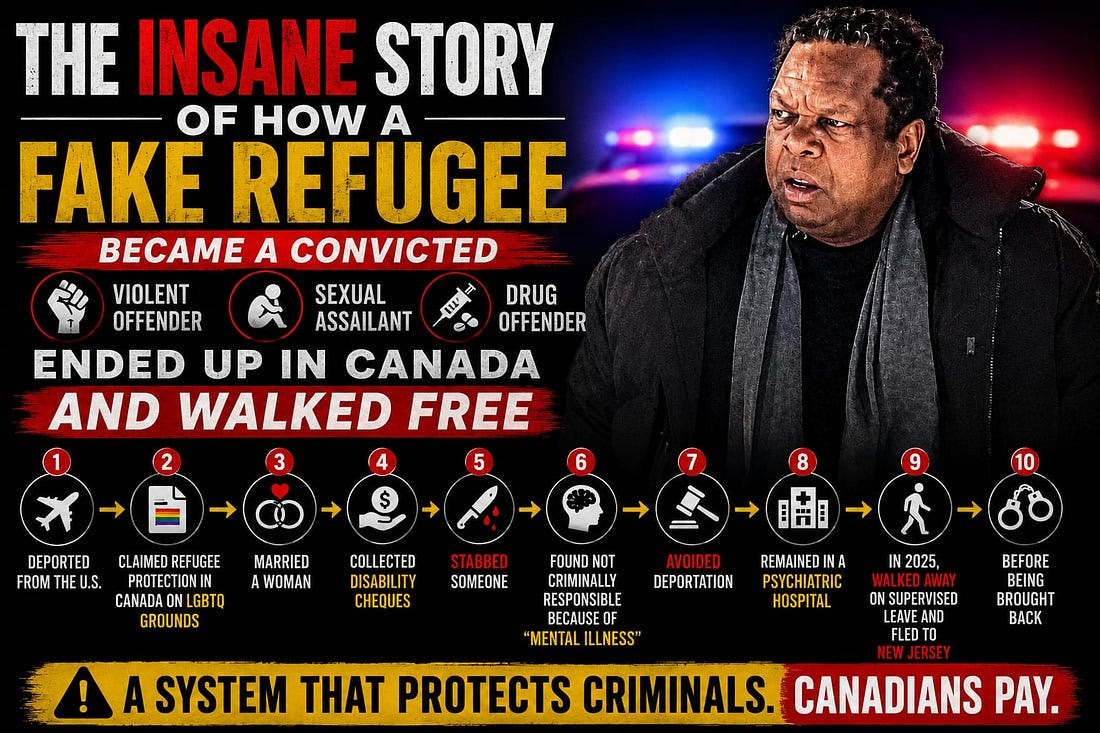
| This “LGBT Refugee” just married a woman, stabbed someone, then avoided deportation Despite being convicted of sexual assault twice, Delroy Apple, 47, is neither behind bars nor removed from the country. ∙ Rather than being deported, a violent Guyanese refugee has managed to play the system, and stay in Canada. Despite being convicted of sexual assault twice, Delroy Apple, 47, is neither behind bars nor removed from the country. Instead, he receives disability benefits funded by taxpayers and is permitted supervised outings into the community.Despite remaining a “significant threat,” the Ontario Review Board (ORB) granted him greater freedom, citing a year without major violent incidents.Apple’s criminal record is extensive and unrelenting.It all began with U.S. drug convictions in 2005 and includes 39 Canadian convictions between 2012 and 2018, including sexual assault, armed robbery, assault with a weapon and assaulting a peace officer, according to the National Post Another episode of violent carnage unfolded on Jul. 17, 2019, when Apple launched an unprovoked attack on a stranger inside a Toronto convenience store, smashing glass bottles and stabbing the victim multiple times before staff subdued him.“Mr. Apple… suddenly attacked the victim, a stranger to him, by shattering two glass bottles from a shelf, wrestling the victim to the floor, and stabbing him multiple (times) with the shattered bottles,” reads the decision by an independent tribunal.“Store staff intervened, and the victim was taken to a trauma centre for treatment of stab wounds sustained in the attack.”Instead of a criminal conviction or deportation, he was found not criminally responsible for the stabbing due to his schizoaffective and bipolar disorder.Instead of being deported, he now lives at the Ontario Shores Centre for Mental Health Sciences in Whitby, Ont., where taxpayers fully fund his treatment.This is unacceptable. But dig a little deeper, and the official narrative starts to unravel. |
Every non-European country claims the right to not only deny all immigration when they want, but to impose harsh punishments on those that violate their immigration laws. For some reason these same countries claim European countries, which includes the states, have no right to have any immigration laws.
Libs Horrified as South African Blacks Brutally Beat, Evict Immigrants Invading Their Country
by Samuel Short, The Western Journal Jul. 9, 2026
Liberal media outlets find themselves in a truly difficult position when looking at immigration in South Africa.
Black South Africans are supposedly victims — they are black and African, after all — but immigrants are victims, too.
Where does that leave us when black South Africans start expressing strong anti-immigrant sentiments against black immigrants?
It’s a quagmire for neo-Marxist ideologues in deciding which victim group to support.
Among the left-wing outlets trying to find their bearings with this news comes The Wall Street Journal, which reported on the situation on June 28.
Africans from countries like Ghana, Mozambique, and Malawi have been subjected to beatings, killings, and calls for them to return home.
South Africans have taken up spears, clubs, and whips to make it known that these people are not welcome.
Ide Juma, a 35-year-old Mozambican, said he was beaten outside the barber shop he worked for.
“I go to the police and they shoot me,” he said. “We have papers. Why do they not treat us like human beings?”
Juma had been legally in the country for a decade when he was targeted by March & March, an anti-immigrant group.
The group calls itself a “grassroots citizen movement,” saying they are “addressing growing concerns about undocumented immigration in South Africa.”
“What began as conversations among communities affected by issues related to illegal immigration, employment competition, and access to public services, evolved into an organized advocacy movement,” its website added.
The Wall Street Journal said they have called for immigration enforcement and economic opportunities for South African natives who are citizens.
Despite South African President Cyril Ramaphosa’s assurances of safety for immigrants, the aforementioned Ghana, Mozambique, and Malawi have sent transportation to the country to repatriate their nationals.
Of the 1,800 Ghanaians and Nigerians who recently went home, more than 75 percent of Ghanaians were on overstayed visas, and 854 Nigerians had entered the country illegally. A majority of the over 1,000 Mozambicans repatriated were illegal.
Malawi is also working to return its 10,000 nationals.
If you’re a leftist, who is in the wrong?
Further, why isn’t this development making headlines across every major media outlet?
The Associated Press reported two Nigerians died on June 28 during protests. A second report from the outlet noted these are the largest anti-immigration protests the country has seen since 2008.
On Tuesday, the BBC reported that Ghana, upset about repatriations, postponed Ramaphosa’s visit to the country, citing “xenophobia.”
Certainly, one can find these stories, but for as big of an issue as illegal immigration has become in the news cycle, it shouldn’t be necessary to go searching.
The left goes ballistic over President Donald Trump deporting illegal immigrants. It would be consistent to denounce black South Africans here.
Is there a lack of concern because of a lack of a racial divide? This is black-on-black violence. The narrative we’re constantly told is that white supremacy is the real threat. Only white America could ever drive out non-white immigrant populations.
How does South Africa fix this problem, and what moral framework are South Africans operating through in addressing the issue?
Beatings, spearings, whippings, and murders by South Africans make Trump supporters look mild in their tactics.
If black lives really mattered to the left, we’d be getting an earful of this story.
This article appeared originally on The Western Journal.
Mohamed Daoud, a 40-year-old St. Catharines resident, has been sentenced to 10 years in custody and designated a long-term offender for human trafficking, sexual assault with a weapon, and criminal harassment. Judge Kendra Coats rejected a request for an indefinite “dangerous offender” designation, deeming the risk manageable with a 10-year custodial term followed by long-term supervision.
Daoud was convicted after a jury found he exploited an intimate partner as an escort between 2018 and 2020, forcing her to meet quotas while supplying her drugs and subjecting her to physical violence and gun-based sexual assault. His prior record includes manslaughter and drug trafficking, and he will remain on the national sex offender registry for life.
Cocoon AI Summary
A Niagara resident has been designated a long-term offender following convictions for human trafficking-related charges.
Mohamed Daoud was found guilty by a jury in February 2024 of several charges relating to those crimes that occurred between 2018 and 2020 in Oakville and elsewhere in Ontario, as well as charges of sexual assault with a weapon and criminal harassment.
Following the trial, the Crown sought a dangerous offender designation. Such a designation would mean the St. Catharines man would be jailed indefinitely.
The dangerous offender hearing was held in March 2026 in the Ontario Court of Justice in Milton.
In her decision, released earlier this month, Judge Kendra Coats rejected the dangerous offender designation, citing insufficient evidence of intractable risk, and imposed a 10-year long-term supervision order alongside a 10-year custodial sentence.
With a long-term supervision order, individuals are supervised in the community by the Parole Board of Canada and Correctional Service Canada upon the completion of a prison sentence.
At trial, the jury was told Daoud, now 40, and his victim were in an intimate relationship for several years.
When the woman lost her job, her partner suggested she work as an escort.
She testified she gave all the money she made to Daoud, who supplied the woman with drugs.
He set a quota of the amount she had to make each night. He made her work when she was ill or menstruating.
The woman also testified Daoud was physically violent toward her and he had sexually assaulted her with a gun.
The offender’s criminal record includes convictions for a number of offences, including sexual assault and drug trafficking, some of which occurred in Niagara.
He was convicted of manslaughter stemming from his role as a lookout in a botched robbery attempt in Toronto in 2020 that resulted in a fatal shooting.
A forensic psychiatrist and forensic psychologist conducted an assessment report and testified at the hearing.
The report dated June 2025 concluded that Daoud presents a risk of violent reoffending. That risk, according to the psychiatrist, could be managed with “lengthy treatment, management and monitoring.”
His name will appear on the national sex offender registry for life. (Niagara Falls Review, July 9, 2026)

Cambridge man charged in scheme that defrauded international students of $126K
Victims were provided with fraudulent enrollment documents but were not enrolled in the post-secondary programs that had been promised
CambridgeToday Staff about 19 hours ago

A Cambridge man is among two facing charges after the Canada Border Services Agency (CBSA) investigated an immigration scheme that defrauded international students of an estimated $126,000.
The investigation began in February 2025 after the CBSA Intelligence and Enforcement Division received a tip from Lambton College.
Investigators interviewed the victims and launched an extensive investigation.
Two individuals are alleged to have taken money from international students by falsely promising the funds would be used to pay their tuition fees. Victims were provided with fraudulent enrollment documents but were not enrolled in the post-secondary programs that had been promised.
CBSA executed two search warrants at the residences and businesses of the accused individuals and collected evidence of the fraudulent scheme from electronic devices. Subsequent warrants were obtained to examine the digital forensic data extracted from those devices.
As a result, both individuals were charged on June 2 with:
- four counts of fraud over $5,000, contrary to section 380(1) of the Criminal Code;
- four counts of uttering forged documents, contrary to section 368(1)(b) of the Criminal Code; and
- four counts of counselling misrepresentation, contrary to section 126 of the Immigration and Refugee Protection Act (IRPA).
Hardik Dave of Cambridge, Ontario, is scheduled to appear in court on July 10, at the Ontario Court of Justice in London, Ontario.
The charges are subject to validation by the court.
Jainishkumar Patel, 35, of London, Ontario, is believed to have fled the country and is wanted on an arrest warrant.
35, of London, Ontario, is believed to have fled the country and is wanted on an arrest warrant.
“The Canada Border Services Agency is protecting vulnerable individuals from fraud and other harms. Those seeking to profit from fraudulent financial schemes are being held to account and brought to justice,” said Minister of Public Safety Gary Anandasangaree in a press release. (Cambridge Today, July 7, 2026)
[Pity poor Canada. We have one of the highest acceptance rates for people who sneak into Canada and claim “refugee” status. Nevertheless, occasionally a particular egregious scammer or liar is denied. In steps our federal court, packed with judicial activists and social justice warriors may of them appointed by Justin Trudeau. Case in point is Ezzat Fahs, “an 81-year-old Lebanese man with dementia who obtained refugee status in Canada “on the basis of threats from terrorist organizations” in his homeland, then lost it for returning to Lebanon five times to visit his sick and dying siblings and to attend their funerals, has won another shot at staying in this country.” That should be it: he returned five times to the land he claimed he fled as a “refugee”? Nonsense. His claim is bogus. Oh, yes, he’s suffering from dementia to boot. What a prize for the Canadian taxpayer. Then, in steps Federal Court Justice Lobat Sadrehashemi. I’ll bet she wasn’t born in Cape Breton (Iran, actually). He decides that faker Fahs may be legit after all and has sent the case back for a review.]

Man who lost refugee status gets new chance
Returned to Lebanon on five occasions
An 81-year-old Lebanese man with dementia who obtained refugee status in Canada “on the basis of threats from terrorist organizations” in his homeland, then lost it for returning to Lebanon five times to visit his sick and dying siblings and to attend their funerals, has won another shot at staying in this country.
Ezzat Fahs, who holds Lebanese citizenship, obtained refugee protection in Canada about 14 years ago, according to a recent Federal Court decision regarding his case.
“Since he obtained permanent resident status in 2017, Mr. Fahs returned to Lebanon on five occasions,” said the June 11 decision out of Ottawa.
Immigration Minister Lena Diab “brought an application for cessation of his Convention Refugee status” to Canada’s Refugee Protection Division (RPD), which allowed it, and found Fahs “voluntarily reavailed himself of the protection of Lebanon,” said the decision.
“Ultimately, the RPD found that the three elements of the cessation test were met: Mr. Fahs acted voluntarily, intended to re-avail himself of Lebanon’s protection and actually obtained such protection,” said the decision.
Fahs started showing “early signs of dementia” in 2012, according to his doctor.
“The RPD found that the medical evidence did not establish that Mr. Fahs was unaware of the consequences of his decision to travel to Lebanon because of his medical condition. The RPD also found that Mr. Fahs took minimal safety precautions that did not demonstrate that he was living in hiding while in Lebanon.”
It acknowledged that Fahs “travelled by car with a family member directly from the airport to his family’s home in the south of Lebanon and that he would cover his face with a scarf,” said the decision.
It concluded “the totality of the evidence before it demonstrates that while (Fahs) may have been making minimal efforts to conceal his identity, they do not amount to him being in hiding.”
That analysis contains “two significant problems,” wrote Federal Court Justice Lobat Sadrehashemi, who ordered the decision to be reviewed.
“First, the RPD required that Mr. Fahs demonstrate that the efforts he took amounted to living in hiding. This is not the requirement,” said the judge.
“Similarly, the RPD erred by requiring (Fahs) to have been ‘in hiding’ during (his) travels.”
The “relevant consideration,” Sadrehashemi said, is whether he took any precautionary measures while in Lebanon.
The RPD failed, “to consider the impact of the totality of the evidence about the precautionary measures taken by Mr. Fahs and instead focused on the binary question of whether these actions amounted to living in hiding,” said the judge. “This is a sufficient basis on which to set aside the decision.” (National Post, June 18, 2026)
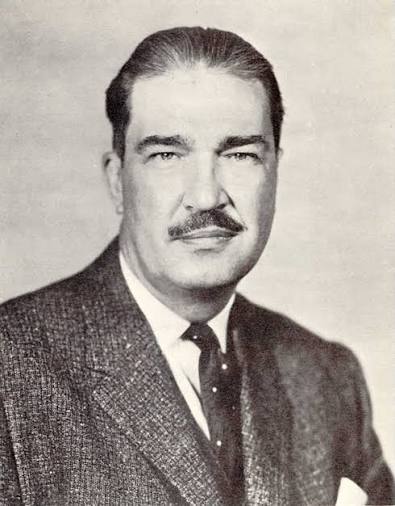
In Memoriam Dr. Revilo Pendleton Oliver (1908 – 1994)
I hope you will all join me tomorrow in raising a glass to celebrate the birth of a legend for our people and personal friend to some of you.
Revilo Pendleton Oliver was born on July 7, 1908 and we are all better off for his presence on this earth.
I have included a few phrases and quotes from the learned professor. — Kevin
Quotations
“Our enemies and therefore their lackeys are utterly ruthless, and to imagine that they are capable of compunction, mercy, or honor towards us is to have hallucinations much worse than seeing pink elephants on the wall.”
“Have our own minds become so befuddled by the hypocritical jabbering of unhuman invaders and the babbling of our own fools that we have lost the instinct of self-preservation?”
“The do-gooder is another species. He claims to want to do good with other people’s money and often at the expense of other people’s lives.”
“But I have said enough, surely, to show you what is really the greatest single obstacle that we face: the perverted collective masochism that has been incited in so many of our people.”
From: “To See The Invisible” article about the Council on Foreign Relations in the October 1962 edition of American Opinion magazine:
“All history raises the question of which type of malefactor is worse for society- the robber baron or the reformist.”
“The human capacity for self-delusion is virtually infinite. You cannot turn a page of history without coming upon another proof that mediocre minds under the stimulus of vanity or ambition so lose touch with reality that they can believe almost anything possible.”
“One could fill pages with just the names of well-meaning dolts who wrought enough ruin to others- and often to themselves- to be remembered by posterity.”
Phrases: My comments in parenthesis.
Ad infinitum, nauseam (how liberals love to praise our enemies, be they Martin Luther King or John Brown)
Baleful figure in our history (describing Woodrow Wilson)
Blarney that intoxicates do-gooders
Bloated and sneering visage of the great war criminal (in reference to Franklin Roosevelt’s image being placed on an American stamp)
Crime-breeding centers (our public schools)
Degenerates, traitors, and alien subversives (those whom Franklin Roosevelt surrounded himself)
Dregs, the shiftless, the irresponsible, the stupid, the degenerate (those elements of society that liberals promote and foster)
Grotesque and debasing superstitions (what school children are taught in public schools)
Idiocy, fecundity of the unfit, the criminal, and the imbecile elements of society (Again, what we are encouraging and breeding in America)
Ignominious and insane retreat (in reference to Whites giving up the world that was theirs at the beginning of the 20 Century)
Implanted humanitarian hallucinations (what Whites need to overcome in ourselves)
Jewish livestock or cattle to be herded (into Europe to fight wars for them)
Manager employed on the conspiracy’s estate (referring to Kruschev’s rule in Russia)
Most precious and irreplaceable gift of any race (how important our genetic heritage is to us)
No race can afford much do-gooding on that scale (decrying the fraternal slaughter of the American Civil War)
Preposterous drivel and nonsense (what many imported savages into Western nations think of our societal norms and morality)
Race of imbeciles (asking if we have become this due to our retreat and subservience to do-gooders)
Sheep-shearing sheds (our colleges)
Sniveling sentimentalists (liberals, abolitionists and such)
That distinguished horse thief and homicidal maniac John Brown
Treason trap called the United Nations
Vaporized at dawn tomorrow (describing the “beatific” possibility of Communists, Illuminati, or Jews being eliminated from the earth)
Viscid slobber of humanitarian drivel (liberal thinking)
We may not be very bright, but we sure got hearts of gold (after describing how a journalist who was able to collect money for Cinderella from New Yorkers)
With hordes of vermin, fleeing the wrath of an aroused and angry nation (those he expected to be fleeing from Americans after they realized we had been duped into WWII)