Blog Archives
Telling CBC HQ to get fucked to their faces at their workplace while they stared fearfully, scurrying around in the windows was a high point of my year.
Immense thanks and respect to the club, their supporters and families.
I’ve carried this weight around for a long time and it was very satisfying and righteous to be able to physically point to those who are truly responsible for so much death of our people.
You wanted our “comments”, CBC. Soon the entire country will have them.
They hate you.
They hate me.
Fuck the anti-white CBC.
Jeremy MacKenzie

Our Noble Stewards of Planet Earth (PART 1 ) ( 1st in a Series )
Part of the mythology re: the Indigenous is that they are in sync with Nature and that they are stewards and protectors of Mother Earth. Perhaps to some degree ,..at least in the Past.
What is rarely noted is that since the “Settlers” came..the Indigenous numbers grew substantially as Settlers provided modern amenities, much like the Black population exploded in South Africa under the Boers. We should all refute, debate and expose false gods. My Terms of Reference is we are ALL, at least in theory, ” EQUAL “.
However we have every right to both defend ourselves from demeaning and insulting words ,outright lies and also expose hypocrisy and those continually taking advantage of our benevolence and generosity . However, if we don’t ,then this further emboldens and encourages abuse, exploitation and rising INequality and we ALL will suffer.
Article and ” COMMENTS “ below:
Dump Site on Cowichan Tribes Reserve

In August 2023, it was reported that there was dumping of large amounts of material on land within the Cowichan Tribes reserve on Tzouhalem Road. The unauthorized dump site is causing environmental concerns due to the presence of construction and demolition debris, soil, and other materials. Asbestos was detected. A recent report estimated the volume of waste exceeded 290,000 cubic meters and highlighted issues with leachate impacting the Cowichan River.
Waste at the dump site includes construction debris, imported soil, wood, and household garbage. It releases harmful substances like heavy metals (arsenic, lead, zinc), hydrocarbons, and volatile organic compounds. The MOE order relates to 3 lots 5544 Indian Road above the Cowichan River.
James Anthony Peter, 59, has been fingered for the illegal dumping and for the expensive task of cleaning it up. Peter is required to hire a professional to develop a site pollution prevention and remediation plan. He appeared on a list of Councillor Candidates in 2022.
![]() | The three destroyed lots fall on Cowichan Tribes land. |

Fisheries and Oceans Canada has conducted a “formal investigation” into the dumping on the Cowichan Tribes reserve on Tzouhalem Road.
——————————————–
COMMENT:
I will expose more of these “abuses” in upcoming PARTS . In this case, it appears some “rogue” Cowichan Band Member has been “fingered” as THE cause and in control aka “to blame “. Really ?
QUOTE:
“……In August 2023, it was reported that there was dumping of large amounts of material on land within the Cowichan Tribes reserve on Tzouhalem Road. The unauthorized dump site is causing environmental concerns due to the presence of construction and demolition debris, soil, and other materials. Asbestos was detected. A recent report estimated the volume of waste exceeded 290,000 cubic meters and highlighted issues with leachate impacting the Cowichan River…….”
HOW MANY TRUCK LOADS = 290,000 cubic meters ?
FROM AI
The number of truckloads for 290,000 cubic meters depends entirely on the capacity of the dump truck used. Dump trucks have widely varying capacities, typically ranging from 6 to 30 cubic meters for full-size commercial trucks, or up to 80 cubic meters for larger specialized trucks with trailers.
Here are the estimated number of truckloads based on common dump truck sizes:
| Dump Truck Type |
|---|
| Approximate Capacity (cubic meters) | Estimated Number of Truckloads | |
|---|---|---|
| Small dump truck | 3 m³ | ~96,667 loads |
| Tandem dump truck | 8 m³ | ~36,250 loads |
| Full-size/Large dump truck | 15 m³ (average within 6-25m³ range) | ~19,333 loads |
CONT’ D
Let’s average this out and estimate it’s around 40,000 loads.
AI Overview re: Truck sizes.
+1
An average standard dump truck is about 8.5 feet wide, 20–26 feet long, and 10–12 feet tall. They can typically haul 10 to 25 cubic yards of material, with payload capacities ranging from 10 to 25 tons depending on the model.
40,000 Dump Trucks lined up end -to -end = approx . 175 MILES.
Finger Pointing one individual is laughable.This Reserve is pretty much surrounded by Non Indigenous lands. This attack on Nature seems to be packaged
as a figurative quick event that happened overnite.
” We just found out “. It’s beyond reasonable that the Band was aware as were neighbouring properties given all the truck traffic, noise, leaching, smells etc.
CUI BONO
AI Overview
Dump fees in the Cowichan Valley, charged by the Cowichan Valley Regional District (CVRD), have specific rates for different materials effective as of January 1, 2025
. For example, the fee for garbage is $204.00 per tonne, and the minimum fee for a small amount of garbage remains at $7.00. Mattresses are $16.00 each, while organics/food waste costs $140.00 per tonne.
…….It is further reasonable to assume each “average” Dump Truck load dumping fees would be in excess of $1,000. This would then
calculate to 40,000 truckloads @ $1,000/truckload = $40 MILLION (WOW.)
The obvious reality is Indigenous Bands have control over their lands to a degree that far exceeds NON Indigenous landowners..
even though Band Lands are effectively kept IN TRUST by the Crown(Gov’t). So..why doesn’t Gov’t intervene re:this abuse and pollution ?
This cowardly approach to allow and not challenge and stop the start of this dumping is very disturbing. WHO knows WHAT is in this unauthorized and illegal
dump. The list posted already shows some very bad and toxic compounds. Are BODY’s part of the dump contents ? Who knows?
The fallout out will be leaching
and off -gassing for decades and there are few if any means to address this . Surrounding properties and waterways will be impacted as well as the pollution
crosses property lines. Rather than set an example of good stewardship,it appears their legacy is to exploit Planet Earth as they see fit.
$$$ trump good stewardship ?
They have also shite in their own beds as the Dumps pollutants will. also leach onto the Band’s own lands and ultimately end up in the Ocean as well.
CUI BONO/SUMMARY: A combination of things.
It is fair to say the Cowichan Dumping Fees would be less than approved Dump Sites. We can be sure complaints
were filed soon after dumping commenced. However, the various Authorities, as usual, are too timid to treat the Indigenous Bands as “Equals” but
instead as “Superior UNtouchables”, no more obvious than with ad nauseam Land Acknowledgements. In all likelihood the Taxpayer-” Settlers ” will pay for the
clean up ( if its possible ) of Indigenous- led pollution, greed and being a bad neighour. It appears that greed took over, as you likely made $MILLIONs off dumping fees and turned a blind eye
as to what was actually dumped..the evidence is all there in the article (above).
Message to Cowichan. Clean up your own back yard first before attacking and insulting others. and imposing UNnecessary and avoidable costs onto Taxpayers solely due to to your actions.
If you want equality and respect.?….. then YOU EARN IT like the rest of US !!!
STAY TUNED……To Be Continued.
Roland
| White Guilt, Made Up Native “History”, Out-of-Control Courts: Could this be the end of private land ownership in Canada? |
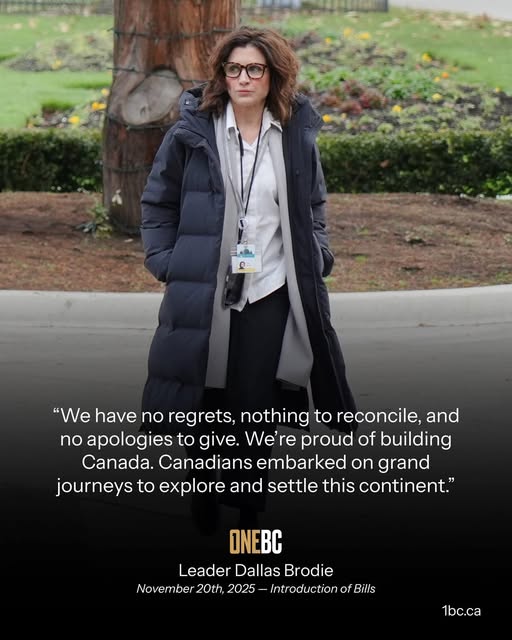
All eyes are on Richmond, B.C., a Vancouver suburb now at the centre of a growing storm over private land rights in Canada. A recent Supreme Court ruling granted Aboriginal title to the Cowichan Tribes on privately owned land. Days later, homeowners opened their mail to discover something shocking — they might not fully own their homes after all! Amid a nationwide push for “reconciliation,” many Canadians are now asking the same question: Are our homes truly safe? This decision has reignited the debate over land acknowledgements —the scripted rituals repeated in schools, workplaces, and government meetings. If these acknowledgements declare that Canada sits on “stolen land,” are they quietly laying the groundwork for more claims like the one in Richmond? That’s why OneBC Leader Dallas Brodie introduced the Land Acknowledgement Prohibition Act last week. It’s a bill she calls a stand against “the anthem of a suicidal nation.” I sat down with Brodie and her Chief of Staff Tim Theilmann, a former Aboriginal law attorney, to talk about why this bill mattered. I also spoke with B.C. Conservative MLA David Williams to discuss why most of his party joined the NDP in killing this bill. Click here to watch my report. Land acknowledgements have gone from symbolic to absurd ritualistic mantras that humiliate ordinary Canadians and deny our country’s sovereignty. Unfortunately, Brodie’s bill never got a fair hearing, thanks to the NDP, and shockingly, most of the B.C. Conservatives. (If the so-called Conservatives won’t defend land rights, what exactly are they conserving?) This situation is directly connected to B.C.’s adoption of the United Nations Declaration on the Rights of Indigenous Peoples (UNDRIP) — now law in the province. Brodie’s bill was an opportunity to push back against compelled speech and to stand up for B.C.’s sovereignty. Instead, the political class chose cowardice and wouldn’t even allow the bill to pass first reading. If you want to help fight back against this UN-fuelled overreach and support our independent reporting that defends Canada’s sovereignty, visit StopUNDRIP.com. Yours truly, Drea Humphrey P.S. B.C.’s UN-inspired Declaration on the Rights of Indigenous Peoples Act creates a two-tiered society where an elite group’s influence and legal authority take precedence over the interests of the vast majority of Canadians. That’s not reconciliation. It’s discrimination. Help us stop it by visiting StopUNDRIP.com and sending a one-click email to B.C. Premier David Eby demanding this dangerous law be repealed. |
| Forwarded this email? Subscribe here for more Sovereignty at Stake: Why Parliament Must Review Treaties Before They’re Signed Oct 23 READ IN APP Dear Family, As you know, for years I have been closely following the activities of the World Health Organization and Canada’s involvement with the Global Pandemic Treaty. Thanks for reading! Subscribe for free to receive new posts and support my work.Subscribed This treaty, once ratified, will directly influence the public health decisions and responses of all signatory countries. I have raised red flags about its implications on Canada’s health sovereignty and the federal government’s willingness to enter a legally binding treaty of this weight without any input from Parliament. In May 2025, after many rounds of negotiations, the World Health Assembly adopted the main text of the treaty. However, it has not yet been signed or ratified – meaning Canada has not yet agreed to be legally bound by the treaty. We are now in a critical window of opportunity to ask tough questions and debate the treaty before it is signed by the Minister of Foreign Affairs and binds our nation. What You Can Do We need your help to get this treaty before Parliament so that your elected Member of Parliament can ask questions and hold the government accountable on Canada’s behalf. Here’s what you can do: Sign this petition that calls on the Prime Minister to allow Parliament the opportunity to review and debate the pandemic treaty before it is signed and ratified. Write to your Member of Parliament to ask that they publicly support that same call for parliamentary review. Share this post and the petition to drum up the momentum and pressure in Ottawa. Why This Matters During the COVID-19 pandemic, we witnessed the WHO’s failures at a global level;. and, nationally, under the expansive claim of the “health and safety of Canadians,” basic civil liberties were suspended broadly and at length. Canadians are rightly concerned that a legally binding agreement could cede too much authority to an unelected and unreliable international organization the next time a pandemic is declared. Meanwhile, five years after COVID-19, the government has yet to show it is serious about improving its pandemic response, with no public inquiry into its actions and decisions during the crisis. The Background Story of the Global Pandemic Treaty In December 2021, while the world was still in the grip of the COVID-19 pandemic, the WHO proposed a Pandemic Treaty, known as the Pandemic Prevention, Preparedness and Response Agreement. This would be a legally binding framework that, would seek to prevent and manage future pandemics. Once in force, the treaty would “guide” each country’s response through recommendations to adopt specific measures, such as those related to vaccines, surveillance, data sharing, and travel. In parallel, the WHO moved to amend the International Health Regulations (IHRs) – the existing legal framework that governs its authority. Over 300 amendments were proposed and later adopted, including a new category called “pandemic emergency” – giving the WHO broader authority to trigger a global response. Both the treaty and the IHR amendments sparked scrutiny worldwide over the expanded legal powers they could grant the WHO. Many expressed great concern about the level of powers that the WHO would have over national and provincial decision-making during a global public health emergency – concerns that continue with the final treaty text. Here at home, I launched petitions to call attention to the treaty and its implications – particularly the fact that Parliament had neither debated nor voted on Canada’s participation in a legally binding treaty. I repeatedly urged the government to reject certain amendments or opt out entirely. I wrote to the Minister of Health multiple times to demand answers and transparency. On May 20, 2025, after three years of negotiations, the World Health Assembly adopted the treaty by consensus. (Notably, the United States did not participate in the negotiations and is not bound by the treaty.) One key component of the WHO Pandemic Treaty — an annex on sharing pathogens and vaccines — is still being negotiated. Once that section is finished, countries, including Canada, can sign and ratify the agreement. Canada is currently reviewing domestic laws to make sure they align with the newly adopted IHRs, and plans to table the amended regulations in Parliament this year. The Pandemic Treaty, which is distinct yet negotiated in parallel, will likely be tabled in Parliament only after the annex is complete. Together, the two pieces will form the core of the WHO’s new pandemic response framework. How You Helped Shape the Final WHO Pandemic Agreement Early drafts of the WHO Pandemic Agreement included broad provisions on global surveillance, misinformation control, and travel or vaccine measures that raised serious concerns about transparency and national sovereignty. It was the pushback from concerned and informed citizens like you that forced these changes. Your sustained engagement led negotiators to scale back or remove the most contentious sections. By the time the final text was adopted in May 2025: References to “misinformation” and “infodemic management” were removed entirely, ensuring the WHO has no authority over domestic speech or information controls. Clauses that could have enabled travel bans, vaccine mandates, or lockdown coordination were replaced with explicit guarantees of national sovereignty. Provisions on surveillance and data sharing were narrowed to voluntary cooperation, with safeguards for privacy and domestic law. This outcome is a direct result of public vigilance and civil-society advocacy, proving that when citizens engage, international negotiations become more accountable, transparent, and respectful of national democracy. We Must Insist on Parliamentary Oversight Many people are unaware that Parliament is not required to debate or approve international treaties before ratification. MPs may request debate, but it is not guaranteed. Canada’s treaty ratification process is governed by policy, rather than law, and remains fully controlled by government (through Cabinet), which can waive or bypass when necessary. In Canada today, the government — not Parliament — has the final say on signing and ratifying international treaties. The Minister of Foreign Affairs is supposed to table new treaties in the House of Commons for 21 sitting days so MPs can see them, but this review is only a formality. Parliament can debate the issue or pass laws to make the treaty work inside Canada, but it never votes to approve or reject the treaty itself. If the government wants to move quickly, it can even skip the 21-day waiting period. In fact, Canada’s Parliament has never fully reviewed or voted on a treaty before it was ratified — not once in our history. Every other G7 country has a legal process that gives their parliaments that power. Canada is the only one that doesn’t, and as such major international agreements can be signed without real parliamentary oversight or accountability. A Proposed Law to Review Treaties Before Ratification There is a private member’s bill before Parliament — Bill C-228 — that aims to make Canada’s treaty process more transparent and accountable. It’s written in the right spirit, recognizing that major international agreements should be reviewed by Parliament before Canada is bound by them. However, the bill is technically weak and poorly structured, which could make it hard to review the number of international documents that Canada signs each year. Still, it raises an important principle: Canadians deserve strong oversight when their government makes binding commitments abroad. International cooperation is important, but only Canada’s Parliament should set our national direction. Safeguarding sovereignty and democracy means ensuring the people’s representatives—not the government in power alone—have a voice in every major decision. Before Canada Signs, Canadians Must Be Heard Thanks to the engagement of countless Canadians and concerned citizens around the world, the most extreme provisions in the WHO Pandemic Treaty were removed ——these measures would have undermined national healthcare sovereignty and given international bureaucrats sweeping powers. The removal of provisions on vaccine mandates, misinformation and disinformation, censorship requirements, travel restrictions, global surveillance, and mandatory health measures happened because people paid attention and spoke up! But Canadians should not have to fight this hard every time. We need a permanent, transparent process in our own Parliament to review and debate major treaties before Canada commits to them. A national treaty review law would act as a democratic safeguard, ensuring that future agreements are examined openly, that overreach is checked, and that the voices of Canadians are always heard before any government binds the country to new international obligations. Until that safeguard is in place, let’s continue to raise our voices. Before Canada ratifies the Pandemic Treaty, sign the petition, write to your MP, and share this call to make sure Parliament, and Canadians, have a say about which international treaties will bind our nation. In Your Service, Leslyn Lewis Member of Parliament for Haldimand—Norfolk |
| Dear Family, As you know, for years I have been closely following the activities of the World Health Organization and Canada’s involvement with the Global Pandemic Treaty. Thanks for reading! Subscribe for free to receive new posts and support my work.Subscribed This treaty, once ratified, will directly influence the public health decisions and responses of all signatory countries. I have raised red flags about its implications on Canada’s health sovereignty and the federal government’s willingness to enter a legally binding treaty of this weight without any input from Parliament. In May 2025, after many rounds of negotiations, the World Health Assembly adopted the main text of the treaty. However, it has not yet been signed or ratified – meaning Canada has not yet agreed to be legally bound by the treaty. We are now in a critical window of opportunity to ask tough questions and debate the treaty before it is signed by the Minister of Foreign Affairs and binds our nation. What You Can Do We need your help to get this treaty before Parliament so that your elected Member of Parliament can ask questions and hold the government accountable on Canada’s behalf. Here’s what you can do: Sign this petition that calls on the Prime Minister to allow Parliament the opportunity to review and debate the pandemic treaty before it is signed and ratified. Write to your Member of Parliament to ask that they publicly support that same call for parliamentary review. Share this post and the petition to drum up the momentum and pressure in Ottawa. Why This Matters During the COVID-19 pandemic, we witnessed the WHO’s failures at a global level;. and, nationally, under the expansive claim of the “health and safety of Canadians,” basic civil liberties were suspended broadly and at length. Canadians are rightly concerned that a legally binding agreement could cede too much authority to an unelected and unreliable international organization the next time a pandemic is declared. Meanwhile, five years after COVID-19, the government has yet to show it is serious about improving its pandemic response, with no public inquiry into its actions and decisions during the crisis. The Background Story of the Global Pandemic Treaty In December 2021, while the world was still in the grip of the COVID-19 pandemic, the WHO proposed a Pandemic Treaty, known as the Pandemic Prevention, Preparedness and Response Agreement. This would be a legally binding framework that, would seek to prevent and manage future pandemics. Once in force, the treaty would “guide” each country’s response through recommendations to adopt specific measures, such as those related to vaccines, surveillance, data sharing, and travel. In parallel, the WHO moved to amend the International Health Regulations (IHRs) – the existing legal framework that governs its authority. Over 300 amendments were proposed and later adopted, including a new category called “pandemic emergency” – giving the WHO broader authority to trigger a global response. Both the treaty and the IHR amendments sparked scrutiny worldwide over the expanded legal powers they could grant the WHO. Many expressed great concern about the level of powers that the WHO would have over national and provincial decision-making during a global public health emergency – concerns that continue with the final treaty text. Here at home, I launched petitions to call attention to the treaty and its implications – particularly the fact that Parliament had neither debated nor voted on Canada’s participation in a legally binding treaty. I repeatedly urged the government to reject certain amendments or opt out entirely. I wrote to the Minister of Health multiple times to demand answers and transparency. On May 20, 2025, after three years of negotiations, the World Health Assembly adopted the treaty by consensus. (Notably, the United States did not participate in the negotiations and is not bound by the treaty.) One key component of the WHO Pandemic Treaty — an annex on sharing pathogens and vaccines — is still being negotiated. Once that section is finished, countries, including Canada, can sign and ratify the agreement. Canada is currently reviewing domestic laws to make sure they align with the newly adopted IHRs, and plans to table the amended regulations in Parliament this year. The Pandemic Treaty, which is distinct yet negotiated in parallel, will likely be tabled in Parliament only after the annex is complete. Together, the two pieces will form the core of the WHO’s new pandemic response framework. How You Helped Shape the Final WHO Pandemic Agreement Early drafts of the WHO Pandemic Agreement included broad provisions on global surveillance, misinformation control, and travel or vaccine measures that raised serious concerns about transparency and national sovereignty. It was the pushback from concerned and informed citizens like you that forced these changes. Your sustained engagement led negotiators to scale back or remove the most contentious sections. By the time the final text was adopted in May 2025: References to “misinformation” and “infodemic management” were removed entirely, ensuring the WHO has no authority over domestic speech or information controls. Clauses that could have enabled travel bans, vaccine mandates, or lockdown coordination were replaced with explicit guarantees of national sovereignty. Provisions on surveillance and data sharing were narrowed to voluntary cooperation, with safeguards for privacy and domestic law. This outcome is a direct result of public vigilance and civil-society advocacy, proving that when citizens engage, international negotiations become more accountable, transparent, and respectful of national democracy. We Must Insist on Parliamentary Oversight Many people are unaware that Parliament is not required to debate or approve international treaties before ratification. MPs may request debate, but it is not guaranteed. Canada’s treaty ratification process is governed by policy, rather than law, and remains fully controlled by government (through Cabinet), which can waive or bypass when necessary. In Canada today, the government — not Parliament — has the final say on signing and ratifying international treaties. The Minister of Foreign Affairs is supposed to table new treaties in the House of Commons for 21 sitting days so MPs can see them, but this review is only a formality. Parliament can debate the issue or pass laws to make the treaty work inside Canada, but it never votes to approve or reject the treaty itself. If the government wants to move quickly, it can even skip the 21-day waiting period. In fact, Canada’s Parliament has never fully reviewed or voted on a treaty before it was ratified — not once in our history. Every other G7 country has a legal process that gives their parliaments that power. Canada is the only one that doesn’t, and as such major international agreements can be signed without real parliamentary oversight or accountability. A Proposed Law to Review Treaties Before Ratification There is a private member’s bill before Parliament — Bill C-228 — that aims to make Canada’s treaty process more transparent and accountable. It’s written in the right spirit, recognizing that major international agreements should be reviewed by Parliament before Canada is bound by them. However, the bill is technically weak and poorly structured, which could make it hard to review the number of international documents that Canada signs each year. Still, it raises an important principle: Canadians deserve strong oversight when their government makes binding commitments abroad. International cooperation is important, but only Canada’s Parliament should set our national direction. Safeguarding sovereignty and democracy means ensuring the people’s representatives—not the government in power alone—have a voice in every major decision. Before Canada Signs, Canadians Must Be Heard Thanks to the engagement of countless Canadians and concerned citizens around the world, the most extreme provisions in the WHO Pandemic Treaty were removed ——these measures would have undermined national healthcare sovereignty and given international bureaucrats sweeping powers. The removal of provisions on vaccine mandates, misinformation and disinformation, censorship requirements, travel restrictions, global surveillance, and mandatory health measures happened because people paid attention and spoke up! But Canadians should not have to fight this hard every time. We need a permanent, transparent process in our own Parliament to review and debate major treaties before Canada commits to them. A national treaty review law would act as a democratic safeguard, ensuring that future agreements are examined openly, that overreach is checked, and that the voices of Canadians are always heard before any government binds the country to new international obligations. Until that safeguard is in place, let’s continue to raise our voices. Before Canada ratifies the Pandemic Treaty, sign the petition, write to your MP, and share this call to make sure Parliament, and Canadians, have a say about which international treaties will bind our nation. In Your Service, Leslyn Lewis Member of Parliament for Haldimand—Norfolk |