VANCOUVER — The Bureau has learned from a source with direct knowledge that Richmond’s mayor and city councillors were asked to attend an extraordinary closed-door briefing delivered by senior regional officials of the Canadian Security Intelligence Service.
According to the source, the briefing, in July, addressed threats facing municipal election candidates ahead of British Columbia’s October 17 general local elections, including significant vulnerabilities within the Chinese Canadian voting diaspora. The source said the material presented was not classified and included case knowledge previously canvassed in the Hogue Commission of Inquiry into foreign election interference. The substance of the warning, according to the source, concerned the prospect that individuals with ties to the People’s Republic of China may approach Richmond candidates in ways that could undermine election integrity.
The Bureau has agreed not to identify the source because of the sensitivity of the matter.
Several prominent British Columbia municipal leaders — former Vancouver mayor Kennedy Stewart and Port Coquitlam Mayor Brad West — have disclosed to The Bureau that the Service warned them of Chinese interference threats touching their own elections in recent years.
West was re-elected in 2022. Stewart lost the Vancouver mayoralty that same fall. As The Bureau has reported, based on leaked CSIS intelligence, Canada’s spy service concluded that Vancouver’s then Chinese consul general and a network of Chinese community leaders pushed Chinese Canadian voters to support a specific Chinese Canadian candidate in 2022.
When the Globe and Mail, working from the same intelligence The Bureau holds, reported that Chinese networks had supported the campaign of Ken Sim, the incoming Vancouver mayor, Sim rebuked the reporting indignantly, saying the insinuation would not have been made “if I was a Caucasian.”
British Columbia Premier David Eby said the Vancouver election was won “fair and square,” and has separately and categorically denied to The Bureau any suggestion that he met with or invited support from the Chinese consulate during his own 2022 party leadership campaign, calling the allegations completely false.
The Richmond briefing appears to be exceptional in British Columbia local government, with an entire mayor and council warned by the Service behind closed doors of the heightened Chinese interference threat landscape facing candidates. That senior officials would convene a council in closed session, three months before a general local election, and walk elected officials through case material at an unclassified level, indicates a judgment inside the Service that the risk to the coming municipal contest was concrete enough to warrant it.
Asked whether such a briefing took place, and on what authority the Service briefs municipal officials, CSIS declined to confirm the meeting but confirmed the power to hold one.
Recent amendments to the CSIS Act, spokesperson Magali Hébert said, have enhanced the Service’s ability to share information about threats to Canada’s national security with a wider range of entities beyond the Government of Canada. Those authorities, she said, enable CSIS to share information more frequently and with a broader range of sectors and partners to help strengthen Canada’s national security resilience. Increased sharing, she added, helps elected officials, other orders of government, industry, academia, and communities better understand and recognize threats, allowing them to protect themselves, their particular interests, and Canada more generally.
On the specifics, Hébert said CSIS does not publicly disclose details related to its engagement activities or its investigations, and does not confirm or deny whether an investigation is ongoing, in order to protect sources, tradecraft, and methods.
What the Service would not describe, the public record already reveals, in a series of cases matching the Hogue Commission precedents The Bureau‘s source said were canvassed at the Richmond briefing.
In August 2024, the Office of the Commissioner of Canada Elections concluded a 112-page investigation finding that foreign influence had been exercised in the Chinese Canadian community in Greater Vancouver during the 2021 federal election, in a campaign directed against Kenny Chiu, then the Conservative member of Parliament for Steveston–Richmond East.
Chiu was targeted, investigators found, for his support of Uyghur human rights and Hong Kong’s pro-democracy movement, and for his attempt to legislate a foreign agent registry. Chinese consular officials in Vancouver, local community associations, and Chinese-language media outlets combined to cast him as a threat to the very community he represented. Witnesses told investigators that community association leaders had served as messengers for consular officials. One recounted a community figure boasting at a post-election banquet that they had succeeded in defeating him.
No one was charged. Investigators could not trace the funding behind the campaign, identified no direct victims of intimidation willing to testify, and concluded the burden of proof under Canadian law could not be met. The investigation had opened only in December 2022, and only because journalists reported the allegations first.
An intelligence assessment dated October 31, 2022, reviewed by The Bureau, states that Chinese consular officials work through trusted interlocutors — proxy agents and co-opted community organizations — to channel monetary donations and other assistance to preferred candidates in elections, with the intent of fostering a bond of obligation. Should a candidate later pursue a course of action contrary to that of the foreign state, the assessment says, community support would likely be withdrawn and the candidate could potentially lose their next election.
The same document records that a Chinese consulate clandestinely supported a mayoral candidate in a British Columbia city by mobilizing the leadership of three co-opted Chinese Canadian community groups to provide material and financial support, and that the same consulate had used the same three groups to channel support to the same candidate in the previous municipal election four years earlier.
There is no suggestion in the assessment that the candidate knowingly accepted the support.
The document states plainly that interference actors and activities can span various levels of government, and that Beijing seeks to manipulate and influence key media entities during election periods. A 2019 record from the National Security and Intelligence Committee of Parliamentarians states that Vancouver’s consul general boasted of controlling more than 100 community groups. These documents contain intelligence, which does not carry the weight of evidence, and none of the cases has been proven in an election interference investigation.
British Columbia, unlike Alberta, Ontario, and New Brunswick, maintains no provincial intelligence office to advise elected officials on foreign interference threats. Stewart told The Bureau that CSIS warned him in late May 2022 that China would likely interfere in that fall’s municipal election, and that neither the city nor Elections BC had meaningful tools to establish where campaign money originated. Stewart won Vancouver’s 2018 election by 957 votes.
Turnout in Richmond’s 2022 municipal election was 24.5 percent. It is a margin structure in which a small mobilized bloc decides outcomes, and it is the reason officials describe local races as the softest ground in the Canadian system.
Richmond’s council has meanwhile become preoccupied with its own election information environment. On July 27, three weeks after the briefing described by The Bureau‘s source, councillors passed a motion demanding an apology over a Chinese-language social media graphic that set the city’s Chinese and South Asian populations against one another by share of the electorate, and referred the matter to the British Columbia Human Rights Tribunal.
From the outside, Canada still looks like a functioning democracy. Elections are held on schedule, Parliament convenes, and parties campaign against one another. The trouble is that almost none of it functions as advertised.
Today, Canada’s “democracy” operates as a procedural husk — a system that retains every formal structure of democratic governance being repurposed to serve the political class rather than the public it claims to represent.
Over the past five years, the governing party has called elections to bury active investigations into national security breaches and financial corruption. Parliament sat for just sixteen percent of the available days while MPs collected full salaries and per diems for the other eighty-four.
More than 121,000 ballots went uncounted in a single federal election. A riding was decided by one vote after an Elections Canada employee printed the wrong postal code on dozens of ballot envelopes — and the Supreme Court had to annul the result. A 298-vote Conservative lead in another riding disappeared overnight and surfaced as a 29-vote Liberal win, chalked up to “data entry errors.”
A foreign power interfered in two consecutive federal elections, funded at least eleven candidates, and faced no meaningful consequence. A sitting Liberal MP publicly encouraged people to collect a bounty placed by the Chinese Communist Party on a Conservative candidate. The current Prime Minister was initially installed by 131,674 Liberal Party members — roughly one-third of one percent of the Canadian population — and governs with a cabinet largely comprised of people who served the man that resigned in disgrace before him. And in the months since, five Members of Parliament elected under one banner have crossed the floor to hand that Prime Minister an impending majority no Canadian voter ever granted.
Not one of these events has triggered a constitutional crisis. The Governor General has not intervened, the courts have addressed only the most egregious case, and the media has covered each as an isolated story — a bad recount here, a questionable floor crossing there, a foreign interference inquiry that found “troubling” events but assured Canadians the overall outcome was not affected.
That is how a democracy dies. Through a slow and methodical dissolution of integrity, where each violation is absorbed, normalized, and filed away as an exception rather than recognized as part of a pattern.
This piece documents the pattern. Over the following sections, we trace a five-year arc of democratic erosion in Canada, from the Winnipeg Lab cover-up in 2021 through the manufactured majority likely to take hold next week. Every claim is sourced and every event is a matter of public record. Taken in isolation, any one of them could be dismissed as an anomaly. Taken together, they form a case that the country’s democratic institutions have not merely failed. They have been repurposed. While the husk may still remain, the substance is gone.
We’re up against a billion dollar propaganda machine. Please consider subscribing to support independent media.
Elections as Escape Routes
There is a question Canadians ought to ask every time a federal election is called: what was Parliament about to find out?
In the summer of 2021, the House of Commons was closing in on one of the most serious national security breaches in Canadian history. Dr. Xiangguo Qiu and her husband Keding Cheng — both scientists at the National Microbiology Laboratory in Winnipeg, Canada’s only Biosafety Level 4 facility — had been fired in January of that year after CSIS determined that Qiu had “intentionally” worked to benefit the People’s Republic of China. The scope of what she had done was staggering. Qiu transferred live Ebola and Henipah viruses to the Wuhan Institute of Virology, collaborated with People’s Liberation Army Major-General Chen Wei on published research, allowed PLA-affiliated personnel access to Canada’s highest-security lab, and was listed as co-inventor on two Chinese government patents for innovations related to the Ebola and Marburg viruses — work that was the direct product of her position inside a Canadian government facility.
The House of Commons demanded answers. Opposition MPs passed a motion ordering the government to produce unredacted documents about the firings and the security breach. The Trudeau government refused. The House ordered it again. The government refused again. Over the course of months, four separate orders of Parliament were defied — a level of contempt for the legislative branch that has almost no precedent in Canadian history. When the Speaker of the House ruled that parliamentary privilege had been breached and prepared to enforce disclosure, the government did something extraordinary: it took the Speaker of the House of Commons to Federal Court to get a judge to block the release. The executive branch of government sued the legislative branch of government to prevent Canadians from learning what had happened inside their own national laboratory.
And then, before any of it could be resolved, Trudeau called a snap election in August 2021. The dissolution of Parliament killed all four House orders, ended the court challenge (which the government quietly withdrew during the campaign), and buried the investigation entirely. A Special Committee would eventually reconvene and produce a report with twelve recommendations — including adding the Wuhan Institute of Virology to Canada’s list of Named Research Organizations — but by then the political moment had passed. The documents were not produced during the election. The public moved on. The RCMP investigation into Qiu and Cheng remains open with no charges laid.
Three years later, the pattern repeated.
In June 2024, the Auditor General released a report on Sustainable Development Technology Canada — a federal foundation responsible for distributing hundreds of millions in public funds to clean-tech companies. The findings were damning. The AG found that SDTC had awarded $334 million across 186 cases in which board members held direct conflicts of interest, $59 million to ten projects that were entirely ineligible for funding, and an additional $58 million to projects where basic terms and conditions were never verified. Internal whistleblowers had secretly recorded a senior civil servant describing the mismanagement as “outright incompetence.” In total, roughly $390 million in taxpayer money was either misappropriated or awarded under conditions that should have disqualified it from the start.
The House of Commons passed a motion ordering the government to produce unredacted documents related to the scandal and to refer the matter to the RCMP for potential criminal investigation. The Liberals refused. The Speaker ruled that the government had “clearly not fully complied” with the order. The Conservatives seized the House with a privilege debate, and all legislative business ground to a halt on October 3, 2024. Rather than produce the documents, the government chose to let Parliament die. The House did not sit for a single productive day from that point until well into 2025 — a stretch of nearly eight months during which Canadians were governed without a functioning legislature.
The same playbook, twice in four years. An investigation reaches the point where disclosure becomes unavoidable, and the governing party reaches for the kill switch — dissolution in 2021, procedural paralysis in 2024. In neither case were the documents produced. In neither case did the public receive a full accounting. And in both cases, the mechanism that was supposed to hold the executive to account — Parliament itself — was neutralised by the very people it was meant to hold accountable.
The election is supposed to be the tool citizens use to enforce accountability on their government. In Canada, it has become the tool the government uses to escape it.
This post is public. Please consider sharing it with friends, families, and colleagues.
Even if you set aside the corruption and the cover-ups — even if you accept the premise that Canadian elections are still called in good faith — the machinery of the vote itself is broken.
In the 2025 federal election, more than 121,000 special ballots went uncounted. Out of roughly 1.3 million mail-in ballots issued, nearly one in ten never made it into the tally. Elections Canada has not provided a clear breakdown of how many were misdirected, how many arrived late, and how many were simply never returned— a distinction that matters enormously when the integrity of an election depends on public confidence that every eligible vote was counted.CBC reported on the scale of the problem, but no satisfactory explanation has followed. The ballots were issued but not counted. And the country moved on as though that were normal.
In the Quebec riding of Terrebonne, it was worse than normal. Liberal candidate Tatiana Auguste defeated Bloc Québécois candidate Nathalie Sinclair-Desgagné by a single vote — the narrowest margin in the country. The result might have stood had it not emerged that an Elections Canada employee had printed his own postal code on at least forty special ballot envelopes, causing them to be misdirected. One of those ballots belonged to a confirmed Bloc voter whose vote was rejected because it arrived at the wrong returning office. Quebec’s special ballot rejection rate ran between two and six times the national average. Over 800 ballots in British Columbia were never counted at all. The Bloc filed a legal challenge, and a Superior Court judge initially ruled against overturning the result. The Supreme Court of Canada disagreed, annulling the election and ordering a byelection for April 13, 2026. It took the highest court in the country to acknowledge what should have been obvious from the start: a riding decided by one vote, in an election where the administering body itself caused valid ballots to be rejected, is not a legitimate outcome.
Then there is Milton East–Halton Hills South, which may be the most troubling case of all. On election night, Conservative candidate Parm Gill led by 298 votes. It was not a razor-thin margin. It was a clear and comfortable win by any normal standard of Canadian electoral math. Then came the validation process. Elections Canada reported that Liberal candidate Kristina Tesser Derksen had in fact won the seat by 29 votes — a swing of 327 votes, all moving in the same direction, attributed entirely to “data entry and calculation errors.” A judicial recount overseen by Justice Leonard Ricchetti confirmed the Liberal win, narrowing the margin to 21 votes. Elections Canada issued a formal announcement and the result was certified.
What was never adequately explained is how a 298-vote lead transforms into a 29-vote deficit through clerical errors alone. Errors in vote tabulation are not uncommon — small discrepancies surface in virtually every recount — but they tend to distribute randomly across candidates. A uniform directional swing of 327 votes, every single one of which moves from one candidate to the other, is not a random distribution. It is a statistical pattern that demands a better explanation than the one Canadians received.
Three ridings. Three different failures. In Terrebonne, an employee’s mistake disenfranchised voters in a riding decided by the smallest possible margin. In Milton East, a candidate who won on election night lost his seat through a validation process that no one has convincingly explained. And across the country, 121,000 ballots were issued and never counted, with no public accounting of why.
The ballot is the most basic unit of democratic power. It is the one moment where every citizen is supposed to stand as an equal — one person, one vote, counted once. When that mechanism fails at scale, and when the failures consistently favour one party over another, the question is no longer whether Canadians trust their elections.The question is whether they should.
Foreign Interference — The CCP and Canadian Elections
The People’s Republic of China has been interfering in Canadian federal elections for years, and the Canadian government has known about it for just as long.
Classified intelligence documents, first reported by the Globe and Mail and later confirmed through the Public Inquiry into Foreign Interference led by Justice Marie-Josée Hogue, established that China’s Ministry of State Security and United Front Work Department ran covert operations during both the 2019 and 2021 federal elections. The operations were not subtle. Beijing deployed disinformation campaigns on Chinese-language social media platforms, arranged for international students to work on preferred candidates’ campaigns, and funnelled money through a network of proxy donors who received reimbursement for their contributions — a direct violation of the Canada Elections Act. CSIS warned the Prime Minister’s Office in 2023 that China had “clandestinely and deceptively” interfered in both elections, and internal intelligence identified a network of at least eleven federal candidates across multiple parties — seven Liberal, four Conservative — who received funding or operational support linked to CCP-affiliated organizations.
Trudeau was briefed, yet, chose not to act. When the intelligence leaks reached the press and public pressure mounted for a full inquiry, the government resisted for over a year before finally conceding. The Hogue Commission’s first report, released in May 2024, confirmed that Chinese state actors had engaged in foreign interference but concluded that the meddling had not altered which party ultimately formed government — a finding that offered just enough cover for the political class to treat the entire affair as a closed file. The final report, issued in January 2025, identified disinformation spread through social media as a major and growing threat to Canadian democracy, but by then the political conversation had moved on to leadership races and tariff wars.
What the Hogue Commission did not do — what no institution in Canada has done — is impose consequences. No candidate who received CCP-linked funding has been charged. No Liberal operative has been held accountable for ignoring the intelligence. No mechanism has been created to prevent the same interference from happening in the next election. CSIS confirmed that at least one former parliamentarian actively worked on behalf of a foreign government to influence proceedings inside Parliament itself, and even that revelation produced no criminal prosecution.
The interference extended beyond funding and disinformation into something far more direct. During the 2025 federal election campaign, Liberal MP Paul Chiang — the incumbent candidate for Markham–Unionville — stood before a Chinese-language media conference and told the room that they could claim a million-dollar bounty placed by Hong Kong authorities on Conservative candidate Joe Tay, a co-founder of HongKonger Station and a democracy advocate targeted by the CCP. “To everyone here,” Chiang said, “you can claim the one-million-dollar bounty if you bring him to Toronto’s Chinese consulate.” A sitting member of the Canadian Parliament publicly encouraged citizens to turn a political opponent over to agents of a foreign dictatorship for a cash reward. The RCMP opened a probe into whether Chiang had broken the law. Mark Carney, by then the Liberal leader, initially stood by him. Chiang issued a brief apology calling his own remarks “deplorable,” and withdrew from the race only after the RCMP investigation became public. He was not charged. He was not expelled from the party. He stepped aside quietly and the news cycle absorbed it within days.
Consider the full picture. A foreign government interferes in two consecutive Canadian elections. Intelligence agencies confirm it. The Prime Minister is briefed and does nothing. A public inquiry confirms the interference but assures Canadians the outcome was unaffected. A sitting MP promotes a foreign bounty on a domestic political opponent and faces no criminal consequence. And then the new Prime Minister — the one installed after all of this — flies to Beijing within months of taking office to forge a strategic partnership with the same regime.
The word for this is not diplomacy. When a foreign power interferes in your elections, places bounties on your candidates, collaborates with scientists inside your highest-security laboratory, and your government responds by deepening the relationship, the word is capture.
The Installation of Mark Carney
By January 2025, Justin Trudeau’s position had become untenable. His party was collapsing in the polls, his caucus was in open revolt, and a no-confidence vote was looming that his government almost certainly could not survive. The democratic resolution to this crisis was straightforward: face the confidence vote, lose, and let the Canadian public decide what came next in a general election. Trudeau chose a different path. On January 6, 2025, he prorogued Parliament — suspending the legislature entirely — and announced his resignation as Liberal leader, triggering an internal leadership race that would determine who governed the country without Canadians having any say in the matter.
The race itself was a formality. Mark Carney, the former Governor of the Bank of Canada and the Bank of England, entered as the prohibitive favourite and won on March 9, 2025, with 85.9% of the vote. The official results show that 131,674 Liberal Party members cast ballots — out of 163,836 who had registered to vote. In a country of roughly forty million people, Canada’s next Prime Minister was chosen by one-third of one percent of the population. Candidates who did not align with the party establishment were blocked from competing. The outcome was never in doubt.
What followed was not a transition of power in any meaningful sense. Carney kept the same Trudeau-era cabinet ministers in their posts — the same faces who had presided over the Winnipeg Lab cover-up, the Green Slush Fund scandal, the parliamentary gridlock, and the refusal to act on foreign interference. The personnel did not change because the governing apparatus did not change. A new name sat at the top. Everything beneath it remained identical. Jagmeet Singh and the NDP immediately pledged to prop up the new government, ensuring that the confidence of the House — the one remaining democratic check — would not be tested.
Carney then called a general election for April 28, 2025, and won a minority government. That election is now the democratic mandate he points to. But what preceded it matters. The prorogation was not a neutral act — it was a tactical manoeuvre designed to prevent the House from expressing non-confidence in the Liberal government before a new leader could be installed and a campaign launched on favourable terms. Canadians did not choose between Trudeau’s government and the alternatives. They were presented with a rebranded version of the same government, under a new leader they had no role in selecting, running on a timeline the outgoing Prime Minister engineered specifically to avoid accountability.
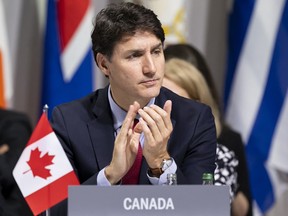
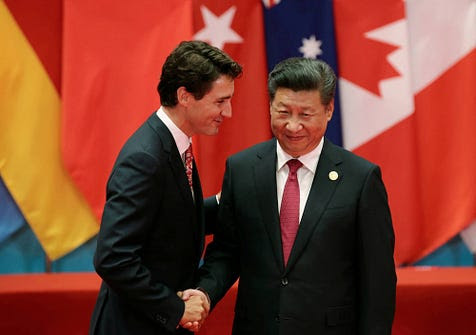
Within months of taking office, Carney made his priorities clear. In January 2026, he became the first Canadian Prime Minister to visit Beijing since 2017, announcing a new “strategic partnership” with the People’s Republic of China focused on energy, agri-food, and trade. The agreement included tariff reductions on Canadian canola and commitments to expanded agricultural exports. Finance Minister François-Philippe Champagne travelled alongside representatives of Brookfield Asset Management — Carney’s former employer, which had already invested over $3 billion in China before Carney took the helm in 2020. The Bureau documented the depth of Carney’s financial entanglement with Chinese state-linked entities during his time at Brookfield, and the East Asia Forum noted that Canada’s turn toward Beijing, while framed as trade diversification away from Trump-era tariff pressure, carried significant strategic risks that the government appeared willing to absorb.
The sequence deserves to be stated plainly. A Prime Minister prorogues Parliament to avoid a confidence vote. A leadership race selects his replacement from within the party, chosen by fewer than 132,000 people. The new leader governs with the same cabinet, propped up by the same coalition partner, and calls an election on a timeline of his own choosing. He wins a minority. And his first major foreign policy act is to deepen Canada’s relationship with the authoritarian regime that his own intelligence agency confirmed had interfered in two consecutive Canadian elections, whose military collaborated with compromised scientists inside a Canadian government lab, and whose bounty a member of his own party promoted against a Canadian political candidate.
Mark Carney was installed as Prime Minister. 131,674 Liberal members elected him to lead their party, and a minority of Canadian voters gave that party the most seats in a general election that followed. Those are not the same thing, and the distinction matters — because every decision Carney has made since taking office flows from a mandate that was engineered, not earned.
Taxation Without Representation
The phrase is older than Confederation. It was the rallying cry of the American Revolution and a foundational grievance of every democratic movement that followed — the principle that a government which taxes its citizens without granting them a functioning legislature to oversee how that money is spent has forfeited its legitimacy. In Canada, between October 2024 and May 2025, that principle was not violated in theory. It was violated in fact.
When the House of Commons ground to a halt on October 3, 2024, over the Liberals’ refusal to produce documents related to the Green Slush Fund scandal, the conventional expectation was that the standoff would resolve within days or weeks. It did not. The privilege debate consumed the remainder of the fall sitting. Christmas recess arrived with no resolution. And then, on January 6, 2025, Trudeau prorogued Parliament entirely — not to break the deadlock, but to avoid a no-confidence vote his government could not survive. The House did not reconvene until March 24, 2025, and when it did, it sat only briefly before the election was called for April 28.
According to the Library of Parliament’s own records, the House of Commons sat for just 73 days out of 455 available days between October 2024 and December 2025 — a rate of sixteen percent. For eighty-four percent of the time, Canadians had no functioning legislature. No bills were debated. No committees met. No government spending was scrutinized. No questions were asked in Question Period, because there was no Question Period to attend. The executive branch governed unimpeded by the legislative branch for the better part of a year.
Throughout all of it, every Member of Parliament continued to collect their full salary. The base compensation for a Canadian MP is $194,600 per year, with additional allowances for housing, travel, and office expenses. Members received per diems for days they were nominally “in session” and continued to draw from taxpayer-funded budgets for constituency offices that had no parliamentary business to report on. The House of Commons sitting calendar tells the story: vast stretches of blank space where sittings should have been, interrupted by the occasional cluster of days that achieved nothing of substance before the next recess.
The cost of this arrangement was not abstract. During the months Parliament did not sit, the federal government continued to spend, regulate, and govern by Order in Council. Tax revenues continued to flow. Programs continued to disburse funds. Regulatory changes continued to be enacted. All of it happened without the oversight mechanism that exists specifically to ensure the executive does not spend public money without legislative approval. The entire premise of responsible government — the system Canada inherited from Westminster, in which the executive can only govern so long as it holds the confidence of the legislature — depends on the legislature actually sitting. When it does not, responsible government is a fiction. The government is responsible to no one.
What makes this period particularly corrosive is that Parliament did not shut down because of a crisis, a natural disaster, or a national emergency. It shut down because the governing party was caught in a corruption scandal and refused to comply with a lawful order of the House. The Liberals could have produced the Green Slush Fund documents, allowed the RCMP referral to proceed, and continued governing. They chose instead to let the legislature die rather than face accountability — and then used the resulting vacuum to engineer a leadership transition, install a new Prime Minister, and call an election on their own terms.
Canadians paid for every day of it. They paid the salaries of MPs who did not sit, the operating costs of a Parliament that did not function, and the price of a government that spent their money without anyone in the room to ask where it was going. The phrase “taxation without representation” is not a metaphor in this context. For nearly eight months, it was a literal description of how Canada was governed.
Manufacturing a Majority
Mark Carney won a minority government on April 28, 2025. Six months later, he began assembling the majority the electorate refused to give him.
On November 4, 2025, Nova Scotia MP Chris d’Entremont — elected as a Conservative — crossed the floor to the Liberal caucus. On December 11, Toronto-area MP Michael Ma followed. On February 18, 2026, Edmonton MP Matt Jeneroux became the third Conservative to cross. On March 10, NDP MP Lori Idlout, representing the vast riding of Nunavut, left the NDP to join the Liberals. And on April 8, four-term Sarnia–Lambton MP Marilyn Gladu became the fifth. Five crossings in five months, each one bringing the Liberals closer to the 172 seats required for a majority.With Gladu’s defection, they sit at 171 — one seat short, with three byelections scheduled for April 13 that could deliver the rest.
In every one of these ridings, voters cast their ballots for a specific party. The residents of Sarnia–Lambton elected a Conservative. The people of Nunavut elected a New Democrat. Those voters did not choose a Liberal representative, and no one has asked them whether they accept one. The ballot they marked and the member who now claims to represent them belong to two different political parties — and under Canadian law, there is nothing they can do about it until the next general election.
Gladu’s crossing is the most revealing. In January 2026 — three months before she herself crossed — Gladu publicly stated her position on the practice. “We elected you under this banner,” she said, “and if you don’t want to be under that banner, then we deserve a chance to have a redo.” She backed proposals that would require floor-crossing MPs to face an automatic byelection, giving voters the final say. The principle she articulated was clear and correct: the mandate belongs to the voter, not the member. By April, she had abandoned it entirely. The mayor of Sarnia and the president of the local Conservative riding association both called on her to resign and face a byelection. She has not done so. Carney has not asked her to.
The public’s view on this is not ambiguous. Angus Reid polling found that just one in four Canadians believe an MP who crosses the floor should be allowed to finish their term with the new party. Seventy-five percent believe some form of democratic accountability — a byelection, a recall mechanism, or an automatic trigger — should follow. The political class has ignored this consensus completely. There is no law requiring a byelection after a floor crossing, and no party in power has any incentive to create one, because the practice only benefits whichever party is doing the recruiting.
What makes this particular wave of crossings different from historical precedents is the arithmetic. CBC’s own analysis of floor-crossing history shows that it is rare for so many MPs to cross to the same party in such a compressed timeframe, and rarer still for those crossings to carry explicit strategic weight — each one narrowing the gap between a minority and a majority. This is not a handful of disaffected backbenchers following their conscience. This is a coordinated accumulation of seats that transforms the composition of Parliament without a single Canadian casting a vote.
The Hub framed the problem directly: Carney is “undemocratically winning a majority.” The word is precise. A majority government carries enormous power in the Westminster system — it controls the legislative agenda, dominates committees, and governs with near-impunity between elections. That power is supposed to be granted by the electorate. When it is assembled instead through backroom recruitment of individual MPs who switch their allegiance after the fact, the mandate is manufactured. The voters who created the minority Parliament on April 28, 2025, did not consent to the majority Parliament that is taking shape in April 2026.
Floor crossing is legal in Canada. It is also, in the plainest sense of the word, undemocratic. The voter chose one thing. The system delivered another. And no one with the power to change it has any reason to try.
The Husk Holds
On April 13, 2026, three federal byelections will determine whether the Carney government crosses the threshold from minority to majority. If the Liberals win even one of them (which they almost certainly will), they’ll hold 172 seats and command the House of Commons without needing the NDP, the Bloc, or anyone else. A government that was never supposed to have a majority will have obtained one through a combination of floor crossings no voter consented to and byelections triggered by the very scandals documented in this piece.
And waiting on the other side of that majority is a legislative agenda that should concern every Canadian who still believes the state answers to the citizen rather than the other way around.
Bill C-9, the Combatting Hate Act, passed third reading in the House of Commons and is now before the Senate. The bill creates new criminal offences for the “wilful promotion of hatred,” expands the definition of hate crimes, and — most critically — removes a long-standing religious-expression exemption from Section 319(3) of the Criminal Code that protected Canadians who spoke in good faith on the basis of religious texts. The exemption had never once been successfully invoked to defend hateful speech. It was removed anyway. The bill also eliminates the requirement that the Attorney General approve hate-propaganda charges before they proceed, stripping away a prosecutorial safeguard that existed specifically to prevent politically motivated charges. The Canadian Civil Liberties Association warned that the bill’s vague language could be used to criminalise peaceful protest and silence unpopular expression. The Canadian Labour Congress raised concerns about its potential to infringe on freedom of association. The Canadian Constitution Foundation called it a direct threat to the Charter right to freedom of expression.
The Online Harms Act — the previous incarnation of which died on the order paper when Trudeau prorogued Parliament — is being prepared for reintroduction. The original Bill C-63 proposed the creation of a Digital Safety Commission with regulatory power over online speech, provisions that critics including the Canadian Civil Liberties Association said amounted to government censorship of lawful content, and penalties that included the possibility of house arrest before an offence had been committed and life imprisonment for certain categories of speech.
And then there is the broader architecture of executive power that Carney has been assembling since taking office. The One Canadian Economy Act, passed in June 2025, allows Cabinet to declare any infrastructure project to be in the “national interest” — at which point all regulatory findings required under any federal law are deemed to have been made, and the Minister can issue a single document authorizing the project to proceed. The government has invoked emergency-powers rhetoric to justify everything from housing construction to trade corridors, framing routine policy priorities as crises that require bypassing normal democratic processes. And in March 2026, the Carney government asked the Supreme Court of Canada to overturn two lower-court rulings that found the invocation of the Emergencies Act during the 2022 Freedom Convoy protests was unlawful and violated the Charter. Two levels of court agreed the law was used unconstitutionally. Carney’s response was not to accept the rulings but to appeal them — seeking to establish the legal precedent that a future government can invoke emergency powers to crush a protest it finds politically inconvenient.
This is the legislative programme that a manufactured majority will be asked to pass. Criminalization of speech the government deems hateful, with fewer safeguards against abuse. Mass surveillance of Canadians’ digital metadata. A regulatory framework for online content that hands a government commission authority over what can and cannot be said on the internet.Executive power to bypass environmental and regulatory law by declaring projects to be in the national interest. And a legal campaign to establish that the Emergencies Act can be wielded against citizens who dissent.
A minority government would face opposition, amendment, and compromise on every one of these bills. A majority government faces none. With 172 seats, the Liberals control the legislative agenda, dominate every committee, and pass legislation without a single opposition vote. The bills listed above move from contentious proposals to foregone conclusions.
That is what is at stake on April 13. Not merely which party holds a few extra seats, but whether the legislative checks that remain — the last thin barriers between proposal and law — survive the week. The husk of Canadian democracy has absorbed every violation documented in this piece: elections used as escape routes, votes that went uncounted, foreign interference met with partnership rather than prosecution, a Parliament that did not sit, a Prime Minister no one elected, and a majority no one voted for. Each one was treated as an isolated incident. Each one was normalized. And each one made the next one possible.
The husk holds. It absorbs. And if the majority falls into place next week, it will have served its final purpose — providing the appearance of democratic legitimacy to a government that has spent five years systematically dismantling the substance of it.
TORONTO, Canada — In one of the most closely scrutinized races of Canada’s 2025 federal election, Joseph Tay—the Conservative candidate identified by federal authorities as the target of aggressive Chinese election interference operations—was defeated Monday night in Don Valley North by Liberal Maggie Chi, following a campaign marred by threats, suspected intimidation, and digital suppression efforts.The Bureau has learned that Canadian police last week reviewed complaints alleging that members of Tay’s campaign team were shadowed in an intimidating manner while canvassing in the final days of the race.
The status of the incident review remains unclear.With over 20,000 votes—a 43 percent share compared to 53 percent for Liberal Maggie Chi—Tay nearly doubled the Conservative Party’s 2021 vote total of 12,098 in this riding.Last Monday, federal intelligence officials disclosed that Tay was the subject of a highly coordinated transnational repression operation tied to the People’s Republic of China. The campaign aimed to discredit his candidacy and suppress Chinese Canadian voters’ access to his messaging through cyber and information operations.That same day, federal police advised Tay to suspend door-to-door canvassing, according to two sources with direct knowledge, citing safety concerns.
Several days later, Tay’s campaign reported to police that a man had been trailing a door-knocking team in a threatening manner in a Don Valley North neighbourhood.Following The Bureau’s reporting, the New York Times wrote on Sunday: “Fearing for his safety, Mr. Tay… has waged perhaps the quietest campaign of any candidate competing in the election. The attacks on Mr. Tay have sought to influence the outcome of the race in Don Valley North, a district with a large Chinese diaspora in Toronto, in what is the most vote-rich region in Canada.”In a twist, in neighbouring Markham–Unionville, Peter Yuen—the Liberal candidate who replaced former MP Paul Chiang, who had made controversial remarks about Tay being turned over to Chinese officials—was defeated by Conservative candidate Michael Ma.
According to Elections Canada’s results, Ma secured the riding by about 2,000 votes.Tay and his campaign team had conducted extensive groundwork in Markham–Unionville earlier this year, where he publicly announced his intention to seek the Conservative nomination in January. However, the party ultimately assigned him on March 24 to Don Valley North—a riding that, according to the 2024 report of the National Security and Intelligence Committee of Parliamentarians (NSICOP), was the site of serious foreign interference by the People’s Republic of China during the 2019 election.At 2 a.m., Tay posted a message to X thanking supporters: “By God’s grace, though we did not win tonight, we have already won something far greater—the courage to stand, to speak, and to dream together.”
Signaling he may run again, Tay added: “Our journey does not end here. I remain committed to upholding Canadian values—freedom, respect, and community—and will continue to serve and help build a wholesome, principled community in every way I can.”Last Monday, SITE—Canada’s election-threat monitoring task force—confirmed that Tay was the target of a coordinated online disinformation campaign, warning in briefing materials that “this was not about a single post” but a “deliberate, persistent campaign” designed to distort visibility and suppress legitimate discourse among Chinese-speaking voters.
The tactics bore striking resemblance to interference allegations uncovered by The Bureau during the 2021 federal election, when Conservative MP Bob Saroya was unseated in Markham–Unionville amid allegations that operatives linked to the Chinese government had shadowed Saroya, surveilled his campaign, and sought to intimidate voters. Senior Conservative officials said CSIS provided briefings at the time warning of what they described as “coordinated and alarming” surveillance efforts.In Tay’s case, official sources confirmed that Chinese-language platforms circulated disinformation framing him as a fugitive, invoking his Hong Kong National Security Law bounty—set at $180,000 CAD—to portray his candidacy as a threat to Canada
.Earlier this month, The Bureau reported that former Liberal MP Paul Chiang—who defeated Conservative incumbent Bob Saroya in 2021—withdrew as a candidate after the RCMP opened a review into remarks he made suggesting that Joe Tay’s election could spark “great controversy” for Canada because of Hong Kong’s national security charges, and that Tay could be handed over to the Chinese consulate to collect a bounty. Chiang later apologized, describing the comments as a poorly judged joke. However, prominent diaspora organizations and human rights groups condemned the remarks as a disturbing example of rhetoric echoing transnational repression.
According to SITE assessments reviewed by The Bureau, coordinated suppression efforts were particularly acute in Don Valley North, where Tay’s online visibility was sharply curtailed across Chinese-language social media ecosystems.The status of the RCMP’s review into Chiang’s remarks—and a separate complaint to Toronto police alleging that Tay’s campaign staff may have been intimidated while canvassing—remains unclear.With Mark Carney’s Liberals securing a narrow minority and Canada’s political landscape growing increasingly polarized—against the backdrop of an intensifying cold war between Washington and Beijing—some pundits predict voters could be heading back to the polls sooner than expected. Whether election threat reviewers will now dig deeper into China’s suspected interference in this and other ridings remains an open question
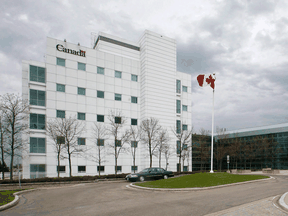
An image of Winnipeg’s National Microbiology Laboratory. Photo by Photo Courtesy of the National Microbiology Laboratory
Canadian public health authorities didn’t have to let the Wuhan Institute of Virology infiltrate and co-opt our country’s highest-security biolab. The warning signs had been there for years, and no one to our knowledge was holding a gun to the heads of the rubber-stampers who authorized a security-threat-flagged scientist’s shipment of live Ebola back to the motherland.
That’s part of why the latest report from the House of Commons committee on China, released Tuesday (conveniently, on the day of the American presidential election), is such a puzzling read. Though a lot of the information contained within has previously trickled into public knowledge, through reporting, committee hearings and released records, the Commons committee’s synthesis shows how Canadian authorities reacted with the haste of a slug — and continue to leave gaping holes in the security of research that can literally be weaponized against human health.
The report sets out a comedy of errors that preceded the 2019 expulsion of scientists Dr. Xiangguo Qiu and Keding Cheng, both Canadian citizens from China working at the Winnipeg National Microbiology Lab, who were ousted for “administrative” reasons.
The husband-wife pair was hired back in 2003 and 2006, respectively, but a decade later began showing suspicious links to Chinese research programs. In 2012, wife Qiu began collaborating with a Chinese military virologist specializing in “bio-defence and bio-terrorism.”
.
In 2016, she was nominated by a Chinese military official for an “International Cooperation Award,” which nodded to her work with the military bioweapons expert and stated that she “used Canada’s Level 4 Biosecurity Laboratory as a base to assist China to improve its capability to fight highly pathogenic pathogens … and achieved brilliant results.” She published a paper with military-linked colleagues sometime afterward, and became a visiting professor at the Academy of Military Medical Sciences working on infectious disease — a position that she left out of her English CV.
In 2017, PHAC greenlit Qiu to travel to Beijing for a conference — but from there, unbeknownst to PHAC, she travelled to the Wuhan Institute of Virology to present on Ebola vaccines. Later that year, PHAC approved Qiu to train others at the Wuhan lab. Around this time or later, via the Wuhan lab, she applied for the Chinese government’s Thousand Talents Program which incentivizes members to clandestinely send overseas research back to China.
After Qiu signed up, the suspicious activity accelerated. In February 2018, she brought over an employee from the Wuhan lab to join her at the Winnipeg lab. In April, she returned to China to “visit family,” with travel expenses paid for by a Chinese biotech firm. In May, Cheung received protein samples from China labelled “kitchen utensils.”
In April 2018, Qiu and Cheung were finally flagged as possible insider threats after CSIS briefed PHAC on foreign interference.
The warning made its way up the chain at a snail’s pace: PHAC’s national security found a suspicious Chinese patent including Qiu in September; the PHAC president was briefed in December, and ordered a private firm to investigate. The private firm tasked with the job concluded in March 2019 that more investigations were needed (duh). PHAC leadership contemplated an internal investigation and finally called the RCMP in May. CSIS began investigations in June.
In July, the scientists were finally kicked out of the lab.
During the entire time that authorities were groggily waking up to the idea that these top scientists might be working as agents for a foreign government, the scientists accelerated their pace. Qiu flew back to the Wuhan lab — with PHAC’s approval — where she was now a “visiting research scientist.” Qiu’s staff recruit from Wuhun was caught trying to sneak tubes out of the Winnipeg lab. The Winnipeg security began noticing a suspicious number of visitors walking around the lab unattended. Cheng tried to enter the lab with another employee’s passcode. Qiu shipped a live sample of Ebola back to the Wuhan lab — again, with PHAC’s approval.
The final stages of a fatal Ebola infection (that is, about half of all Ebola infections) involve profusely bleeding from one’s eyes, nose, mouth and rectum. It’s absolutely not the kind of virus you want getting into the wrong hands, say, those of an unfriendly government whose modified virus experiments have been “credibly suggested” to have escaped from its labs.
Nevertheless, it was only after the scientists’ exile that a CSIS investigation determined that their continued presence at the Winnipeg lab would pose a national security threat. They were formally fired in 2021, and have since disappeared to who knows where — yes, they were permitted to leave the country after the debacle.
The entire period of infiltration was lined with an attitude of nonchalance by government officials who appeared at the China committee. The Winnipeg lab director at the time defended the lab’s slow response by stating that neither CSIS nor PHAC advised him to kick the scientists out; he handwaved approving the Ebola-by-mail. The PHAC president justified the long timeline with the thoroughness of the investigation.
Only former CSIS director Richard Fadden was the voice of reason: “too long,” was his assessment of the kicking-out.
On the health and research side, the passive attitude seems to go all the way up to the top. Security-wise, Canada brought in a new research policy in January 2024 restricting government funding from supporting research on “sensitive technology” (weapons, surveillance, AI, space, etc.) with any connection to certain suspicious research organizations.
The list of collaborators banned from receiving Canadian funding includes only Chinese, Russian and Iranian schools and military units. Not on the list, however, is the Wuhan Institute of Virology, which has already benefitted from exploited Canadian research once. It’s also known for possibly being the place that accidentally started a pandemic by letting COVID out of the lab, which doesn’t inspire confidence when it comes to handling our mail-in Ebola.
The House of Commons China committee is wisely recommending that the Wuhan lab be added to the list of research collaborators ineligible for Canadian taxpayer support, and, more wisely, the end to all government research teamwork with China on sensitive matters.
It’s further recommended that Canada come up with a list of “trusted” countries which will be the sole permitted recipients of highly dangerous live viruses that could kill millions if unleashed. Because, it turns out, we didn’t have one.
But under all this is a problem that’s going to take more than a committee to solve. Careless lab directors can still allow suspicious lab staff to send live pathogen samples to unfriendly countries. Research dollars can be siphoned off to support places like the Wuhan lab. Half-measures and painstakingly laggy responses are endemic to this government, and this weakness will continue to make us a prime target.
Red Chinese Consulate interfered in re-election bid of former Conservative MP: report
Kenny Chiu, a former Conservative MP who unsuccessfully tried to pass foreign registry legislation, was targeted by Chinese agents for attacking Beijing’s human rights infringements, particularly in Hong Kong.
The Canadian Press / Sean Kilpatrick
Chinese consular officials in Vancouver orchestrated a targeted campaign against Conservative MP Kenny Chiu during the 2021 federal election, validating his claims that foreign interference played a crucial role in his electoral defeat.
Initiated in December 2022, the investigation found British Columbians of Chinese descent voted with direction from Chinese officials in Beijing. The Hogue Commission, which oversees the inquiry into foreign interference, learned that agents used an atmosphere of fear and media manipulation to compel voters.
Foreign ownership of Canadian media outlets also posed concerns, raising the potential that broadcasting regulations were violated.
That said, there is insufficient legal basis to pursue charges under current Canadian laws, reportedThe Bureau. Investigators say prosecution requires a high burden of proof.
Fines of $5,000 under the Election Act do not adequately deter foreign interference in Canadian elections.
“However, we are satisfied that foreign influence was exercised in the Chinese Canadian community in Greater Vancouver,” the investigation found. MP Chiu has repeatedly attributed his 2021 election defeat to foreign interference.
The former Conservative MP was targeted for attacking China’s record on human rights, particularly Hong Kong, and his failed attempt to pass foreign registry legislation, according to officials.
The tenured member of Parliament introduced Bill C-282, An Act to establish the Foreign Influence Registry, months before the 2021 general election to try to establish the Foreign Influence Registry.
“As an immigrant, it is already very challenging to build a life here in Canada,” Chiu said, who immigrated from Hong Kong as a schoolboy in 1982.
A 112-page report, compiled by the Commissioner of Canada Elections (OCCE), revealed Vancouver’s Chinese Consulate corroborated with local Chinese Canadian associations and media outlets to undermine Chiu’s reelection bid.
Chinese-language media and social media channels, primarily WeChat, portrayed MP Chiu as anti-Chinese and racist.
“When I [went] door knocking…there have been supporters of mine who just shut the door in my face,” said Chiu. “There [was] so much hatred that I sense.”
Findings contend Vancouver community leaders allegedly worked for China’s United Front Work Department to interfere in elections.
Evidence showed Chinese state media apparently posted false reports on Bill C-282, claiming it would put Chinese Canadians behind bars for supporting mainland China, reportedBlacklock’s Reporter.
However, investigators could not probe funding tied to the ‘disinformation’ campaign, as they could not identify victims intimidated by foreign agents.
“We need witnesses that are willing to testify,” said Carmen Boucher, OCCE Executive Director, who testified that the Chinese diaspora is reluctant to come forward because of intimidation.
In one redacted passage, an unidentified witness said a community leader allegedly bragged about defeating MP Chiu with help from the United Front networks.
At the Foreign Interference Commission, MP Chiu testified the Trudeau government “left him to drown” when Chinese agents targeted his campaign. “The government doesn’t seem to care,” he said.
A submission to the inquiry said Chinese proxies targeted Conservative candidates who supported the implementation of a foreign-agent registry.
The CSIS document adds further clarity to findings from a new Australian government report that quoted the WeChat allegations and questioned the federal response to Chinese meddling.
“You weren’t aware of any of these reports at the time?” asked Commission Counsel Matthew Ferguson. “No,” replied Chiu. “I have been betrayed,” he added.
MP Chiu lost re-election to Liberal candidate Parm Bains by 3,477 votes. Approximately 4,400 fewer residents voted for him in 2021 than in 2019 — of which nearly half translated into Liberal support.
In response, the Trudeau government quietly passed foreign interference legislation before the parliamentary summer recess. Bill C-70, An Act respecting countering foreign interference, will punish diplomats and other agents that target Canadian democracy. (The Rebel, September 18, 2024)
Published Jun 19, 2024 • Last updated 5 days ago • 5 minute read
231 Comments
Canada’s Prime Minister Justin Trudeau attends the plenary session of the Summit on peace in Ukraine, at the luxury Burgenstock resort, near Lucerne, on June 15, 2024. (Photo by URS FLUEELER / POOL / AFP)
Article content
In the ordinary course of heated political controversies, Canadians can sort out the issue that’s launching their politicians at one another’s throats. In the “foreign interference” upheaval that has in turns paralyzed, confounded and outraged Canada’s political class in recent days, we’re not even allowed to know what the federal party leaders are arguing about, exactly.
This doesn’t make the story easy to tell. It was already hard enough to determine when the story really begins, let alone figure how it will all end.
If we wanted to, we could push the beginning of the story back to 2003, when Beijing’s United Front Work Department boasted about electing six of its preferred candidates in Toronto. Three years later, the UFWD — China’s overseas strong-arming, “elite capture” and election-interference infrastructure — claimed electoral success for 10 of its 44 preferred Toronto-area candidates, according to an internal training manual uncovered by the Financial Times.
We could also begin the story with the way then Canadian Security Intelligence Service director Richard Fadden was thrown under the bus by Liberal and New Democratic Party MPs back in 2010, when he said several provincial and municipal politicians in Canada had come under Beijing’s influence, to a worrying degree. The charge against Fadden back then was led by the Liberals’ current health minister, Mark Holland.
But for the opening of this latest chapter, foreshadowed by a series of leaks from intelligence-agency whistleblowers going back to November 2022, we need only go back as far as June 3. That’s when an extraparliamentary oversight committee released a heavily-redacted, 84-page report that seemed to suggest that some MPs have been dallying in conduct bordering on treason.
In this way, the “foreign interference” story has revealed itself to be about something worse. Despite the huge blanked-out spaces the Prime Minister’s Office has insisted on imposing on the public record, all along this has really been a story about collusion, about certain of our politicians collaborating with hostile foreign powers to their own advantage and to further their own parties’ electoral prospects. Some MPs have been “semi-witting or witting” participants in the efforts of foreign states to interfere in Canada’s political life, the report found, particularly during the federal elections of 2019 and 2021.
This is hardly news to anyone who has been paying close attention, but the story has changed in the way its emphasis has shifted. It can no longer be told as a simple story about Canadian politicians as victims. In the story told by the National Security and Intelligence Committee of Parliamentarians, Canadian politicians are the culprits.
In one key respect, however, it’s been the same story, for more than 20 years. While the NSICOP report alludes to bad behaviour on the part of India’s friends in Canada, and Pakistan, and Iran and Russia are mentioned almost in passing, it’s China’s deep involvement in Canada’s democratic processes and institutions that the NSICOP report emphasizes.
By the time of the 2019 federal election, the UFWD’s budget for overseas operations was $600 million, and CSIS assessed that year that Canada had become an “attractive and permissive target” for foreign meddling. Even so, NSICOP reported that same year, public engagement was “almost non-existent.” That, too, has changed.
The public is most definitely engaged now, despite the Trudeau government’s efforts over the past year and a half to shut everything down. By filibuster, by blocking evidence demanded by House of Commons committees, and by enlisting the China-friendly, Trudeau-friendly “special rapporteur” David Johnston in a failed whitewash, the Trudeau government expended every effort to make it all go away.
The Liberals evaded the demands for a public inquiry until their minority position in the House made it impossible to stop. Trudeau and his ministers insinuated that it was all just a big fuss manufactured by anti-Chinese racists, by incompetent CSIS officials, by sour-grapes losers among failed Conservative candidates, and by dubiously-motivated CSIS whistleblowers who deserved to be hunted down and prosecuted. None of it worked.
The release of the NSICOP report followed on the equally astonishing proceedings of the Public Inquiry into Foreign Interference in April. In hearings before Commissioner Justice Marie-Josée Hogue, Prime Minister Justin Trudeau and his officials gave every appearance of committing something close to perjury in their efforts to dispute, dismiss and deny the veracity of incriminating evidence presented by CSIS director David Vigneault. But it was the NSICOP report that left everyone with the worst kind of unanswered questions: Who are these “traitors” on Parliament Hill?
Officially, it’s necessarily a mystery. That’s because huge swaths of the NSICOP report were redacted and expunged by the Prime Minister’s Office on the grounds that the content would be “injurious to national security, national defence or international relations,” or would violate “solicitor-client privilege.” Making things even foggier, NSICOP has been engaged in a running battle with senior officials in the PMO and several federal agencies over their habit of relying on “cabinet confidences” to withhold information. Last year, this rationale was used to blot out, in whole or in part, more than 1,000 documents NSICOP asked the government to disclose.
Even worse, Prime Minister Trudeau, NDP leader Jagmeet Singh and the Greens’ Elizabeth May, each having seen the unredacted version of the report, disagree quite dramatically about what it contains. Conservative leader Pierre Poilievre says he doesn’t want to be drawn into the cone of silence the NSICOP statute would require of him, so he doesn’t know which MPs are named in it.
Despite the furious arguments separating them on all that, there’s a weird circling of wagons going on. Everyone agrees that NSICOP has cast a “dark cloud” of suspicion over the House of Commons. All the party leaders broadly agreed last week that the unredacted version of the NSICOP report should be booted over to Justice Hogue to sort it all out. And separately, a series of national-security measures NSICOP had urged in vain on the Trudeau government for seven years is suddenly roaring through Parliament with all-party support.
Bill C-70 is already at the third-reading stage in the Senate after being introduced in the House of Commons only on May 6. Among other things, the bill contains a version of the foreign influence registry that the Liberals dragged their feet on for three years. First introduced in an April 13, 2021 private members bill tabled by Steveston — Richmond East Conservative MP Kenny Chiu, the registry was ferociously opposed by Beijing’s UFWD proxies in Canada. Chiu was defeated following a well-documented UFWD campaign to punish him at the polls.
Where things get particularly awkward for Trudeau’s Liberals is that leaked CSIS assessments consistently show that the UFWD had identified a very specific objective in the 2019 and 2021 federal elections: keeping the Conservatives out of office and ensuring a Liberal win, preferably in a more easily-manipulable minority government.
There is no way of knowing for certain whether any foreign-meddling effort in any riding in either of those federal elections influenced the vote outcome, one way or another. But however this story ends, it’s hard to see its final chapter containing the Trudeau government’s vindication. It’s much easier to imagine the story coming to a close in Justin Trudeau’s final disgrace.
Xiangguo Qiu’s ouster from the National Microbiology Laboratory in 2019 remained cloaked in mystery until a few days ago. Photo by MCpl Vincent Carbonneau, Rideau Hall/File
Article content
In shutting down an ethics committee probe into just how it came to pass that two Beijing-linked scientists managed to get away with dangerously compromising security at the National Microbiology Laboratory in Winnipeg, at least the Trudeau government is being consistent.
Ever since coming to power in 2015, the Liberals have chosen to hide the scope and extent of Beijing’s ever-expanding influence, interference and infiltration operations in Canada. By acts of obstruction, distraction and filibuster, the pattern is by now easily predictable. There’s nothing surprising about it anymore. The pattern played out exactly as you would imagine in the Winnipeg lab case.
In their zeal to keep the public in the dark about the goings-on at the top-security national infections diseases laboratory, the Liberals went to extraordinary lengths, not least an historic defiance of the convention of Parliamentary supremacy to the point of mounting a court challenge to thwart an order from the Speaker of the House of Commons to release documents relating to the affair.
It was only because a panel of judges eventually found that contrary to the Trudeau government’s claims about the too-sensitive nature of the documents — 600 pages in all — the barricade it built was mostly to protect itself from public embarrassment.
And it was only by releasing those documents that Canadians were permitted last week to learn that four years ago, the Canadian Security and Intelligence Service had determined that research scientist Xiangguo Qiu, a Public Health Canada employee at the lab, had been engaging in clandestine activity to the benefit of Xi Jinping’s regime by secretly sending scientific findings and materials to China.
As far back as 2018, Qiu’s husband Keding Cheng, also a Public Health Canada employee, was found to have allowed access to the Canadian Science Centre for Human and Animal Health by students he was supposed to be supervising. The students were observed trying to remove laboratory materials. Until they were both fired in 2021, Qiu and Cheng routinely violated security protocols and ethical conduct codes, and consistently lied about their unauthorized intimacies with sketchy Chinese state institutions and agencies.
CSIS determined that Cheng was stubbornly untruthful when subjected to questioning, and his responses to CSIS queries were “simply not credible, which reflects adversely on his personal trustworthiness and therefore his basic reliability, the primary building block of security clearance.” As for Qiu, her disregard for basic security protocols posed “a very serious and credible danger to the government of Canada as a whole,” CSIS found.
Just how these two managed to acquire security clearances in the first place is just one question that remains unanswered.
You’d think the Trudeau government would want the public to be well aware of this scandal, illustrating as it does the extreme national-security peril involved in any collaboration with the shadowy world of Chinese state agencies. These collaborations pose a threat to Canada’s national interests that Ottawa claims it wants Canadians — particularly Canadian scientists and university researchers — to better understand, and to guard against.
Instead, the Liberal government persists even now in keeping the public in the dark, by way of teaming with the New Democrats to roadblock an ethics committee probe into the Winnipeg lab affair.
It was only because of its minority position in the House of Commons back in 2019 that the Liberals failed in their efforts to block the establishment of a special standing committee to inquire into the weirdly opaque Canada-China relationship that Trudeau had cultivated and nurtured in the lead-up to Beijing’s hostage-diplomacy abduction of Michael Kovrig and Michael Spavor.
Until then, the matter of Beijing’s vastly expanding shadow over Liberal fundraising, candidate-selection, trade policy and diplomatic priorities was held to be best left to the “experts” from Dominic Barton’s disgraced McKinsey empire and the palm-greasers at the Canada-China Business Council. The pattern seemed to break, but the Canada-China relations committee quickly found itself mired in gridlocks by Liberal members determined to turn the subject back to more parochial matters, and to make excuses based on the presumed implications for the Kovrig-Spavor kidnapping, and to level insinuations that it was “racist” merely to inquire too closely into Beijing’s proxies and their rumoured election shenanigans.
It took years of Liberal ambuscades and transparently bogus pretexts before Canada’s Five Eyes partners finally managed to arm-twist Ottawa to get with the program and at least bar China’s “national champion” telecom Huawei from the core structure of Canada’s fifth-generation (5G) internet rollout.
It took several months of explosive revelations about warnings from CSIS and other agencies to the effect that Beijing really was actively involved in monkey wrenching the 2019 and 2021 federal elections to the Liberals’ benefit before Trudeau decided for appearances’ sake to conjure something to impede calls for a public inquiry. The gambit was a “independent special rapporteur” whitewash undertaken by David Johnston, an old Trudeau family friend, and an especially solicitous and high-profile Canadian friend of China.
When that didn’t work, faced with the demands of several majority votes in the House of Commons, Team Trudeau managed to construct a public inquiry that so far shows every sign that it will extend as much in the way of protection to Beijing’s Liberal-friendly mandarin bloc proxies in Canada as to the Uyghurs, Hong Kongers, expatriate Chinese democrats and Falun Gong practitioners those same well-to-do proxies have been bullying, browbeating and intimidating all these years.
So best of luck to any Parliamentarians who would want an Ethics Committee probe or any other such open inquiry into how the hell the National Microbiology Laboratory in Winnipeg ended up a sieve of intellectual-property patents for Beijing’s benefit, and an open buffet for Beijing’s ravenous appetite for top-secret information about infectious diseases.
Any such initiative would allow Canadians to know things the Liberal government does not want any of us to know, and the pattern with these things is so predictable it’s becoming downright boring.
How the investigation and firing of two high-security virus scientists over leaks to China unfolded
Trudeau and the Ottawa elite, in general, have been blind as to Red China’s aggressive hostility and acquisitiveness. The Sidewinder Report, disowned and shredded in a panic by Jean Chretien, gave us fair warning. In this case there may well have been a huge transfer to lethal knowledge by these two Chinese scientists. Of course, the RCMP is “still investigating” — the pyramids were built faster — and we are kept substantially in the dark. — Paul Fromm
Canadians now know why Xiangguo Qiu and her husband, Keding Cheng were fired from Canada’s highest security lab more than three years ago
Published Mar 02, 2024 • Last updated 11 hours ago • 10 minute read
Xiangguo Qiu’s ouster from the National Microbiology Laboratory in 2019 remained cloaked in mystery until a few days ago. Photo by MCpl Vincent Carbonneau, Rideau Hall/File
Article content
OTTAWA — After being kept in the dark for years, we now know why Xiangguo Qiu and her husband Keding Cheng were fired from Winnipeg’s National Microbiology Lab (NML), Canada’s highest security lab and the country’s only facility authorized to handle deadly viruses such as Ebola.
The federal government released on Wednesday more than 600 pages of documents, including top-secret CSIS assessments, investigations and internal emails detailing the reasons why the scientists were fired, why the process took so long and why it was shielded in opacity for national security reasons.
Qiu was a prominent scientist educated in China whose research at the NML included pathogens that posed significant risk. She was credited with research breakthroughs on the deadly Ebola virus and awarded a Governor General’s Innovation Award.
Then one day in July 2019, she was suddenly escorted out of the lab and subsequently fired, along with her husband, Keding Cheng, who also worked at the lab. For nearly five years, Canadians were in the dark as to what had happened.
At one point, in 2021, the Public Health Agency of Canada (PHAC) was even found in contempt of Parliament for refusing to hand over documents related to the mystery, despite a majority of MPs (not including the Liberals) demanding to see them.
This week, we found out what was being kept so secret: the Canadian Security Intelligence Service alleges that Qiu “developed deep, cooperative relationships with a variety of People’s Republic of China institutions and has intentionally transferred scientific knowledge and materials to China in order to benefit the PRC government.”
She had shipped sensitive materials outside of the national microbiology lab without approval to foreign countries, they alleged. And they accused her of actively covering up, or outright lying, about her affiliations with Chinese institutions. And they allege that Cheng, her husband, participated in leaking secure information and the deception around it.
The National Post reviewed the 600 pages of investigations, assessments and emails, to put together a timeline of how the suspicions first arose, and how the security procedures subsequently played out.
Based on the documents, here’s how it all went down:
September 27, 2018
PHAC is advised that Qiu appeared as a listed inventor of a Chinese patent that may contain scientific information produced at the Canadian Sciences Centre for Human and Animal Health (CSCHAH) in Winnipeg, and that she shared the scientific data without permission. The patent was for an “inhibitor for Ebola virus.”
October 12 and 31, 2018
Allegations surface that Cheng potentially breached security policies regarding students under his supervision who tried to improperly remove laboratory materials from the CSCHAH.
One instance on Oct. 12, 2018, saw an attempted removal of two clear plastic bags, containing 10 vials each, by people known as “restricted visitors.” The incident on Oct. 31, 2018, saw other visitors accompanied by Cheng attempt to leave the CSCHAH with two empty Styrofoam containers.
PHAC’s National Security Management Division contracts a private firm, Presidia Security Consulting, to conduct a fact-finding investigation into allegations involving Qiu and Cheng.
January 27, 2019
Cheng creates a security incident by entering an incorrect passcode when he entered the CSCHAH. The code, it turned out, belonged to someone else.
The National Microbiology Laboratory in Winnipeg. Xiangguo Qiu and her husband, Keding Cheng, were escorted out of the lab in July 2019, and later fired. Photo by John Woods/The Canadian Press/File
March 23, 2019
The fact-finding report conducted by Presidia Security Consulting finds that there were “numerous violations” of the IT policy in the labs, including staff signing into computers and then allowing “restricted visitors” to download experimental data onto private Gmail accounts, emailing it to their homes.
The report also reveals that in May 2018, Cheng was sent vials of mouse protein via courier from China marked as “kitchen utensils”. Cheng’s explanation that the broker deliberately mislabelled the package shipped from China for ease of shipping satisfied the investigator.
Regarding Qiu’s name appearing on the Chinese patent, the report found that top PHAC officials said that the likelihood of a researcher’s name appearing on a patent without the researcher being aware of it was “highly improbable” and that misstating a researcher’s name on a patent could rule it as invalid.
Qiu admitted that she had collaborated with the China National Institute for Food and Drug Control, which is attempting to develop an inhibitor to the Ebola virus, and sent them antibodies without an authorization, thus violating rules on intellectual property and material transfer agreement.
The report also indicates that the investigator later learned that other antibodies were transferred to Thomas Jefferson University, a private postsecondary institution in Philadelphia.
“The current situation has the potential to tarnish the reputation of the CSCHAH, the Public Health Agency of Canada and the Minister of Health and is recommended for further investigation to determine the breadth of any breaches of policy,” the report said.
July 5, 2019
Qiu and Cheng are each informed by the vice-president of the Infectious Disease Prevention and Control Branch at PHAC that an administrative investigation into their actions is being launched and that they are to remain home with pay pending the results of the investigation.
“Should it be determined that the allegations against you are founded, administrative and/or disciplinary measures, up to and including termination of employment, may be taken,” the letter said.
The administrative investigation report on Qiu finds that she violated numerous intellectual-property policies set out by PHAC. While she did have permission to provide small amounts of antibodies to trusted people and organizations, she had been doing so without authorization for at least two years.
Qiu was found to have her name on not one, but two Chinese patents, the second being a “detection method,” or test, for Marburg, a hemorrhagic fever similar to Ebola.
She claimed she had been listed without her knowledge, which made her “angry,” and she believed her research was not patentable because it was too weak.
Management at the National Microbiology Lab was not aware of the work she conducted on the two Chinese projects, the report said.
The report also shows that she “inappropriately disseminated, facilitated or authorized the dissemination of scientific data and other information” including to her personal computer and stored and shared data using unauthorized USB keys, despite being told not to use personal emails and data sharing multiple times.
A separate administrative investigation on Cheng found that he too violated directives on email management and gave access to unauthorized individuals to PHAC’s IT system.
Furthermore, Cheng admitted to conducting work with the Center for Disease Control and Prevention in China for a tick virus, which is outside of his scope of work, but said he did it out of his own self-interest, as the virus is deadly in his home province in China. The work was unknown to his supervisors.
The report determined that Cheng had also been “less than honest” about the package labelled kitchen utensils, and the incident “calls into question his honesty and integrity.”
A secret CSIS Act security assessment sent to PHAC’s executive director of security reveals that Qiu and Cheng were listed as co-authors on an NML research paper that included individuals linked to the Academy of Military Medical Sciences (AMMS) in China.
“Online information states AMMS is the highest medical research institution of the People’s Liberation Army (PLA) of the People’s Republic of China (PRC) and has offensive Chemical and Biological Weapons (CBW) capabilities,” the document said.
The CSIS assessment of Qiu and Cheng found that, although the service has no reason to suggest that both individuals would “willingly” co-operate with a foreign power, they are both “susceptible to influence by a foreign state” that could result in information or materials leaving the lab.
CSIS assessed that there was a “strong possibility” that both individuals would continue to violate policies and procedures should they regain access to the National Microbiology Lab.
June 30, 2020
CSIS sends another security assessment to PHAC revealing that it has uncovered new information which “strongly calls into question” Qiu’s loyalty to Canada.
Qiu was “associated to multiple ‘talent programs’ administered and funded by various PRC entities, the most prominent one being the ‘Thousand Talents Program (TTP)’.” The TTP recruits Chinese experts from western nations to boost China’s national capabilities in science and technology.
One of the TTP applications according to CSIS declares Qiu as the applicant and the Wuhan Institute of Virology as the declaring entity, stating that her work term was from 2019 to 2022.
TTP participants are given up to $1 million in research subsidies and may enjoy preferential PRC tax and visa treatment, housing subsidies and prioritized medical care in China, the report said.
CSIS also uncovered the existence of an unfinalized employment agreement between Hebei Medical University in China and Qiu from 2018 to 2022. Qiu graduated from an immunology program at Hebei Medical University, which is located in Shijiazhuang.
The agreement stipulated that she would be provided with funding of approximately $1.2 million and that her compensation would be the equivalent of $15,000 per month when onsite
Qiu listed the Wuhan Institute of Virology, the Hebei Medical University, China’s National Institute for Food and Drug Control and the Beijing Institute of Biotechnology in CVs that were provided for Chinese audiences, security investigators discovered. But she had omitted her Chinese links on her CV when she provided it to Canadian audiences, including in her applications at PHAC.
CSIS discovered that Qiu was nominated for an “international cooperation award” by China’s Academy of Military Medical Sciences for using “Canada’s Level 4 Biosecurity Laboratory as a base to assist China to improve its capability to fight highly-pathogenic pathogens… and achieved brilliant results.”
Finally, CSIS uncovered an airline ticket for Qiu for travel to Beijing in April 2018, booked by an email address associated to CanSino, a Chinese vaccine company.
CSIS concluded that Qiu has developed “deep, cooperative relationships” with PRC institutions and “intentionally transferred scientific knowledge and materials to China in order to benefit the PRC Government, and herself, without regard for the implications to her employer or to Canada’s interests.”
“The Service therefore assesses that Ms. Qiu has engaged, may engage or may be induced to engage in activities that constitute a threat to the security of Canada as defined in the CSIS Act,” it concludes.
July 7, 2020
An updated CSIS security assessment of Cheng in July 2020 “calls into question” his reliability “as it relates to loyalty” given his “close personal and professional relationship” with his wife, Qiu.
The report reveals that Cheng was aware of his wife’s applications to China-sponsored “talent programs,” as well as her associations to PRC military institutes and related individuals, and that he was himself involved in an application for one of these “talent programs” in 2013, although it is unclear what came of it.
CSIS concluded that he could not credibly claim “complete ignorance” of his wife’s activities, as he did in his security interviews with the spy agency, and that he was therefore “not truthful.”
File photo of scientists working in Winnipeg’s National Microbiology Laboratory. Photo by Handout/National Microbiology Laboratory
August 5, 2020
Both scientists file grievances to PHAC in which they allege that the investigative and disciplinary processes were in violation of their collective agreement, that they were not afforded procedural fairness, and that they were victims of discrimination because they are Chinese.
They claimed that they were asked specific and personal questions regarding their connections to China as a result of racial profiling, and said they were loyal Canadian citizens.
August 20, 2020
Qiu and Cheng are notified by Health Canada, in separate letters, that their respective security statuses are suspended immediately, as is their pay, pending a review for cause.
PHAC’s vice president of the Infectious Disease Prevention and Control Branch reject both scientists’ grievances in separate letters, arguing that the allegations against them are “significant and complex” and that further consultation and investigation were required as new information emerged.
While the PHAC official sympathized with the “significant emotional toll” experienced as a result of this investigation, the official rejected any notion that the two scientists suffered any prejudice, or financial damages given that they had their full salary and benefits during the entire administrative investigation period.
“With respect to your allegation of discrimination, I can assure you that the employer acted only according to the information that was brought to its attention, and your ethnicity was never a factor in determining the course of action,” the official wrote.
November 30, 2020
A report of the review of Qiu’s security status from PHAC claims there were “frequent inconsistencies” in her statements concerning breached PHAC policies and she “deflected” her links to foreign entities. It said she often claimed a lack of memory about the matters in question and rebutted allegations of improper conduct.
“To this day, despite serious consequences, she refuses to acknowledge the seriousness of her actions on PHAC,” reads the report.
It adds that Qiu has been afforded “ample opportunities to be truthful and trustworthy but continues to make blanket denials, feign ignorance and at times provide explanations that are inconsistent with the evidence gathered.”
“It is assessed that Qiu can no longer be trusted and this poses such a security risk in the workplace that cannot be mitigated.”
As for Cheng, the report states that the information collected reflects “a recurring pattern of questionable judgement that may negatively affect the performance of duties” and may lead to “an inability or unwillingness to safeguard sensitive information, assets or facilities.”
It recommends that PHAC revoke both scientists’ reliability status and secret security clearance.
January 19, 2021
Qiu and Cheng are informed of the revocation of their reliability status and secret security clearances.
January 20, 2021
The Public Health Agency officially terminates both scientists’ employment, effective immediately. National Post
Government reveals new alleged Chinese-backed misinformation campaign against Conservative MP Michael Chong
‘Most of the activity centred on spreading false narratives about his identity,’ government said in statement about social media campaign Author of the article: Ryan Tumilty Published Aug 09, 2023 •
Conservative member of Parliament Michael Chong, middle, was a witness at the Procedure and House Affairs Committee on Parliament Hill last month. Photo by Sean Kilpatrick /THE CANADIAN PRESS
OTTAWA — Conservative MP Michael Chong has once again become a target of what the federal government suspects is a targeted misinformation campaign backed by China.
Global Affairs Canada’s Rapid Response Mechanism, a program the government set up to track misinformation, identified the campaign against Chong happening on the social media app WeChat between May 4 and May 13, during recent federal byelection races. The byelections did not involve Chong directly, but his Conservative party did compete.
Global Affairs found a network of accounts spreading false or misleading information about Chong. It found a third of the accounts likely have some link to the Chinese government, while two-thirds of the accounts were anonymous and had not previously promoted news stories about Canadian politics.
The accounts also seemed to be co-ordinated, pushing the information out at roughly the same time, increasing the chance that WeChat users would see it.
“Most of the activity centred on spreading false narratives about his identity, including commentary and claims about his background, political stances and family heritage,” according to a statement from the government.
Chong released a statement and said this is a troubling incident and the Liberals should be calling an inquiry into foreign interference.
“This is another serious example of the communist government in Beijing attempting to interfere in our democracy by targeting elected officials,” he said.
Chong has also said he has informed CSIS about direct threats he has received that he believes are from the Chinese government.
Chong said he appreciates the government informing him promptly this time, instead of waiting two years as it did when he was last targeted. He said the government needs to address all of these issues more quickly.
“The Trudeau government has failed to take several important actions to protect Canadians and our democracy. They have failed to introduce a foreign influence registry for those being paid to act on behalf of hostile foreign governments. They have failed to give our intelligence and law enforcement agencies the resources and tools they need to do their jobs.”
Chong also advocated for the government to expel Zhao Wei, a Chinese diplomat accused of being involved in the operation targeting his family. The government eventually expelled Zhao in May, after months of calls from the opposition, including Chong, to take that step.
Chong said the government should be taking a closer look at other Chinese officials in Canada.
Stephanie Carvin, a former national security analyst with the Canadian government now a professor at Carleton University, said it’s possible Chong was targeted, despite not being a candidate in the byelections because China doesn’t have a good grasp of how Canadian democracy works. It could also be that this was simply a trial run by Beijing for a bigger election campaign, she said.
“We do know that states that do online foreign interference; like Russia, like Iran, like China, absolutely experiment and practice before they do larger-scale things,” she said.
In its statement, the government also noted that the actions targeting Chong would appear to be a violation of WeChat’s own terms of service, but it detected no indication WeChat took any steps to do anything.
WeChat was developed by a Chinese software company and is wildly popular in China where it operates under the name Weixin.
Brian Lee Crowley, founder the Macdonald-Laurier Institute, a public policy think tank focused on Canadian national issues, has unpleasant things to say about China’s presence in Canada. Crowley pulls no punches in an article published this month by The Telegraph in the U.K.
‘Canada’s Secret Service Is Fighting A Hidden Civil War’
“The leaks reveal a China hell-bent on suborning Canadian institutions. The allegations include: charges of Chinese interference in elections at every level (federal, provincial and municipal), the existence of Chinese police stations operating with impunity on Canadian soil, the intimidation of Canadians and permanent residents of Chinese origin, and threats to the families of prominent Canadian politicians.”
A motherload of condemnation it is– from the foreign press. It’s Justin Trudeau’s good fortune that he has been successful in taking the anti-China wind out of media sails in Canada.
Stalling, excuses, futile appointments(David Johnson), obfuscation and delays. Government understand the methodology. Each time a piece of damnation bubbles to the political surface, drawing out conclusions for as long as possible is the remedy. Part of which is preventing articles like Crowley’s from penetrating the consciousness of Canadian society.
This man is no conspiracy theory-pushing flake. He holds degrees from McGill and the London School of Economics, including a doctorate in political economy from the latter. His doctoral thesis focused on F.A. Hayek’s social and political philosophy and was published by the Oxford University Press.
“This civil war doesn’t pit Quebec nationalists against English Canada, but centres instead on China.”
“For decades Canada’s national security establishment has sounded the alarm about foreign authoritarian interference. Their dire warnings were ignored.”
By the Liberal Party of Canada, that is. And why not? It’s a reciprocal relationship. The government of China prop-up Justin Trudeau, and in return receive open doors for communist infiltration of Canadian society.
Think this to be a paranoid delusion? Is it not a fact that ex-Liberal PM Pierre Trudeau was a communist enthusiast who opened the doors for China to waltz into Canada, impacting everything from mineral resources to public education.
Sam Cooper is a Canadian investigative journalist and best-selling author, best known for his coverage of Canada-China relations. In a recent article, Cooper writes:
“Based on recent information from the Canadian Security Intelligence Service (CSIS), those efforts allegedly involve payments through intermediaries to candidates affiliated with the Chinese Communist Party (CCP).
“Placing agents into the offices of MPs in order to influence policy, seeking to co-opt and corrupt former Canadian officials to gain leverage in Ottawa, and mounting aggressive campaigns to punish Canadian politicians whom the People’s Republic of China (PRC) views as threats to its interests.”
And still we wait in silence. In an authentic democratic society, inclusive of media independence, these developments would bring down the ruling government.
The fact that it isn’t happening tells us that Canada is no longer an authentic democracy. Adding to the absurdity is the fact that Trudeau’s Liberals are more concerned about uncovering and punishing those who leaked the information than preventing China’s infiltration of our federal political arena.
It’s a surreal experience not once alluded to by mainstream media. Their job has transitioned away from objective news reporting. As financed by the Feds, the role is monolithic in intent: to preserve Justin Trudeau’s pseudo-dictatorship indefinitely. If and when a replacement is appointed, CBC and corporate media will back that candidate.
On the opposite side of the political spectrum is the Conservative Party. Media’s goal here is equally one-dimensional. No matter who leads the party, depict that individual as “right-wing,” racist and homophobic. Crush their potential for victory at all costs.
All of which fits into the pro-China bag that government, media and academia currently work out of. It should come as no surprise that our government is today chock full of China-apologists.
One of them is Senator Yuen Pau Woo, arguably Canada’s greatest China-pusher, appointed to the Senate by PM Trudeau in 2016. Another goes back to the days of Conservative PM Stephen Harper.
Senator Victor Oh, Vice-Chair of the Canada-China Legislative Association, thinks that our China-detractors are serious meanies.
In a video posted to WeChat, Senator Oh spoke about the “need to raise money to cover costs for [people affected] by all of these unreasonable reporters who try to smear Chinese and discredit Chinese.”
Commonly known as the “race card,” we witness how the China-lovers conflate the issues to arrive at a favourite hobby indulged in by Justin Trudeau and his motley crew of neo-communists.
It’s “racism”– end of story. Senators Victor Oh and Yuen Pau Woo wish it was. Likely, they will get all they ask for. The Chinese interference will eventually blow over. Until this is achieved, no federal election will be called.
Upon which we leap to the Mount Everest of foreign infiltration in Canadian society:
Did the government of China win the past federal election for Justin Trudeau?
According to a series of reports in the Globe and Mail newspaper and by Global News, CSIS intelligence sources, “China provided secret funding through its Toronto consulate to 11 candidates who ran in the 2019 federal election.”
The popular vote was won by the Conservative Party, meaning that 11 ridings may have been enough to seal the deal for Trudeau’s Liberals. Media breathe not a word about the possibility.
Is China in charge, or what? It’s the $8,888,888 million dollar question which, more than likely, won’t be answered for decades, if ever.
Justin Trudeau empowers China, damages democracy, and because of media, gets away with it. Isn’t post-modern Canada just the greatest thing?



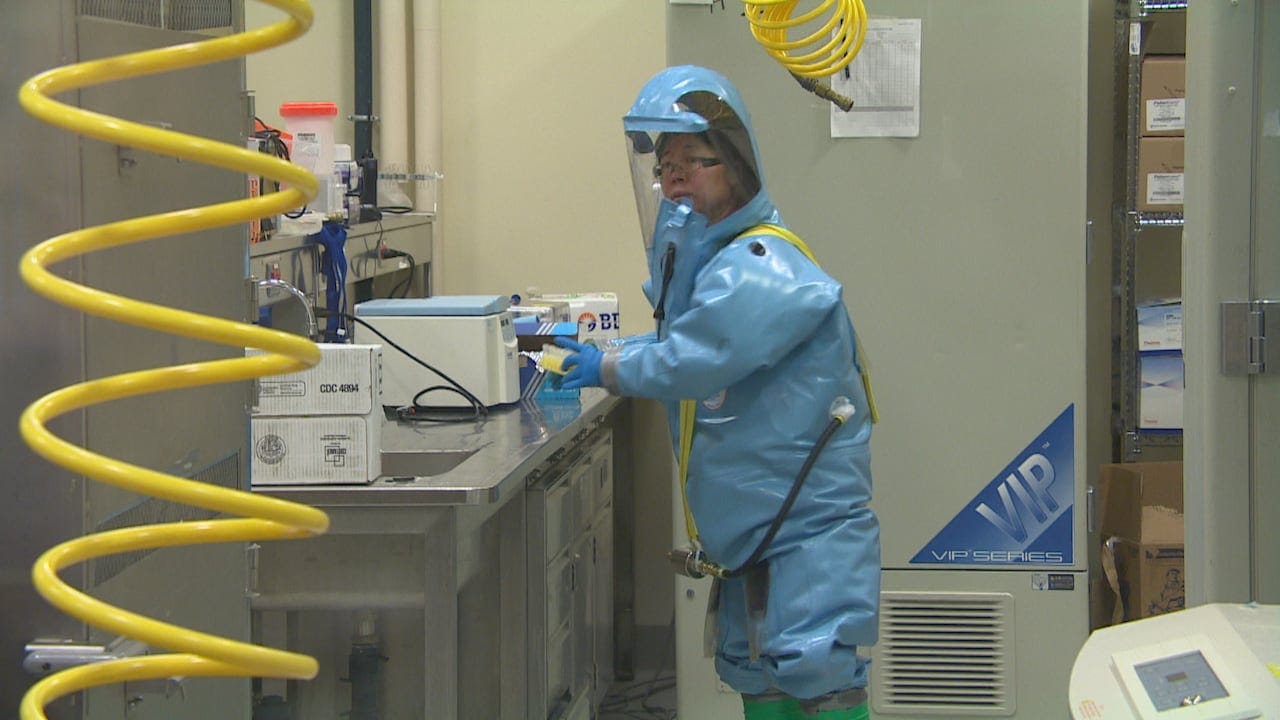
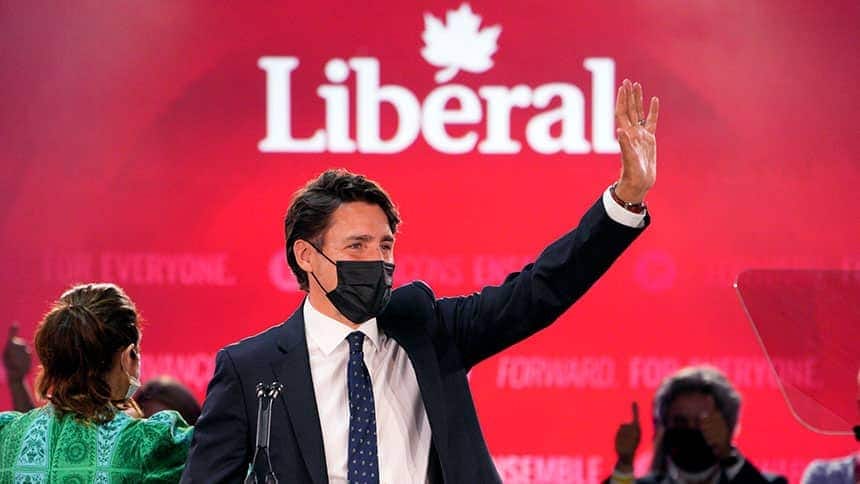
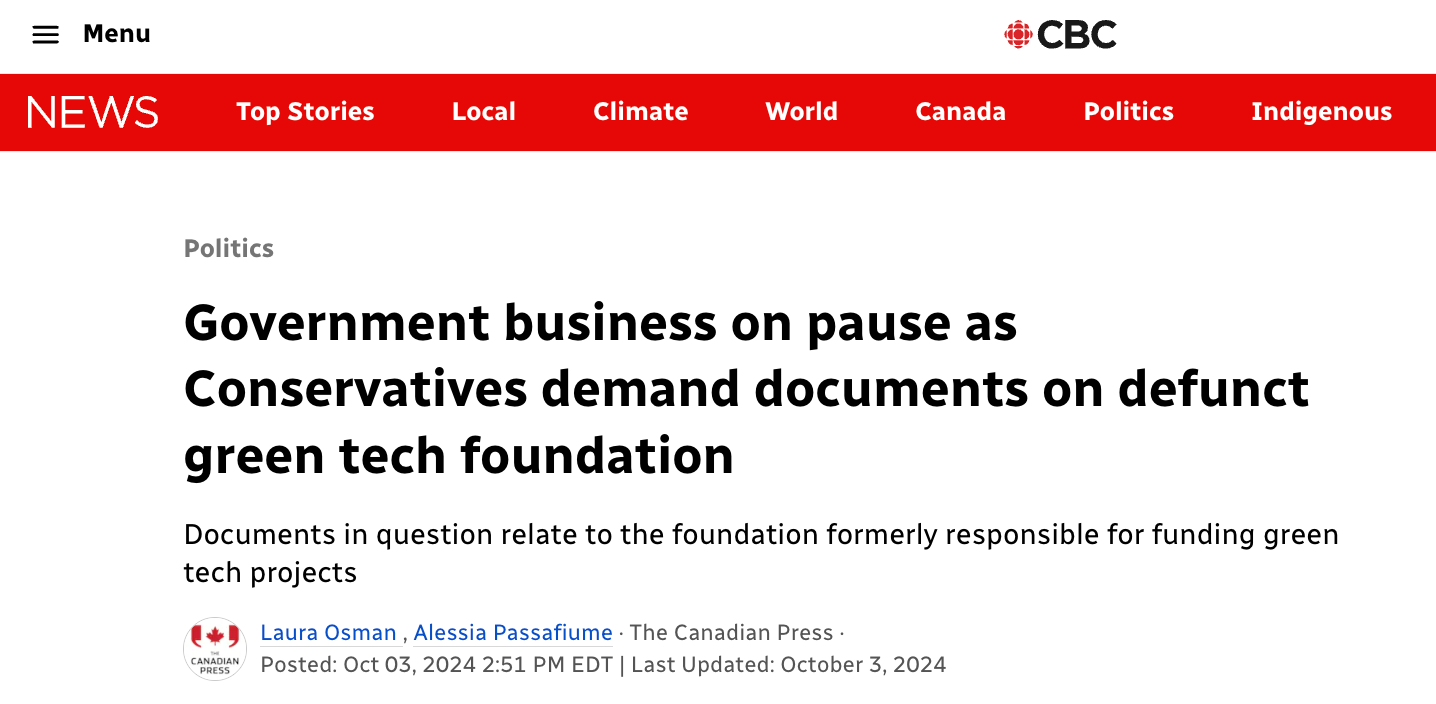
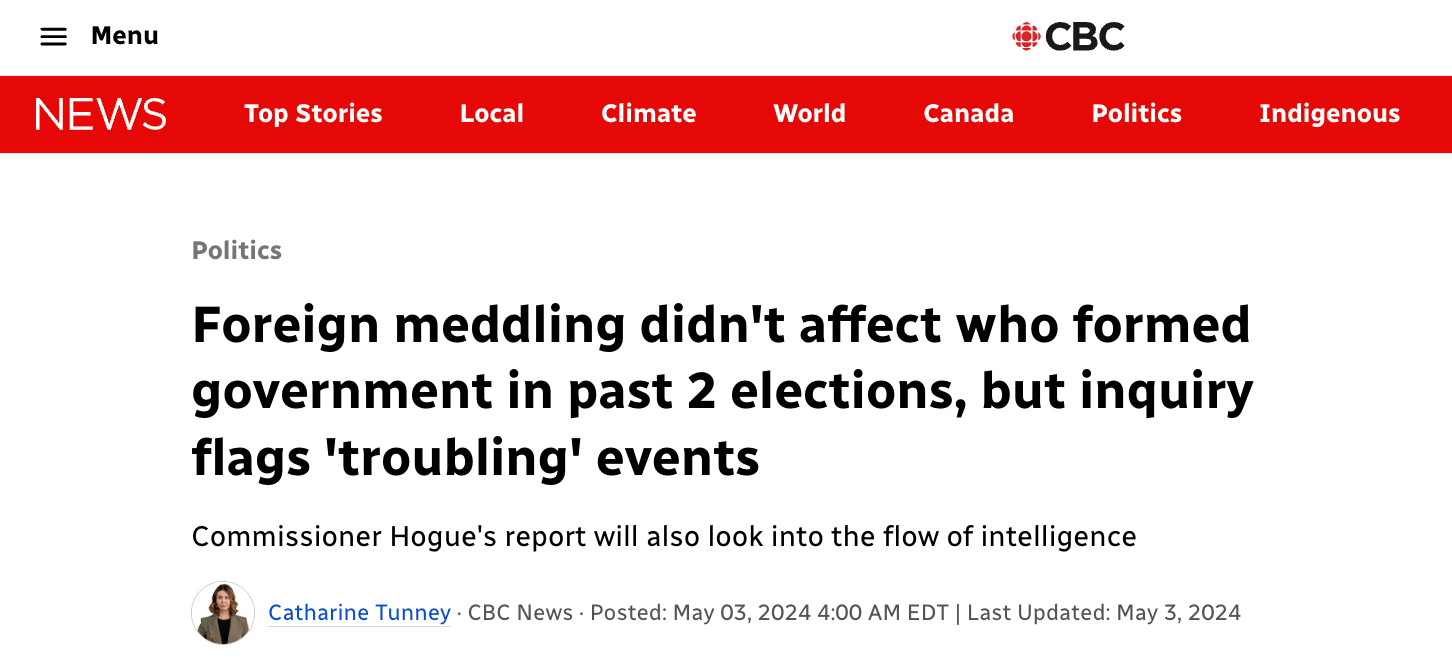
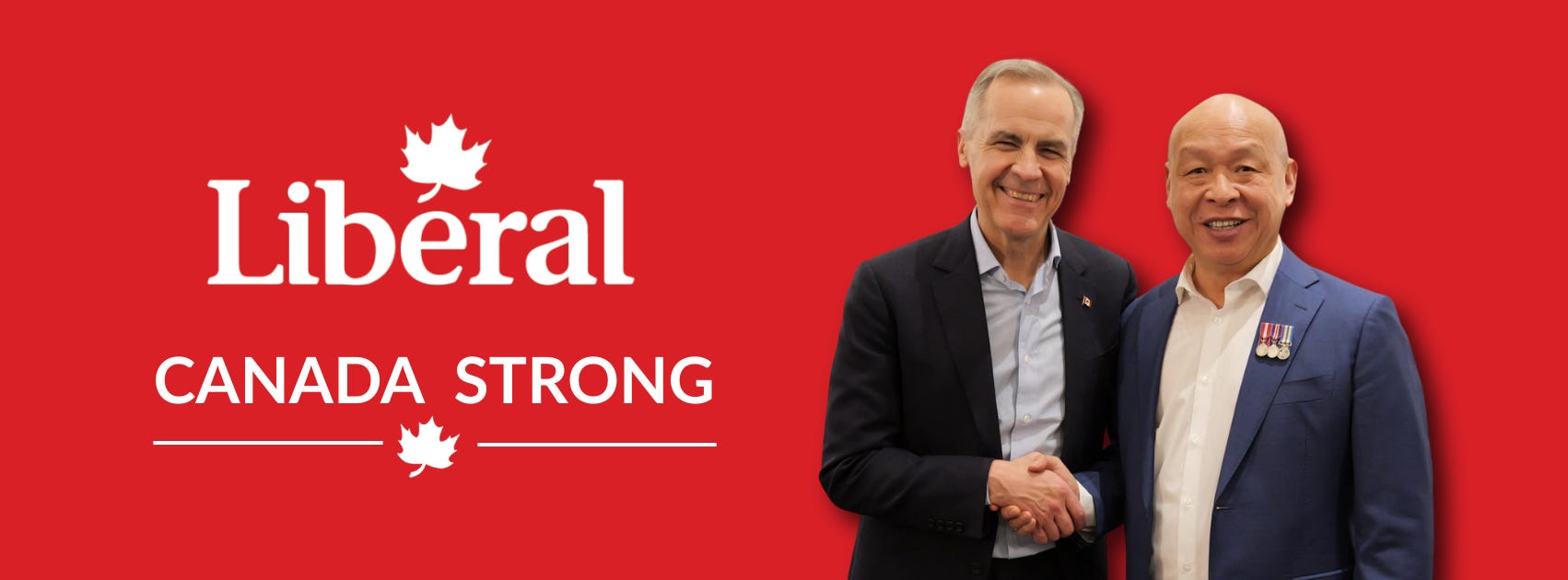
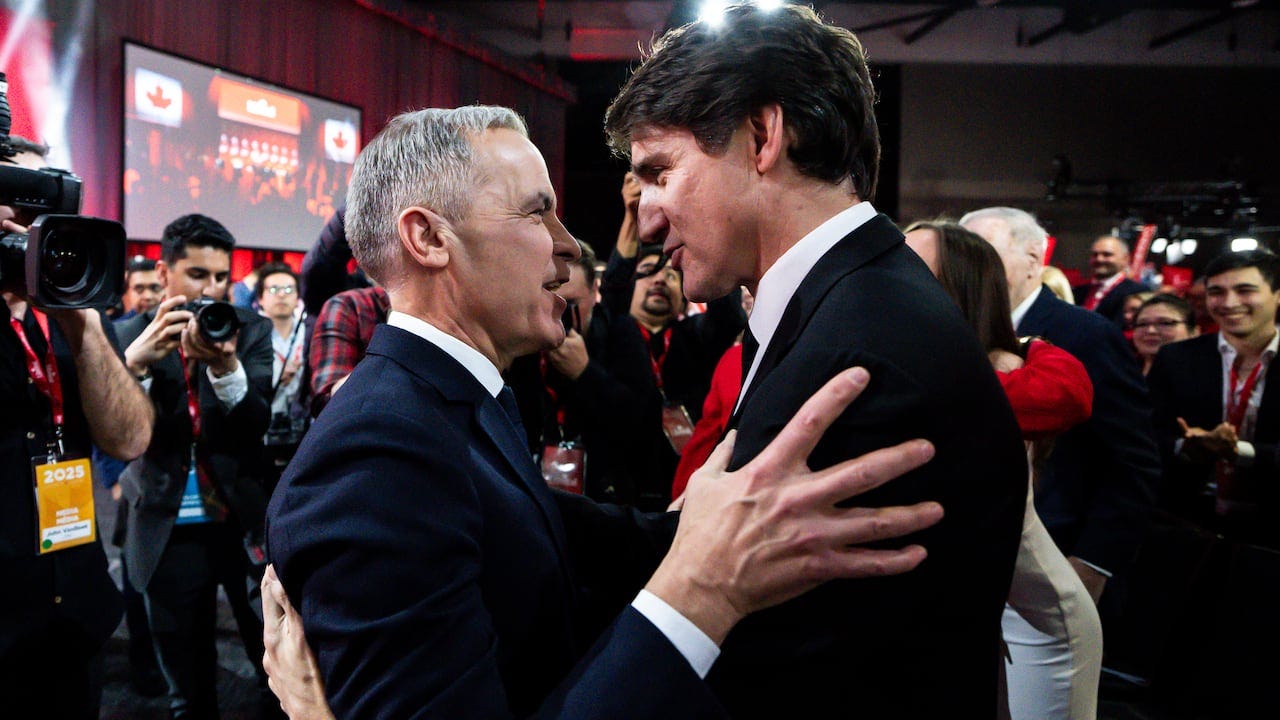
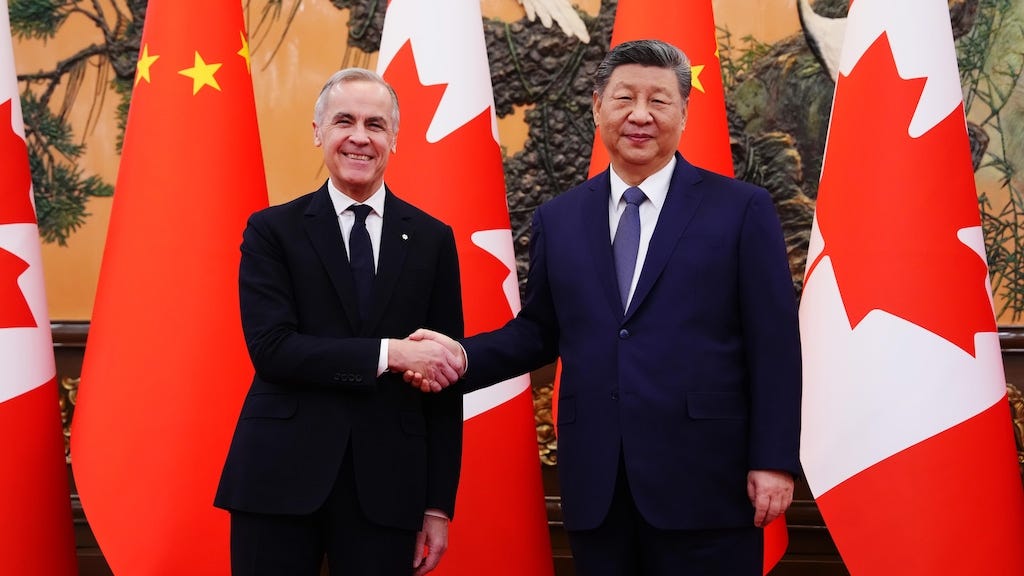

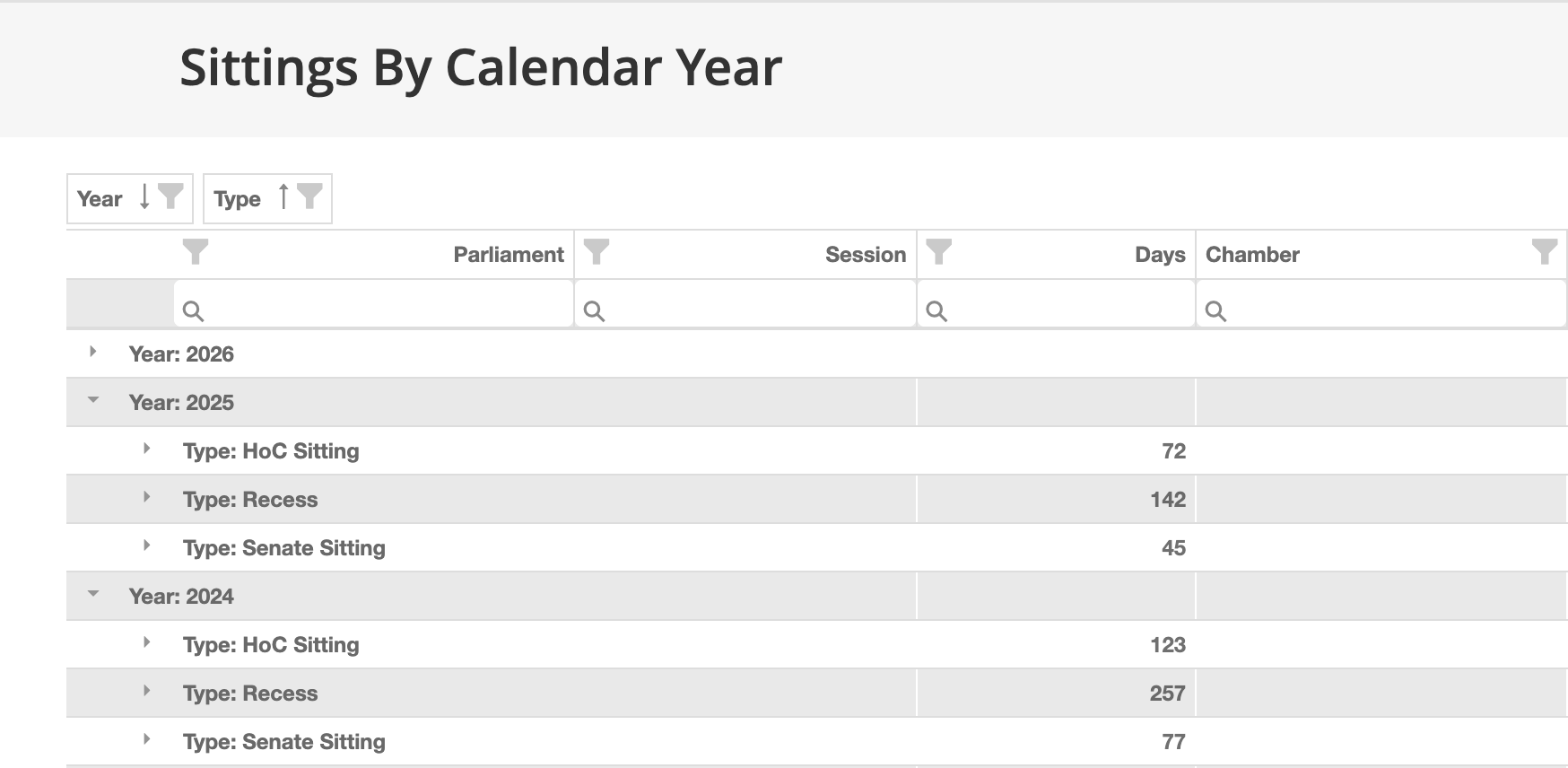
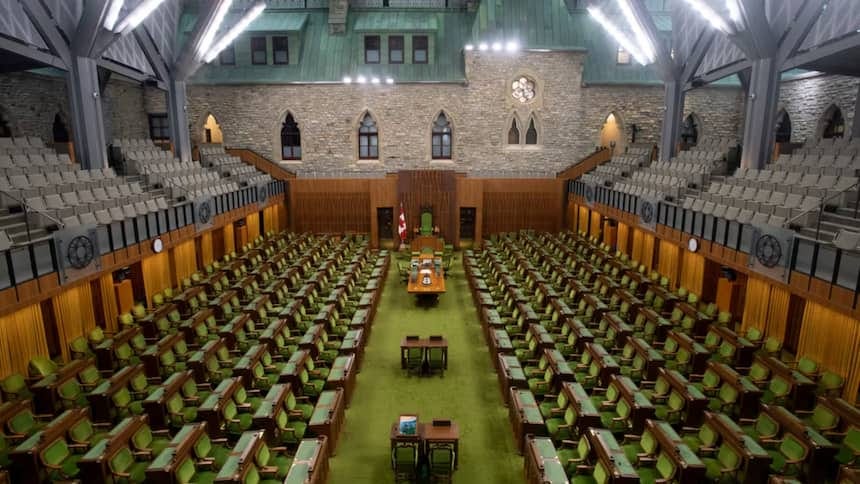

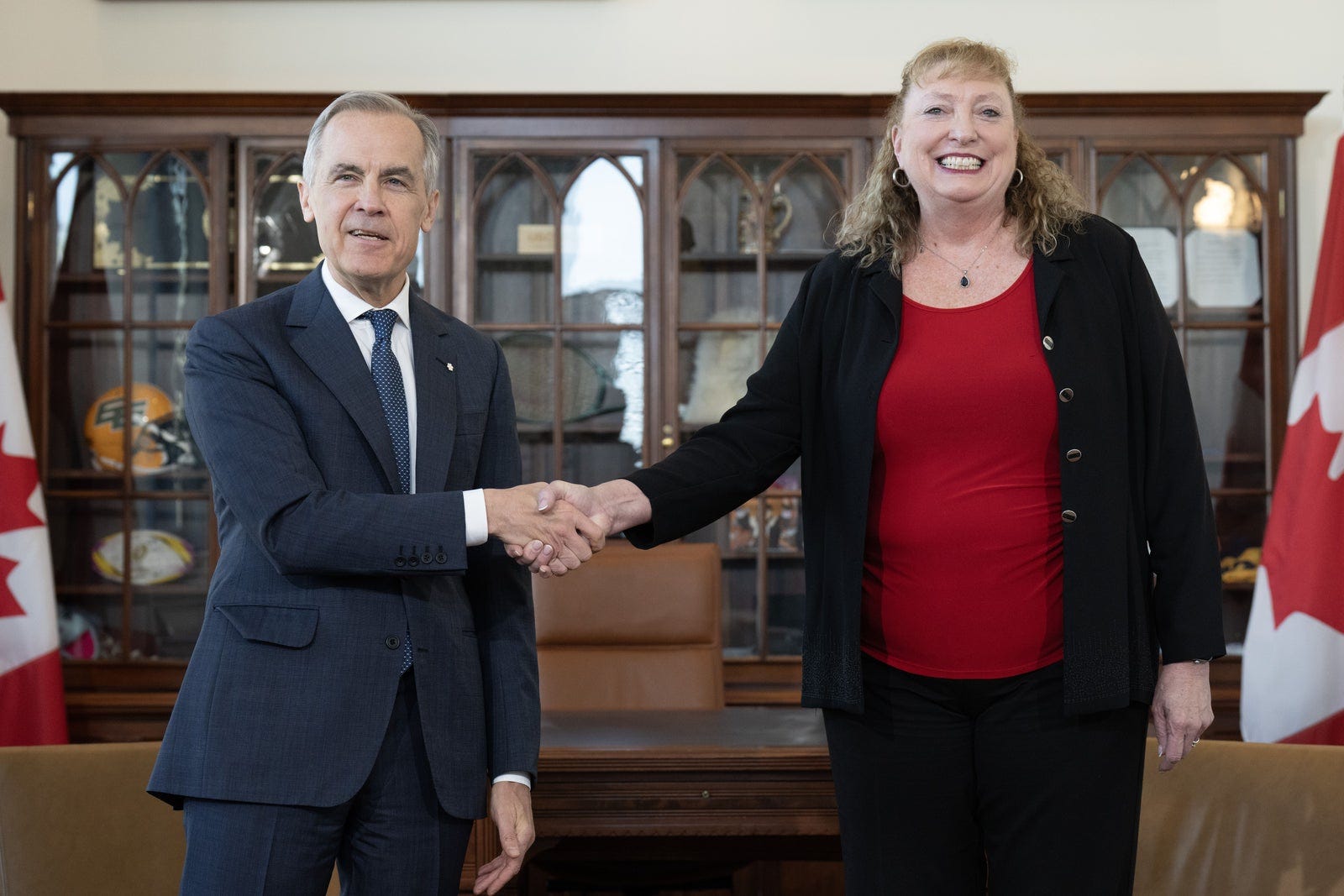

 The Canadian Press / Sean Kilpatrick