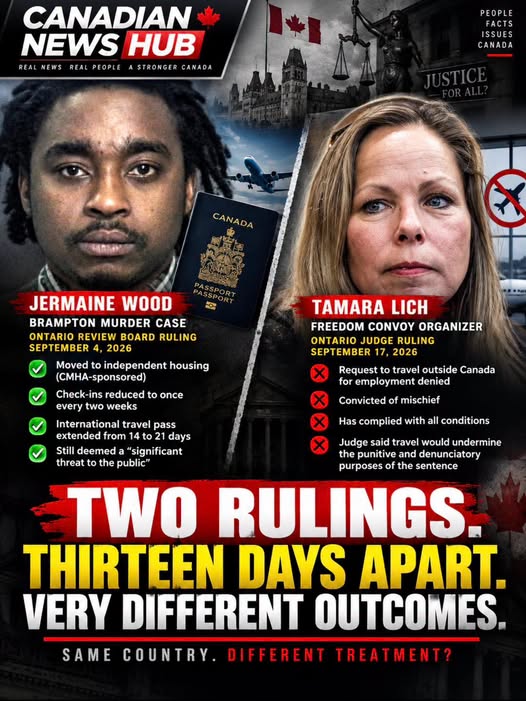
TWO COURT RULINGS, 13 DAYS APART, SPARK QUESTIONS ABOUT CANADA’S JUSTICE SYSTEM
Two Ontario decisions issued less than two weeks apart have drawn attention to sharply different restrictions placed on two people involved in very different cases.On September 4, 2026, the Ontario Review Board ruled that Jermaine Wood, who was found not criminally responsible on account of mental disorder for the 2015 killing of 61-year-old Robert McCollum in Brampton, could remain under a detention order while moving into Canadian Mental Health Association–sponsored independent housing.Wood attacked McCollum with a machete as McCollum was carrying groceries in their apartment building. Wood was found not criminally responsible for first-degree murder in 2019.The Review Board stated that a “significant threat to the safety of the community” remained evident. His reporting requirement was reduced to once every two weeks, and his permitted international trips were extended from 14 days to 21 days. However, the board rejected his request for a conditional discharge and required international travel to be accompanied by an approved person.Then, on September 17, 2026, an Ontario judge rejected Tamara Lich’s request to travel internationally for employment-related activities.Lich, a key organizer of the 2022 Freedom Convoy, was convicted of mischief and received a conditional sentence involving 12 months of house arrest and 100 hours of community service. The judge acknowledged that Lich had complied with her sentence conditions, but ruled that the requested international travel would undermine the punitive and denunciatory purposes of the sentence.The court’s decision was not based on Lich’s political views, and the judge specifically stated that she remained free to speak, write, engage in journalism and criticize the court.The two cases involve fundamentally different legal circumstances: Wood was subject to Ontario’s mental-disorder review system after being found not criminally responsible, while Lich is serving a criminal sentence following a mischief conviction.Still, the contrasting travel and supervision decisions are likely to fuel public debate over proportionality, public safety, rehabilitation and how Canada’s justice system applies restrictions in different circumstances.Two rulings. Thirteen days apart. Very different circumstances—and very different restrictions.