Tag Archives: BIPOC

The War On Whites: Feds Fund Swimming Lessons That Exclude Whites

Posted on by

The War On Whites: Feds Fund Swimming Lessons That Exclude Whites

Fed-funded non-profit hosts black, minority-only swimming lessons

[Growing up in the ’50s and ’60s, Canadians were regaled with stories of discrimination against Negroes in the SOUTH: they had to use their own washrooms, swimming pools and schools. Equality was the by-word. Discrimination was a horrible thing. Similar ideas were introduced into Canada. Our Charter of [Minority Special] Rights and [Majority limited] Freedoms. Insisted on equal rights. But there was a deceptive weasel clause.Discrimination was alright if it benefited special minority groups. The immigration policies of the Liberals, the Conservatives and the NDP seek the replacement of Canada’s European founding/settler people, but not just replacement, but active repression of the dwindling European people. “Employment equity” and “diversity, equity and inclusion” mean preference for minorities and increasing exclusion of Whites. Special federal subsidies to employers hiring recent immigrants (almost all from the Third World( keep wages low and expecially disadvantages young White seeking jobs. And now, the latest: the federal government — that’s YOUR tax money — is funding a swimming programme for non-Whites only. You’re the victim of discrimination in your own country and are paying for it! — Paul Fromm]

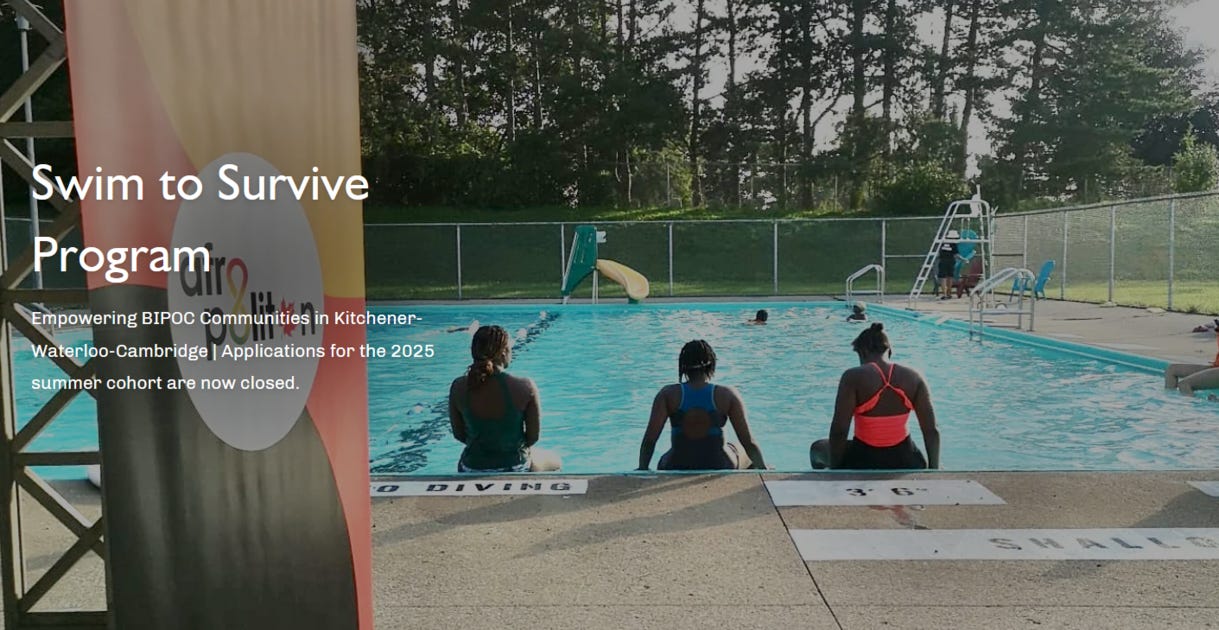
A non-profit organization supported with over $85K in federal funding is delivering race-based swimming lessons.

Jul 03, 2025
Source: afropolitan.ca

Author: Melanie Bennet

A non-profit organization supported with over $85K in federal funding is delivering race-based swimming lessons. Several grants have been awarded to support race-specific services, even as public support for diversity, equity, and inclusion initiatives appears to be declining in Canada and abroad.

Afropolitan Canada describes itself as a bilingual organization that supports lack, Indigenous, and people of colour (BIPOC) communities through education, mental health, and life skills. Many of its initiatives, including swimming lessons, outdoor education, scholarships, and youth employment opportunities, are restricted to participants based on race.

The federal government has awarded multiple grants to Afropolitan Canada. In total, the non-profit has received over $85,500 in federal grants since 2021 under the Community Support, Multiculturalism, and Anti-Racism Initiatives, Employment and Social Development Canada, Supporting Black Canadian Communities Initiative, and Canada Summer Jobs.

In addition to race-exclusive swimming lessons, Afropolitain delivers multiple race-specific programs, including outdoor activities, tennis, and a scholarship fund. The initiatives are said to be “culturally responsive” and necessary to address what it calls equity gaps. These approaches reshape public programs like education, healthcare, mental health or justice to prioritize the cultural backgrounds of specific identity groups.

Equity, in opposition to equality, aims to eliminate gaps between groups rather than meeting the needs of individuals without regard to identity. Some proponents of equity even go so far as to reject racial colour-blindness as a form of racism. For instance, its scholarship program states that BIPOC students are more reliant on loans and as they’re more likely to be living below the poverty line. It’s unclear whether the loans are assessed based on family income or race alone.

Programs like these continue to receive grants even as public support for identity politics wanes. A 2021 Angus Reid Institute survey found that only 28% of Canadians support race-based hiring and admissions policies.

More recently, a 2025 poll by Abacus Data and the Canadian Media Producers Association revealed that 91% of Canadians believe it is important to protect Canadian culture and identity, while 58% would support a political party that promotes a unifying Canadian identity.

Despite millions invested in anti-racism strategies aimed at eliminating disparities, government data suggests that feelings of discrimination remain widespread. According to Canadian Heritage, 38% of Canadians report experiencing discrimination, rising to 50% among Indigenous people and 78% among visible minorities. This raises questions about whether identity-based interventions are achieving their goals or inadvertently exacerbating divisions.

The debate isn’t limited to Canada. An analysis of political sentiment indicates a global backlash against identity-based governance. Across Europe and North America, public frustration is mounting over programs seen as exclusionary or out of touch with material needs.

In countries like Sweden, France, and the U.S., working-class voters increasingly reject progressive identity politics in favour of more universal social policies. Canada, however, continues to expand DEI frameworks within federal funding, research-granting agencies, and community programming.

A report by the Macdonald-Laurier Institute documented the growth of DEI frameworks within Canada’s federal research granting agencies, which collectively manage nearly $4 billion in funding annually.

Supporters argue that these initiatives are corrective and time-limited, meant to close disparities caused by historical injustices. However, racial groups continue to report discrimination, while race-based eligibility for social programming ignores a multitude of other factors affecting Canadians.

More Anti-White Hatred in Our Education System

Posted on by

Forwarded this email? Subscribe here for more

EXCLUSIVE: School board trains staff that the term ‘family’ is harmful, racist

Waterloo Region District School Board staff are being trained that the word “family” is a harmful concept rooted in white supremacy.

Guest post
 
READ IN APP
 
Source: True North

Waterloo Region District School Board staff are being trained that the word “family” is a harmful concept rooted in white supremacy.

Juno News is funded by proud Canadians like you. Join us and support our work. Upgrade to become a paid subscriber.

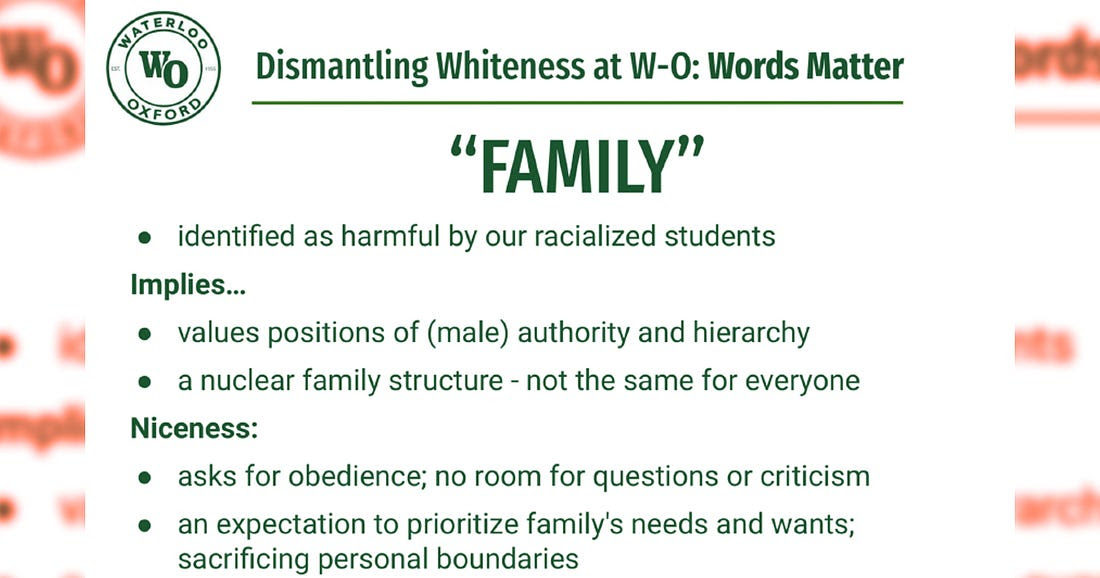
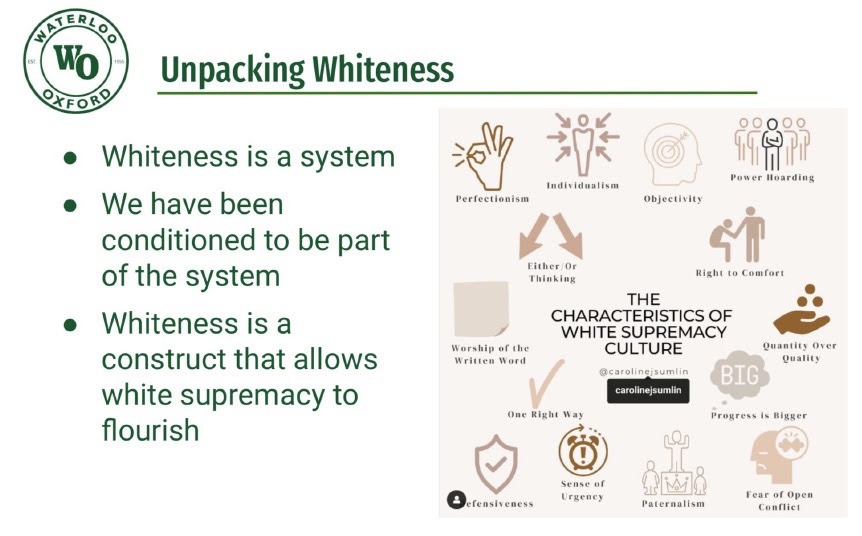
True North obtained internal training materials delivered to the staff at Waterloo-Oxford District Secondary School by the Ontario Secondary School Teachers Federation which assert that terms like “objectivity,” “perfectionism,” and “worship of the written word” are hallmarks of “Whiteness” and upholding white supremacy.

A close-up of a white text

AI-generated content may be incorrect.

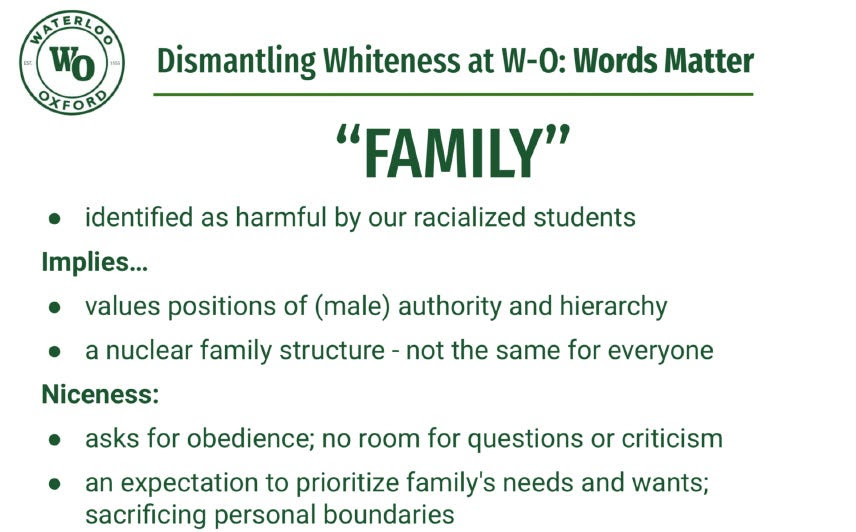
Quoting from Culturally Relevant Pedagogy by Laura Mae Lindo, one slide states that “biases are the socialized teachings of the white culture,” and “we use key words and phrases to promote the dominant culture.” One of the offensive words in question is “family,” which is said to be harmful to racialized students because it implies male authority, demands obedience without question, and erodes personal boundaries by “prioritizing the family’s needs.”

Another slide asserts that asking for evidence for claims of racism or acknowledging racism toward white people is a “characteristic of whiteness” that must be dismantled.

“The pain and hurt and discomfort are not ancillary to antiracism work, they are the guts of it” it says. “Without them, change simply does not happen,” quoting from White Women: Everything You Already Know About Your Own Racism and How to Do Better. The WRDSB’s 2024 workforce census reports that 90% of staff are white and 79% are women.

A source within the board who provided the materials and asked to remain anonymous questioned whether the messaging truly reflects the views of most staff. “Teachers just want to get on with their job of teaching,” the source said. “Ideology—if you will—is just something many teachers acknowledge as being present. They just want to get on with their jobs.”

Within staff circles, caution has become routine as the source was advised to “be careful” when sharing information with outsiders. They pointed to the case of Ontario teacher Chanel Pfahl, who the Ontario College of Teachers investigated after publicly criticizing anti-racism education.

“Whether [anyone within the administration] believes it or not is anyone’s guess,” the source said.

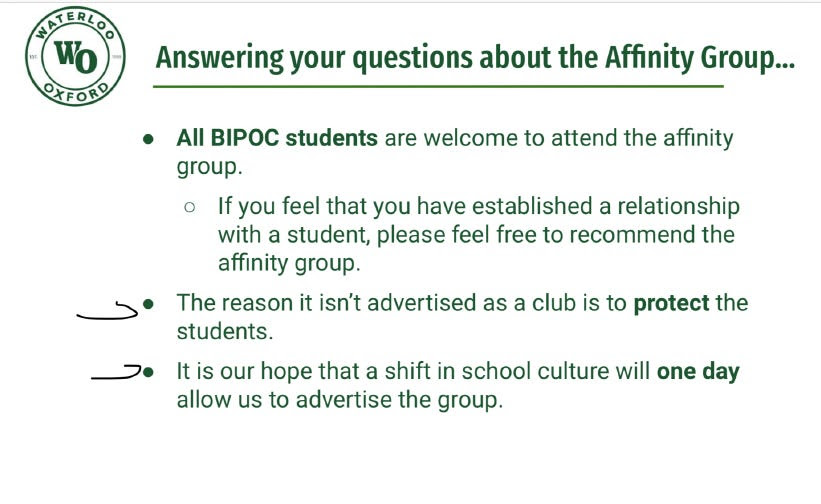
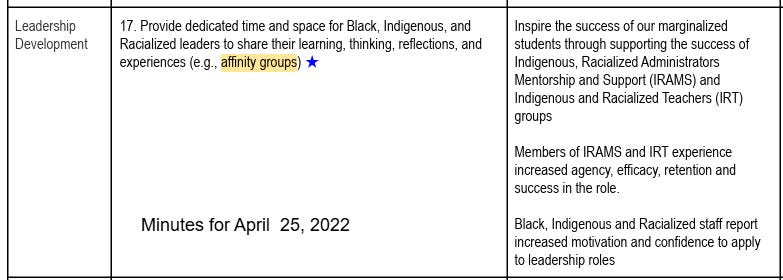
Another slide promotes the use of “BIPOC affinity groups,” described as exclusive, invitation-only spaces for non-white staff or students. These groups are deliberately kept confidential, justified by the claim that school culture is inhospitable to racial minorities. Despite their private nature, the groups are cited in WRDSB board meeting minutes and equity reports as markers of institutional progress.

A screenshot of a questionnaire

AI-generated content may be incorrect.

Despite denials, Ontario’s Ministry of Education endorses culturally relevant and responsive pedagogy, which serves as the applied form of critical race theory. It is not a standalone course but a political framework that filters classroom instruction through the lens of identity, power, and systemic oppression. The Ministry’s Equity Action Plan requires that culturally relevant and responsive pedagogy should be integrated across all subjects.

Support Juno News

According to Stephen Reich, a PhD student in educational leadership and policy at the Ontario Institute for Studies in Education, the concept of “whiteness” is directly borrowed from critical race theory. Reich, who studies the politicization of education, told True North that there is no experimental evidence showing that anti-racist approaches reduce discrimination. In fact, he argues these methods often “create bias where none previously existed.”

Reich noted that there is “no evidence that anti-oppression education narrows learning gaps” adding that limited studies attempting to measure any benefits have found that such programs “make students more fluent in anti-oppression language—nothing more.”

The WRDSB previously denied that critical race theory is part of its programming. In June 2022, trustee Cindy Watson introduced a motion requesting a report on the use of critical race theory in lesson plans.

“There is much confusion from parents and staff around CRT and white privilege, the confusion is breeding concerns, sharing concerns leads to fear of being judged or being labelled a racist and judgment will ultimately always bring division,” Watson said during the board meeting. WRDSB staff responded that critical race theory was not part of the curriculum, and the motion was voted down.

True North reached out to the WRDSB for comment but did not receive a response.

Anti-racist hiring practices have followed similar lines. On March 23, WRDSB hosted a job fair specifically for “Indigenous, Black & racialized individuals.” The stated rationale was to ensure that students “see themselves reflected in the education system.”

The board does not currently have a formal anti-racism policy although one is currently under consultation, with a target completion date in Fall 2025.