
Anti-White Discrimination at Yukon Hospitals & B.C. Parks
[The degrading of the European founding/settler people of Canada increases every day. The perpetrators are our own treasonous elite. The latest: the Yukon’s three hospitals will now practise segregation with privileged parking spaces reserved for native Indians. Another slap in the face to the Whites who pay the overwhelming majority of the taxes.The justification? “These spaces are one way we are showing our commitment to Truth & Reconciliation, Decolonization & Indigenization.”
The soul-sickening, phony White guilt pervades the hospitals approach.
“Systemic racism and intolerance is pervasive and deep-rooted . … We know it is present in Canada, in the Yukon and in our communities. It exists within our hospitals and health care system,” reads the agency’s 2022-2027 strategic plan. Yes, “systemic racism” directed at the overtaxes, White dispossessed Majority.
Meanwhile in neighbouring British Columbia, Whites will be excluded from certain provincial parks they pay for for certain times this summer. “
One of the more controversial was the B.C. government agreeing last year to begin closing select provincial parks to non-indigenous users.
Just this weekend, in fact, B.C. is set to shut off public access to Botanical Beach, a popular section of the Juan da Fuca trail. According to a statement by the B.C. Ministry of Environment, the 72-hour closure is being done “to give members of the Pacheedaht First Nation time and privacy to harvest marine resources, connect with part of their territory.”
A much longer closure is also being ordered for Joffre Lakes Provincial Park, which will be closed between June 20 and 27, and then again between Sept. 8 and 30. “These periods will provide space for the Lilwat Nation and N’quatqua to connect with the land,” reads a disclaimer on the park’s official site.” (National Post, June 16, 2026)
n Canadian first, Yukon creates race-based parking
YUKON POLICY IS TO ASK PATIENTS INDIGENOUS STATUS TO ACCESS SPECIALIZED SERVICES
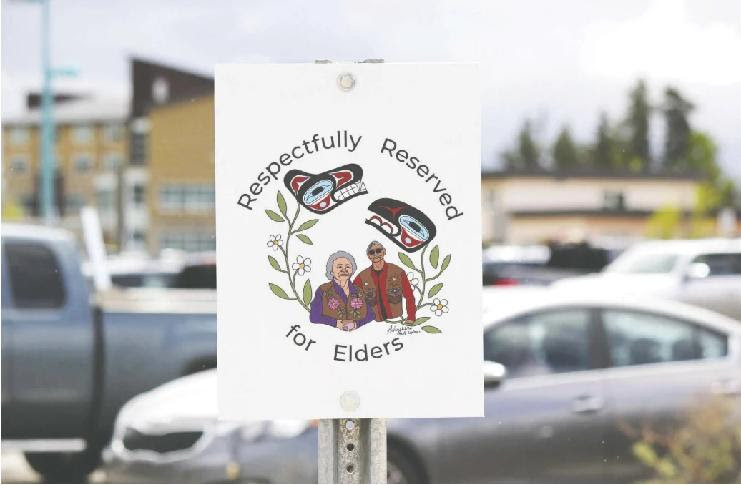
As part of their stated commitment to “decolonization and Indigenization” in health care, the Yukon is debuting Indigenous-only parking spaces at all three of its hospitals.
In a social media post last week, Yukon Hospitals announced that the territory’s hospitals would henceforth feature reserved parking spots marked “Respectfully Reserved for Elders.”
Reserved exclusively for “First Nation, Inuit, and Métis Elders,” the spaces are marked with signs featuring commissioned art from two Yukon-based Indigenous artists; one prepared a stylized image of two elders, while another prepared the accompanying text reading “respectfully reserved for elders.”
“These spaces are one way we are showing our commitment to Truth & Reconciliation, Decolonization & Indigenization,” reads a description by Yukon Hospitals.
The elder spots are set to be installed at the territory’s main hospital in Whitehorse, as well as at the Dawson City Community Hospital and the Watson Lake Community Hospital. Parking for everyone at all three hospitals is free.
They will be placed in lots whose only other designated parking is currently for staff or disabled users. Although the Whitehorse General Hospital notably has designated RV parking: a service for patients from distant communities driving in for scheduled procedures.
Yukon Hospitals, like many Canadian government and health-care authorities, has publicly embraced the notion that its facilities are shot through with “systemic racism” that can only be alleviated via differential treatment for marginalized groups.
“Systemic racism and intolerance is pervasive and deep-rooted . … We know it is present in Canada, in the Yukon and in our communities. It exists within our hospitals and health care system,” reads the agency’s 2022-2027 strategic plan.
That same plan has the hospital authority pledging to make “Yukon First Nations ways of knowing, doing and being part of everything we do.”
Up to one-third of patients at Whitehorse General Hospital are Indigenous, according to a Yukon Hospitals estimate in a 2016 newsletter.
And the territory, like B.C., has a policy of asking patients their Indigenous status in order to access culturally specific services such as traditional food or “traditional medicine.”
The system is largely based on the honour system, however. The patient guidebook to the Whitehorse General Hospital notes that the facility’s admitting desk will “ask every patient if they would like to identify as First Nations, Métis or Inuit.”
“This will ensure that all persons that self-identify will have access to our programs,” it notes.
The threshold of Indigenous-only parking spots is a new one. Not just in the Yukon, but in Canada generally.
In fact, the Indigenous-only spots appear to be Canada’s only instances of public parking spots being set aside based on the immutable characteristics of the driver.
The closest analogue would be instances in both Germany and South Korea where public parking spots were set aside exclusively for women. Germany has been installing women-only parking spots since the 1990s, following a wave of violent sexual assaults taking place in parking garages.
The spots, labelled “reserviert fuer frauen,” are typically in well-lit areas located close to building entrances. No such “she-spots” or “Frauenparkplatz” are known to exist in Canada, although there are spots for expectant mothers, or parents with young children.
The Yukon parking spaces do fit within a larger trend of Indigenous Canadians being given priority access to public spaces in the service of reconciliation.
One of the more controversial was the B.C. government agreeing last year to begin closing select provincial parks to non-indigenous users.
Just this weekend, in fact, B.C. is set to shut off public access to Botanical Beach, a popular section of the Juan da Fuca trail. According to a statement by the B.C. Ministry of Environment, the 72-hour closure is being done “to give members of the Pacheedaht First Nation time and privacy to harvest marine resources, connect with part of their territory.”
A much longer closure is also being ordered for Joffre Lakes Provincial Park, which will be closed between June 20 and 27, and then again between Sept. 8 and 30. “These periods will provide space for the Lilwat Nation and N’quatqua to connect with the land,” reads a disclaimer on the park’s official site.