Australia’s populist One Nation scores first-ever lower house victory
Winning candidate, David Farley, has advocated for stricter migration and farming reforms.
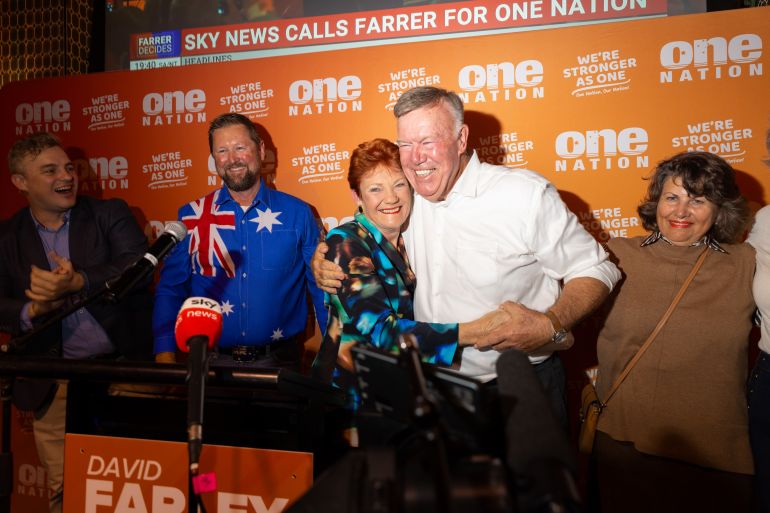
One Nation leader Pauline Hanson and winning candidate David Farley embrace as their party wins the Farrer by-election on May 9, in Albury, Australia [Jesse Thompson/Getty Images]
Australia’s far-right One Nation party has captured a seat in the country’s House of Representatives for the first time, according to preliminary election results.
David Farley, a former agribusiness consultant, is on course for a decisive victory in the special election for Australia’s southwestern division of Farrer, located in New South Wales state, the Australian Broadcasting Corporation reported on Saturday.
Farley had a projected 59.1 percent of the vote, compared with 40.8 percent for his independent opponent Michelle Milthorpe, according to the ABC. The centre-left Labor Party, which has a majority in the lower house, did not run a candidate for the seat.
“It’s very clear, the next member for Farrer is David Farley,” ABC election analyst Casey Briggs said in a broadcast. “It’s not a close result.”
One Nation at ‘the end of its beginning’
Farley, who has advocated for reduced migration and farming reforms, will hold the vacant seat left by the resignation in February of Sussan Ley, leader of the centre-right Liberal Party.
The result marks the first time One Nation, founded by politician Pauline Hanson, has won a lower house seat in its 30-year history. Farley, speaking after his projected victory, said the party “has reached the end of its beginning” and is “going through the ceiling”.
Addressing his policy priorities, Farley said he would pursue an immigration policy based on the needs of Australia’s labour market, particularly in agriculture. “We’re not going to implode any of our industries that are reliant on good quality, assimilating migrants into the country,” he said. “But we’re not going to entertain people to come here and live off our balance sheet, our purse and give us nothing.
Advertisement
He also said he would work to bring down the cost of living. “We’re going to have policy that fits Australia, not the world,” he said.
‘Reflect the anger we feel’
Milthorpe congratulated Farley on his election win and said the next two years would be a test for One Nation, which now faces the tough challenge of translating the popular anger it has tapped into concrete results. “They will successfully reflect the anger we feel out here. But that is the easy part,” she said. “The hard part is doing something about it.”
Get instant alerts and updates based on your interests. Be the first to know when big stories happen.
Farley’s victory does little to affect the balance in the lower house of parliament, where the Labor Party holds 94 of 150 seats.
However, the victory is in line with growing electoral support for far-right populist parties globally. Earlier this week, Britain’s populist right-wing Reform UK party made sweeping gains in local council elections at the expense of Labour.
As I was writing this article several thousand British citizens were outside a police station in Southhampton, England, demanding accountability for the murder of a young white British student, Henry Nowak, by a black immigrant-invader and the white British police.
The black immigrant-invader murdered Nowak by stabbing him five times. The white British police murdered Nowak by ignoring his testimony that he had been stabbed and what turned out to be Novak’s last words: “I can’t breathe.” The British police, trained as they successfully have been to see the white person as the aggressor, instead of arresting the black immigrant-invader who attacked Nowak, fatally as it turned out, the white British police arrested the dying Nowak, who died in police handcuffs. The “racially sensitive trained” white British police believed the black immigrant-invader’s lie that Nowak had used a racial epithet. They did not believe Nowak that he had been stabbed. The “racially sensitive police” did not even look to see if Nowak had been stabbed. Instead, they handcuffed a dying man and did not call for medical help.
You would think that this would be a scandal–and it was–but not for the right reason. The rabidly anti-white white British prime minister Starmer characterized the several thousand white protesters, a small number in view of the enormity of the injustice, as “far-right rioters and racist thugs.” In other words, the Prime Minister of England sees racism not in the unprovoked deadly attack on the white Nowak by the black immigrant-invader, not in the British police’s ignoring of Nowak’s dying plea for help. The white British Prime Minister Starmer sees racism in the British citizens’ protest about what has happened. Is there any lower form of pure political excrement than Starmer ? How does a piece of political excrement such as Starmer survive as Prime Minister of Great Britain?
Now, let us ask ourselves how a white ethnic British Prime Minister from the Labour Party, which in former times prior to the despicable Tony Blair, represented the ethnic British working class, became indoctrinated and brainwashed to such an extreme extent that the racists in society are the white people who suffer from theft, rape, and murder by immigrant-invaders.?
Confront this fact: The excrement that serves as Prime Minister of Great Britain, formerly a great and reasonably moral country, has defined protest about a racist murder of a white British citizen to be “white racism.”
This is the position of white people today. In NO Western country do white ethnic citizens have the protection of law. Their own government is against them.
The UK, once an ethnic nation, now a Tower of Babel, has a “commitment to racial equality.” What does it mean? To quote the official answer, “it does not mean treating everyone ‘the same’ or being ‘color blind,’” it means limiting racism to white people.
No one but white people can be racists. This is the official position of the Starmer UK government. It was the official position of the Biden regime and the official position of all Western European governments. Trump prefers to hand over to Israel the power otherwise handed over to immigrant-invaders.
This is why the police automatically saw the murderer of Nowak as the victim and Nowak as the racist.
There are now in Britain, the US, Canada, and all of Europe organizations and intellectuals and even universities and pubic and private schools for children that are dedicated to inculcating white ethnicities with the fact that they are racists, guilty of so many crimes against “people of color” that they must now step aside and accept retribution by accepting rule over them by the former oppressed peoples they allegedly exploited and brutalized, just as gentiles must give way to Jews to make up for the holocaust.
For several years I have reported Scandinavian media accounts of white ethnic Swedish, Norwegian, and Danish women raped by immigrant-invader rape gangs. For the most part, the women fear to report their rapes and gang rapes, often in public where the cowardly Scandinavian men hide their eyes, because they fear being accused of a hate crime by disrupting or reporting a rape of a white women by a black person. In Sweden, the rape of white ethnic Scandinavian women by black immigrants is almost a privilege protected by law. Europeans and British are punished for speaking against immigrant-invaders as Americans are for any criticism of Israel.
If you are not convinced that the Western World is so anti-white that white ethnicities are demonized, consider this:
British nurseries have been ordered to report “racist” three-year old toddlers to British police. In Britain white British 3-year-olds can be reported to the police for “hate crimes.”
Childcare workers in Wales have been told to call police on children as young as three if they are suspected of “racist” behavior, according to a new official guidance backed by the Labour government.
This policy introduced by Diversity and Anti‑Racist Professional Learning (DARPL), an anti-white organization that has received government funding, trains childcare workers to assess whether a child’s behavior could be deemed a “hate crime” and, if so, to call authorities.”
Multiculturalism has dissolved Great Britain into an anti-white cesspool.
Everywhere in the Western World white ethnicities have been brainwashed that they are evil, racist, and oppressive and must no longer stand in the way of rule by immigrant-invaders. And they don’t. The indoctrinated white people now elect immigrant-invaders to public office, including prosecuting attorneys who promptly went to work framing President Trump. The leader of the British Conservative Party is a black woman.
There are plenty of black leaders but no leaders of white people. No white leader can arise, because by definition any support for a white leader is racist. Nowhere in the Western world can a white leader be found who is not being suppressed by his/her own white government.
Two-tier policing is now the norm in the Western world. We are approaching the time when the only white people who exist will be in zoos as examples of white racist exploiters.
Jewish interference in Australia’s internal security service
IN A TENSE Senate Estimates hearing, Australian Security Intelligence Organisation (ASIO) Deputy Director-General Miss Gilmore was subjected to extended questioning by Greens Senator David Shoebridge over Israeli President Isaac Herzog’s visit to ASIO’s headquarters in the Ben Chifley Building. This may be the only instance of a Greens Party’ squid helping Australia.
The nearly 13-minute grilling reflected ongoing unease about foreign influence in Australia’s national security apparatus and the unusual decision to host a foreign head of state inside the country’s principal domestic intelligence agency.
MEDIA MOGUL MOSES ZNAIMER ADMITS JEWISH LOBBYING LARGELY RESPONSIBLE FOR INFLUX OF MOSLEMS Professor Kevin Macdonald forcefully argued in his book Culture of Critique (revised edition $50 from C-FAR Books, P.O. Box 332, Rexdale, ON., M9W 5L3, Canada) that Jewish lobbying pressure was lately responsible for the demographic wrecking immigration changes of the 1960s almost simultaneously in Canada, the U.S. and Australia. (No more White Australia.) There was no popular demand at the time urging the politicians to let in the Third World, just a lot of behind the scenes manipulatring and lobbying. In his column in the National Post (June 4, 2026), John Ivison bemoans the fact that Prime Minister Carney was not even more strident in his speech to a Toronto synagogue Monday “denouncing anti-Semitism. The following remarks are vital to see who lobbied to change Canada. In some ways, it may not be turning out the way the lobby had planned.
“In the course of researching my biography on Irwin Cotler, I spoke with his old McGill debating partner, Moses Znaimer, the CityTV and MuchMusic founder.
In typically unfiltered Znaimer fashion he wondered aloud what the former Liberal party justice minister thought about his old party, “which betrayed the Jewish community, in favour of the huge Muslim influx, of which they are largely the authors.”
“It must be heartbreaking,” he said.Znaimer is no stranger to provocative statements. But the enmity toward the Liberals is a view that is widely held in the Jewish community — and there is evidence to suggest the accusation is grounded in fact.
Not least, there was the candid admission by Mélanie Joly, the then foreign affairs minister, that local politics was shaping Canada’s more hostile official approach to Israel during its war with Hamas. According to former NDP leader, Tom Mulcair, she said to him: “Thomas, have you seen the demographics in my riding?”
The influx Znaimer referred to is also a reality. There are around 1.8 million Muslims in Canada, of which 500,000 arrived between 2015 and 2021, compared to just 300,000 Jews.”
Thank you for becoming a valued subscriber. Your support fuels the fight for freedom, sovereignty, and common-sense conservatism, You’re helping us to deliver unfiltered truth, bold ideas, and the real news they don’t want you to hear.
The tragic death of Henry Nowak has become a test of whether Western societies truly believe in equality.
Short on time? Here is a 5 dot point summary of my thoughts.
The muted reaction to Henry Nowak’s murder exposes a double standard in how racial incidents are treated when the victim is white.
Were the police too quick to believe allegations against Henry because they assumed the white person was the likely offender.
I contrast the global response to George Floyd’s death with the comparatively limited attention given to Henry Nowak’s case.
Has DEI ideology contributed to a culture in which concerns affecting white men are increasingly dismissed or ignored?
True equality requires opposing racism consistently, regardless of the race of either the victim or the perpetrator.
What’s a white life worth? Not much if you judge by the muted reaction to the stabbing murder of teenager Henry Nowak in the United Kingdom.
For years politicians, activists, corporations and media organisations have insisted that racism must be confronted wherever it appears.
Yet the reaction to the horrific death of this 18 year old has demonstrated in the starkest terms that racism against white people is considered a lesser form of discrimination.
Henry was stabbed with a 21 centimetre ceremonial sword wielded by an Indian Sikh man who then phoned police claiming the teenager had “racially attacked” him.
Henry lay drowning in his own blood, handcuffed and denied treatment by police who were only too ready to believe that the white person must have been the offender.
“I’ve been stabbed,” the teenager garbled to police as he lay handcuffed in the dirt, blood filling his lungs.
A police officer replied: “I don’t think you have mate.”
Three minutes passed before police finally paid enough attention to realise, too late to save his life, that Henry Nowak had indeed been stabbed.
The killer had already disposed of the murder weapon with the assistance of his mother, who removed it from the scene, and played the race card.
“I’ve been racially attacked by a white guy.” The killer said.
Police, long conditioned to believe that racism can only flow in one direction and that white people are inherently suspect were only too willing to believe the lie.
And now Henry Nowak is dead.
You would think the case would cause outrage.
Across the Atlantic, when George Floyd died in police custody, there were riots in the streets. Not just in American streets. There were protests and demonstrations across the Western world, entire city blocks burned.
Even UK Prime Minister Keir Starmer took a knee for George Floyd. Yet Starmer only commented on Henry Nowak’s murder after media outlets, Elon Musk and people like me began highlighting not just his silence but the legacy media and the Left.
The Prime Minister eventually released a statement expressing his condolences and concern. He said “…we must end the cycle of tragedy by tackling the horror of knife crime…”
Let’s conduct a thought experiment.
Imagine the roles were reversed.
Imagine Henry Nowak was an immigrant. Perhaps a young Pakistani man.
Imagine the outrage.
Imagine the headlines.
Imagine the speeches from political leaders.
Imagine how London would be burning right now.
The British Prime Minister would have addressed the nation and promised to do everything in his power to eradicate racism and bigotry.
But Henry Nowak was not black, he was not brown, he was white and white doesn’t count, or at least it doesn’t count as much.
I am not arguing that George Floyd received too much attention, that is a separate debate. My criticism is that Henry Nowak appears to have received too little.
If political leaders were willing to kneel for George Floyd why is there no comparable national reflection for a white teenager murdered in circumstances that raise serious questions about racial hostility?
In much of the Western world white men have become society’s acceptable target.
Diversity, Equity and Inclusion programs were originally sold as a means of ensuring equal opportunity.
But increasingly these initiatives strip men (especially white men) of their individuality and reduce them to representatives of a supposedly privileged class whose concerns can be safely ignored.
Institutions that boast about opposing discrimination now seem remarkably selective when deciding which forms of discrimination deserve attention.
And perhaps the greatest irony of all is that many of these Diversity, Equity and Inclusion programs are championed by white women who increasingly view white men not as individuals, but as members of a privileged class whose concerns can be safely dismissed.
A black man is murdered? Outrage. It’s racism.
And even if the killer was black, someone, somewhere, will insist that systemic racism was the real culprit.
But if a white man is murdered? Meh. Move along. Nothing to see here.
That is why the Henry Nowak case resonates far beyond a single tragic murder.
For many people it represents a test of whether Western societies genuinely believe in equal treatment or merely equal treatment for some groups.
People are tired of being told that racism is a national emergency one day and an inconvenient topic the next.
If racism is wrong, then it is wrong regardless of who commits it and regardless of who suffers from it.
That principle should not change according to the identity of the victim.
All I want is equality. No matter the colour of your skin.
Is that asking too much?
Senator Ralph Babet, Senator for Victoria, United Australia Party.
Senator Babet is an Australian Federal Senator, a committed advocate for freedom, and an unapologetic voice for common-sense conservatism. He is a passionate defender of Australian sovereignty, traditional values, and the right to speak the truth – no matter how unpopular it may be in the mainstream media or political establishment.
Senator Babet created Let’s Talk About It as a platform to deliver unfiltered truth, bold ideas, and the real news they don’t want you to know – without censorship, spin, or corporate interference.
“In an age of manufactured consent and media manipulation, telling the truth is an act of rebellion. Let’s Talk About It exists to inform, empower, and rally Australians who still believe in freedom, faith, and our way of life.” — Senator Babet
Canadians Face 18 Month Wait for Hip Replacement While Illegals Go to the Head of the Line: $772M FOR ASYLUM SEEKERS’ HEALTH CARE
A big portion goes to ‘failed refugee claimants’: PBO
Canada spent more than $722 million providing extensive health care to tens of thousands of asylum seekers in the last fiscal year, including a considerable portion on “failed refugee claimants” who are either languishing in the system or avoiding removal orders, according to a new report from the Parliamentary Budget Office.
The review of the Interim Federal Health Program (IFHP) also found that its costs continue to climb because of “backlogs” in Canada’s asylum system that keep claimants waiting, in some cases for up to three years.
The IFHP was created to provide limited and temporary health-care coverage to foreign nationals deemed vulnerable and disadvantaged.
Conservative health critic Dan Mazier and immigration critic Michelle Rempel Garner said the report shows that the Liberals’ temporary program “has turned into a multi-year, taxpayer-funded entitlement where tens of thousands of bogus asylum claimants are provided health benefits that Canadians are not eligible for.
“The Liberals must explain to Canadians why asylum seekers who have had their refugee claims rejected, are facing enforceable removal orders, and in some cases fail to appear for removal, continue to receive deluxe, taxpayer-funded health benefits while they avoid leaving Canada,” they said in a statement.
The total spending across all health care categories and beneficiary groups for 202425 was closer to $822 million when resettled refugees are accounted for. Unlike those seeking asylum, they “are selected and assessed abroad, with admission targets set in the Government’s Immigration Levels Plan, resulting in relatively predictable intake and processing timelines.”
The PBO noted that whereas asylum seekers claimed an average of $724 per beneficiary per year on basic care — doctor visits, hospital care, ambulances, labs, diagnostic testing and immigration medical examinations — resettled refugees averaged $97. They’re also typically off IFHP within three months and no longer than a year.
Per-person spending on basic care has increased consistently, PBO found, but spending on supplementary health products and services — urgent dental treatment, prescription drug coverage, vision care, counselling services, assistive devices and others — has grown at a much faster rate.
In 2019-20, Canada spent $94 million on supplementary benefits across all groups. By 2023-24, expenses nearly tripled to $285 million and they reached $457 million in 202425.
Two categories in particular accounted for 80 per cent of the spending: prescription drugs and urgent dental care.
The latter represents 56 per cent of program expenses.
According to PBO, the number of dental claims exploded by 43 per cent between 2019 and 2025 (240,000 to 1.4 million). Combined with a higher average cost per claim, it drove dental costs from $30 million to $257 million over that time.
PBO also found that spending on counselling services increased from less than one per cent of total supplementary spending in 2016 to 11 per cent in 2025. In 2024-25, the bill came in at $38.7 million.
“These are benefits that Canadians who have paid into the system their entire lives can’t access,” Mazier said on X.
And while those rising expenses are increasing the overall cost of the IFHP, “elevated intakes” and the resulting “persistent backlogs” are also major drivers.
Officials who managed 64,150 asylum claims in 2019 had more than 173,000 in 2024.
In line with the new Liberal government’s immigration policies, that number decreased to just over 100,000 in 2025.
“As of December 2025, over 300,000 asylum claims were pending adjudication and roughly 65 per cent of these pending claims have been in the system for longer than a year,” PBO wrote.
“This represents a five-fold increase since 2021 and is anticipated to increase in the near-term due to an influx of claims made between 2023 and 2025.”
At present, almost half (47 per cent) of the claimants have been in the system between one and two years, but the PBO estimates that the number waiting between two and three years “will notably rise by 2026-27, reflecting elevated past intake and constrained exit rates.”
And considering the backlog, PBO calculates that each additional month in processing time could drive the program costs up by $72 million in the upcoming fiscal year.
To attain asylum refugee status in Canada, applicants must pass through several layers of review and have several avenues to appeal if rejected. For instance, 79 per cent of claimants rejected by the Immigration Refugee Board filed at least one appeal, during which time they are still eligible for IFHP.
So, too, are the “nearly 74,000 failed refugee claimants” among the CBSA’S removals inventory, which consists of 23,429 people whose removals are in process and 27,797 who failed to show up for removal and are being sought by border authorities.
“It is undeniable that as the backlog grows, rejected asylum claimants continue adding pressure to a health care system where Canadians are already facing long wait times for care,” Mazier wrote on X.
It should be noted that CBSA removals have increased, climbing from 5,714 in 2021 to 19,579 last year.(National Post, May 27, 2026)\
Where are the feminists on Black Significant Other femicide?
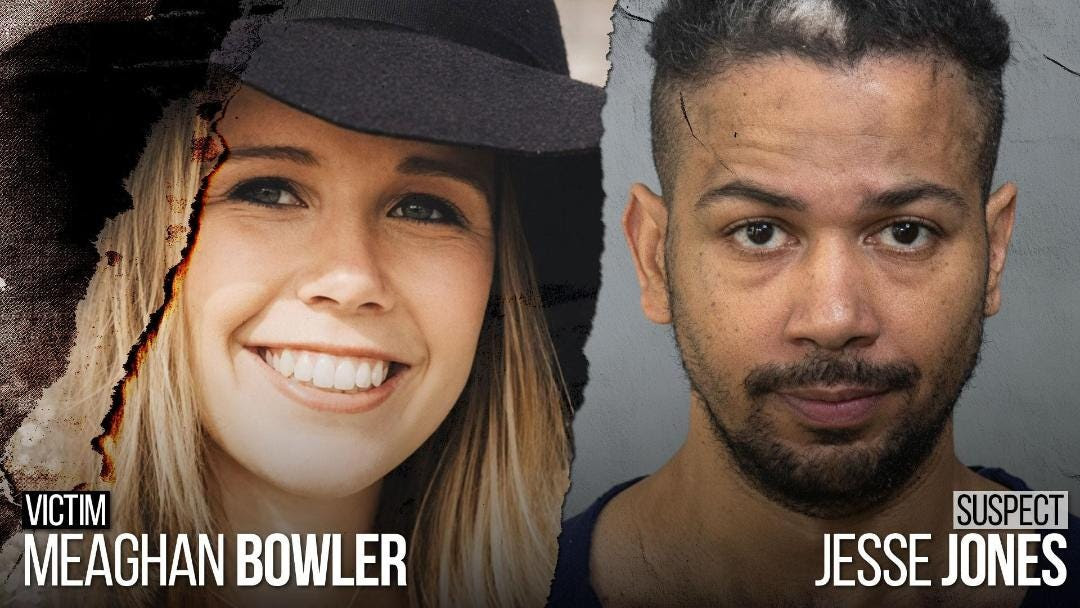
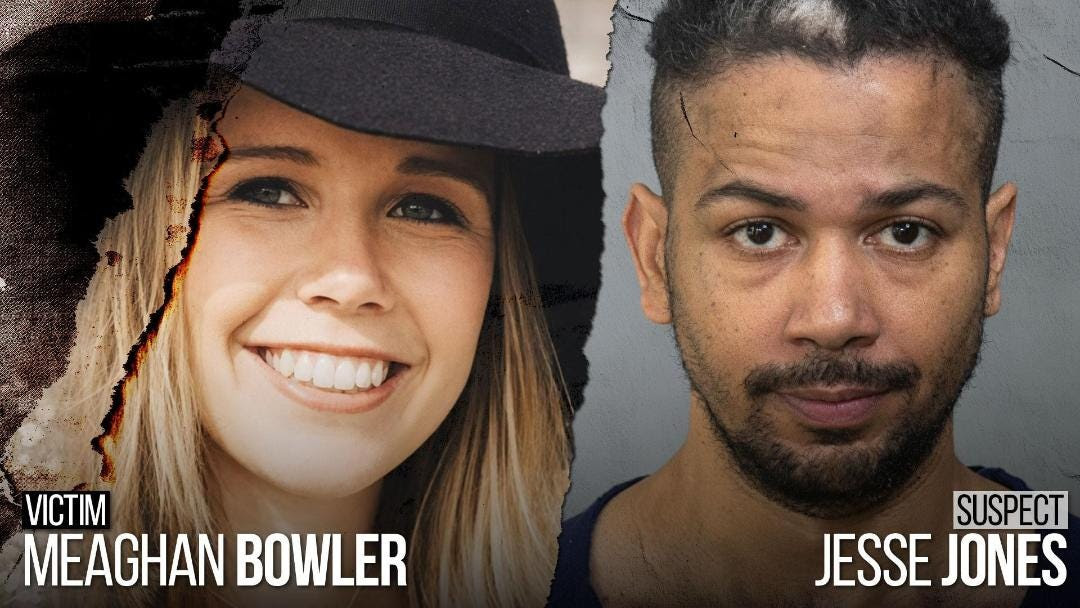
Meaghan Bowler came all the way from Australia to marry Jesse Jones. He stabbed her multiple times
Kenn Gividen’s computer broke down recently (before VDARE.com’s mugging by NYAG Letitia James, we would simply have bought him a new one), so his April 2026 roundup of America’s ongoing black-on-white homicide Holocaust™ wasn’t published until May 21. Which means his May 2026 survey will appear next week—he’s relentless.
PeterBrimelow.com is a reader-supported publication. To receive new posts and support my work, consider becoming a free or paid subscriber.
But then, so is America’s black-on-white Holocaust™.
Before VDARE.com was mugged by Letitia James, we used to report Kenn’s roundup of black-on-white homicides under the running head “A Month In The Death Of White America”—example here. It was one of our most popular features. Maybe that’s why James mugged us. But thanks to her lawfare, VDARE.com can no longer pay Kenn. So I urge you subscribe to his substack AbateHate.com—it covers a lot more than black crime— here!
Since the mugging of VDARE.com, I have begun to analyze Kenn’s results separately from his own roundup e.g. my March analysis here. My analysis usually differs somewhat from Kenn’s, partly because of subsequent developments e.g. I’ve found a couple more immigrants this month; and partly because of methodology. Thus I include all of the black-on-white homicides that Kenn discovers in any given month, whereas in May he broke out the older killings that he had found separately (and there are generally a lot of them, only slowly surfacing). So he reports an April total of 43; my total is 53.
My philosophy: it all come out in the wash. Kenn reports Grok says there are 40-50 black-on-white homicides each month, comporting with FBI figures, which means he always misses 10-20. But the intense Regime Media suppression of Politically Incorrect racial hate facts sometimes lessens after the initial furor, e.g. in trials that no-one is monitoring.
Except for us.
The other difference between Kenn and myself: I look for overall themes in the American black-on-white Holocaust™, whereas he lets the appalling truth just speak for itself.
Not for the first time, the theme that leaps out from the April data:
The absolutely extraordinary number of white women regularly killed by Black Significant Others (here, here, here, here, here, here,here, here, here).
Thus my featured image, above,
is of Meaghan Bowler, who came all the way from Australia to marry Jesse Nichols Jones, also pictured, who then proceeded to stab her multiple times (this is a recurrent aspect of Black Significant Other killings) despite having two children with her.
In other words, even apparently stable Black Significant Other relationships can end in savage homicide.
In contrast, it is vanishingly rare to see the opposite: black women killed by White Significant Others. Kenn found no examples at all in April.
A related theme: Black Significant Other Collateral Damage, e.g, a white brother trying to protect his sister from a black ex-boyfriend (examples here, here).
To put Black Significant Other killings in perspective: in the 1970s, feminist scholars began whooping up the concept of “femicide,” the killing of women. They never agreed whether this meant all killings of women, or just killings of women for being women. But where is the discussion of Black Significant Other femicide of White domestic partners?
And if “femicide” does mean the apparently-motiveless black killing of white women, April examples are here, here, here.
Where are the feminist scholars on this?
Other consistent themes:
Crossfire. Innocent whites die in crossfire between black shooters every month, here, here, here, here.
Black stupidity as in how could he have possibly expected to get away with this? Here
Vehicular homicide. Kenn includes these, although it bothers liberal me because they could be genuine accidents. But some of these are indeed plainly criminally reckless here, here,
Immigrant/ immigrant stock homicides. The Regime Media represses the immigration status of criminals even more sternly than their race. But the recent surge of immigrants is so great that it can be detected because some don’t even have Americanized names— here, here, here, here.
Kenn counted just five white-on-black homicides in April. Obviously this is tellingly disproportionate, given that the white population is (still) so much larger than the black.
One white-on-black homicide was a road rage incident in which the perp has a typically Puerto Rican/ Ashkenazi Jewish name. Another appears to be a confrontation between white and black teenagers.
But we don’t know the details—because local media coverage has ignominiously collapsed, often relying entirely on law enforcement press releases.
This is particularly unfortunate because local media would often report race when the national media was working hard to repress it. But no more.
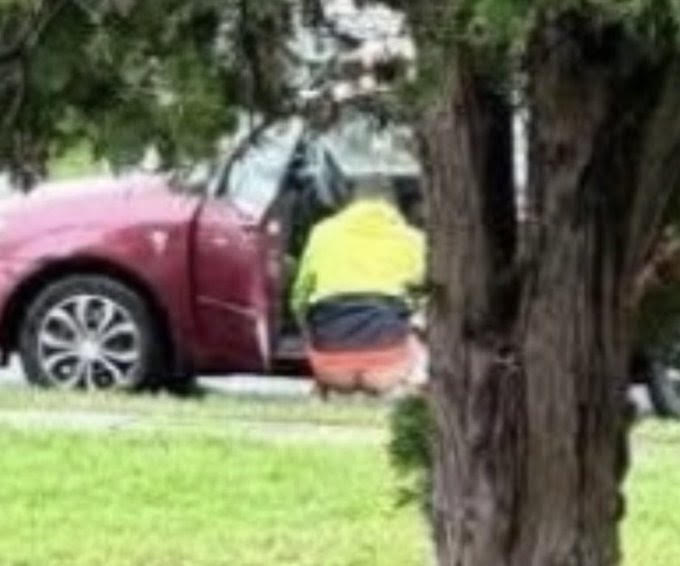
A doctor/ engineer is culturally enriching a sidewalk in Sydney, Australia. Immigration & Multiculturalism has FAILED. We cannot coexist with uncivilized foreign people that poop everywhere