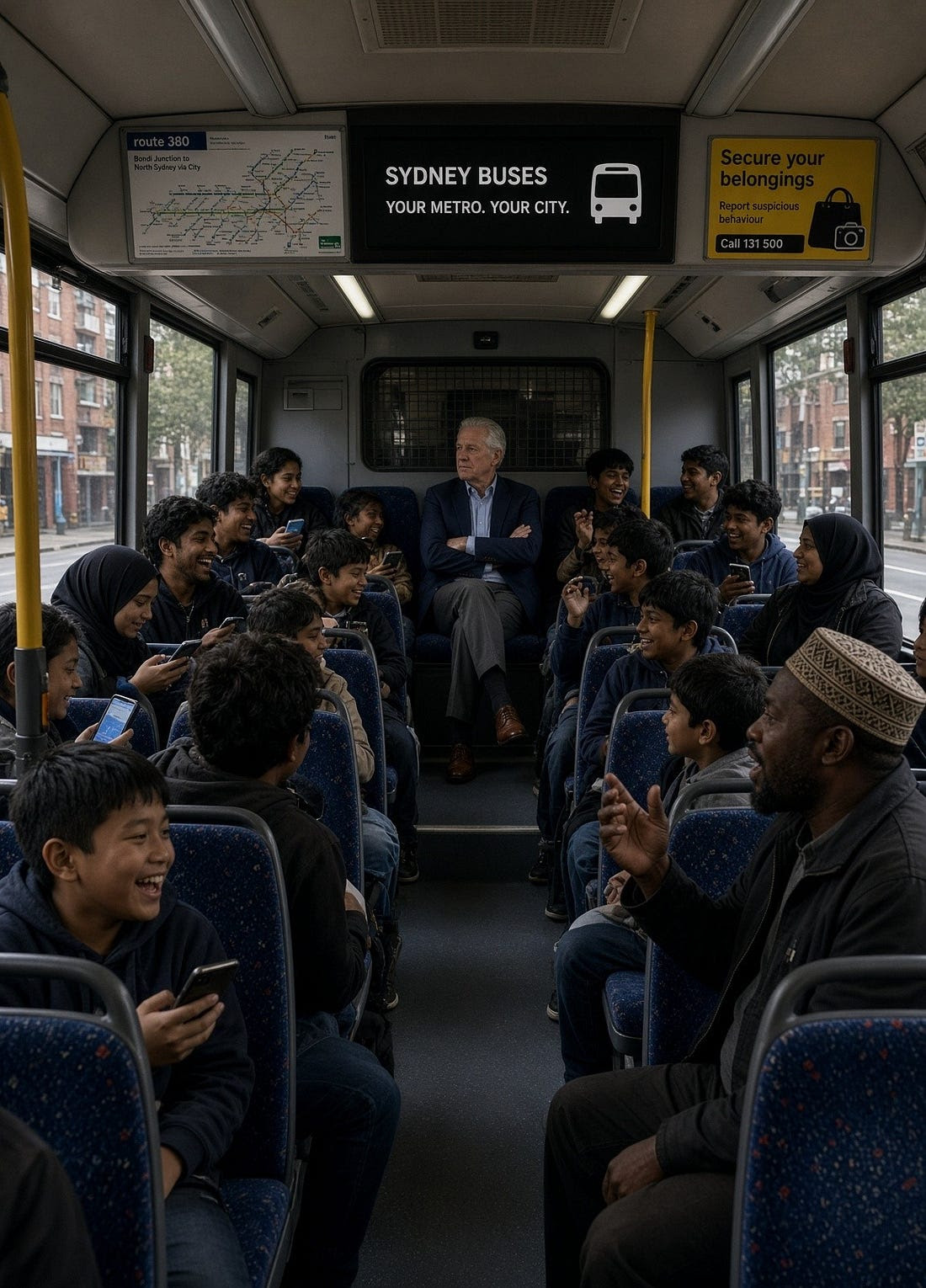
| THE ONLY AUSSIE ON THE BUS How many Australians in our big, Babylonic cities understand how it feels to be the only Aussie on public transport? How many experience that feeling of demoralisation that comes from effectively being the stranger? For, no matter how ‘diverse’ they make it for the ‘others,’ they are united in their otherness—being ‘strangers’ assimilates and empowers them in the greater body of migrants. It is them against us, but lately the ‘us’ component is purely subjective given our apparent scarcity. In most instances, if they even think about it, the ‘other’ likely feels schadenfreude at our revised status. tThey have changed the patient habits of Australians of yore—such as respecting queues, giving up your seat for the infirm or elderly—and frantically steal ahead of others waiting for trains or buses. They will plant themselves in a seat (not all, but a lot) and disregard the common courtesies that we took for granted in the pre-Zoomer generation. In all honesty, it depends on the race, and that person’s level of culture and education, but the best of any people is its absolute minority. One good apple does not excuse a rotten barrel; thus, other anti-social behaviours consume what should be a quiet period of travel.Australia has never been a perfect idyll; yobbish behaviour has plagued our public transport in the form of drunks and obnoxious teenagers. But rather than help change that regrettable inevitability in even a homogeneous society, they have brought their ‘ways’ as per the contract of multiculturalism. For multiculturalism demands no assimilation; it excuses the migrant to form their own enclaves and maintain their language, culture and ‘traditions.’ When coming from a hectic, formerly described ‘third world’ environment these habits persist. But this is tempered by the new morality (or absence of it) based around the digital age, which ensures everybody is entranced in their phone, either studying pages, or listening to TikTok videos, or music. In this latter situation, even headphones do little to mute the irritating noise a passenger generates. Migrants especially love to display their western status symbols, and phones are part of these, but when on hands-free they jabber loudly in conversations that could absolutely be had any other time but on a bus, then the feeling of alienation for the only Aussie on the bus is amplified to the point of resentment. The lone Aussie is now surrounded by various races, numerous languages, and none are his. But this vestibule of cultural detachment is a microcosmic chamber of whatever local destination that bus or train is likely headed to. To step from that experience to walking streets completely transformed by the other—making him a foreigner in his own land—delivers a cruel note to the heart.In this hypothetical instance our lone Aussie is from an older generation, derided as ‘boomer,’ whether they are or not. He has just experienced the cultural alienation of liberal-global policies enacted by all sides of politics, but he has that added sense of rejection from the youth of his own tribe. They demarcate along ageist lines, and even though none of them remembers an Australia that wasn’t like this, they have moved to exclude him as irrelevant. Meanwhile, they fail to realise how truly cosmopolitan they are. For one thing, the old Aussie ‘strine’ is all but extinct in the metropolitan areas, replaced by a more even timbre that reflects the confluence of dialects that shaped it. This is why the typical London youth speak in a patois that is reflective of the pidgin English it has absorbed. Noticing that depresses our lone Aussie even more. But then, he has much to depress him.He is white, single and a heterosexual male, and therefore finds relevance nowhere. But a trip to the heart of the city—a city he once thought of as his—is now an atrocity exhibition designed to smash whatever debris of his morale remains. The heart of Sydney city is uniquely Asian in appearance and character. But the digital transformation of society has now stripped that city of once joyous shops that truly were diverse in their wares. Now it’s all digital boutiques, fashion outlets, food and convenience stores on every corner. The architecture is as alien as the people shadowed beneath. He feels the need to visit the pub, but the price of a beer is so astronomical that even the inclusivity of the old Aussie drinking establishment is economically out of bounds.Having ultimately nowhere to go, and with nobody to visit, he returns home. The bus back is as bad as, if not worse than, morning, now that peak hour has taken over. He cannot find a seat and none of the young Asian or Indian schoolkids on this government bus will volunteer theirs. To the right of him in a seat is a black youth who is conspicuously behaving black to signal his ‘type’. He has braided hair, wears the type of gear that ‘ghetto’ blacks would, and is playing some contemporary variety of atonal hip-hop on his phone which he deliberately holds up to his ear. The Indians to the left of him speak loudly in their bout-bout sounding accents over the loudspeaker of their phones while the Arab youths dominate at the back of the bus with unruly behaviour. Alighting at his stop, he finds the suburb where he grew up and returned to decades later unrecognisable. It is an Arab enclave and hijabs and olive-skinned men and boys with beards abound. He must be careful here because the youth regard all non-Arabs as game, and several times a year they challenge him in infantile confrontations. He can go nowhere to complain. And all the while these loathsome ‘others’—including their liberal and feminist champions—are living on the happy security won for them by a generation who sacrificed and toiled in the Great Patriotic War Against the Japanese, a conflict so quintessential to the existence of modern Australia that it is soundly ignored by the architects of new liberalism who created the hell he just walked through.But he cannot vote his way out of this because the only ones even remotely near the parliamentary power system are all striving so hard to demonstrate their multicultural sensibilities to a supposed ‘nationalist’ audience that they have contradicted the very basis of their newfound populism among hereditary Australians. Anything stronger—anything evoking the old Australia of the labour tradition—is quickly silenced by the unification of these ‘populism chasing’ right-wingers and their satellites.So, he cooks himself a humble meal, puts on an old movie, and tries to forget it’s 2026. All the while he knows that defeatism will not make him feel any better, but being all that we’ve described, he has but to wait out his time when none of it will matter anymore. |