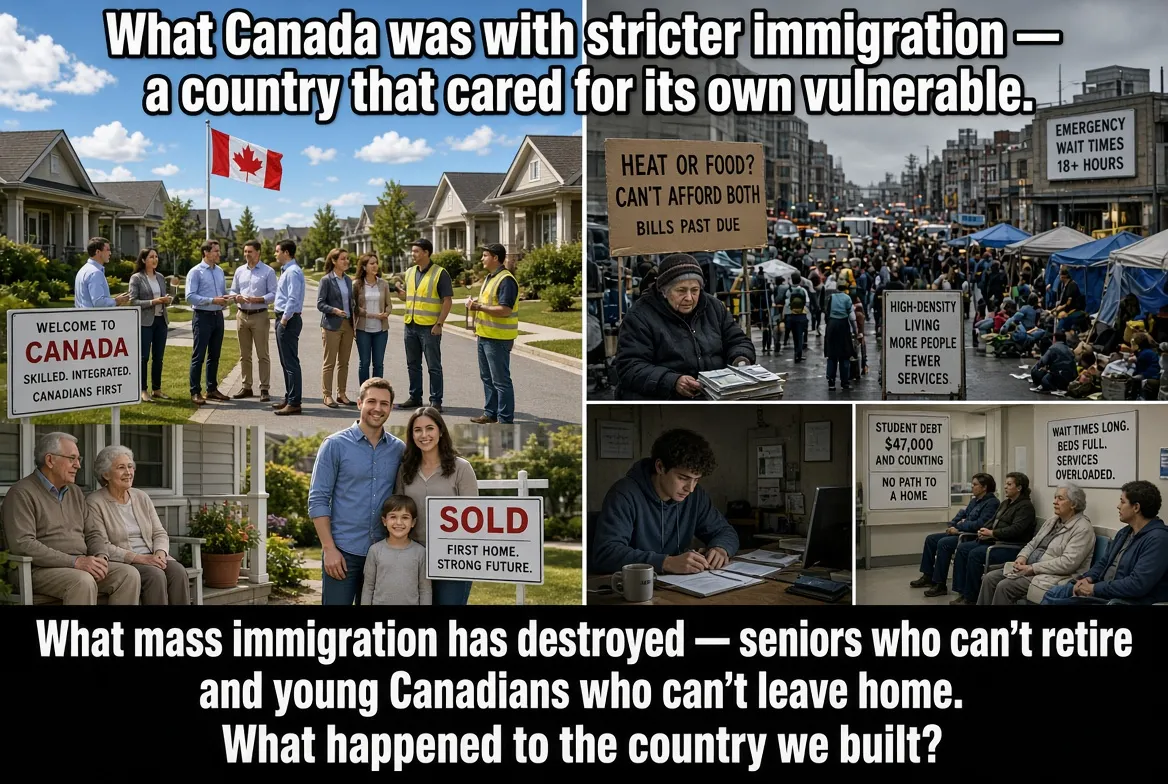
What Happened to the Canada We Built?
From immigrants who arrived with nothing and built a future, to seniors who cannot afford to retire and young Canadians who cannot afford to leave home, I keep asking myself:There are days when I come home from speaking with Canadians and I genuinely want to cry.Not because of something I’ve seen on television or read in the newspaper.Because of the people I’ve met.The elderly woman who worked for 40 years and now has to choose between heating her home and putting food on the table.The homeless woman I met near Burlington Mall who once owned a condominium and now struggles to find somewhere that will accept her and her service dog.The parents whose adult children have moved back home because they cannot afford rent, let alone a house of their own.And the tradesman who tells me that after years of developing his skills, he’s watching Canadian workers struggle to find employment.
These are not abstract political arguments to me.These are people I’ve met, people who have written to me, people who have trusted me enough to share their stories.And I keep coming back to one question.What happened to the Canada we built?The Canada People Once Came Here to BuildI want to take you back to the 2021 federal election.I was canvassing, knocking on doors, and meeting people from every imaginable background.Earlier that day, a Canadian man in his thirties had called me a racist. I asked him why he believed that. He couldn’t give me a specific reason, but he was adamant.Later, I approached a home where a gentleman had turned his Conservative lawn sign around to display a PPC sign.
As I walked up, his landlord, a gentleman originally from India, was there.He asked to see my pamphlet.After the confrontation earlier that day, I wasn’t sure what to expect.But instead of an argument, he told me his life story.He was born in India and had immigrated to the United Kingdom in search of a better life. But the opportunities he had hoped to find simply weren’t there.So he decided to try his luck in Canada.He left the United Kingdom and arrived in Canada with just £500 in his pocket, a Canadian sponsor, and a dream of becoming a landlord.He started out living in a basement, determined to build something for himself.He and his partner worked seven days a week. Eventually, they purchased their first home, a fixer-upper. They poured their own labour and skills into restoring it and sold it.Then they did it again.Over the years, they acquired several properties.He had become what he dreamed of becoming.A landlord.But what struck me wasn’t simply his success.It was how angry he was about what he saw happening to Canada’s immigration and social-support systems, even back in 2021.He believed that people were taking advantage of programs that taxpayers worked hard to support. He was particularly upset by examples he’d seen of people teaching others how to exploit benefits and food banks.Whether every example he had encountered was representative is another question. But his frustration was unmistakable.He knew what it meant to start with almost nothing.He knew what it meant to sacrifice.And he believed that opportunity, responsibility, and hard work were values worth protecting
.I left that conversation thinking about the contrast with the accusation I’d received earlier that day.Here was an immigrant who had built a successful life and was deeply concerned about the same policy questions I was raising.It reminded me why we should listen to people rather than assume we know what they think based on their background.Another Immigrant. Another Dream.I remember another story, this time about a master electrician who came to Canada with his three children.Like the landlord, he arrived with a sponsor and started out in a basement apartment.His family lived in the basement of an Oakville townhouse while he established himself.Within a year, they had purchased a rural home in Acton, Ontario.Imagine that.Three children. A new country. A new beginning.He came with skills, a willingness to work, and a determination to provide for his family.And within a year, he had taken a major step toward the life he wanted.I think about stories like these when I hear people argue that concerns about immigration policy must come from hostility toward immigrants.That simply doesn’t reflect the conversations
I’ve had.I’ve met immigrants who love Canada, believe deeply in personal responsibility, and worry about the future of the country just as much as anyone born here.The question isn’t where someone was born.It’s what kind of country we’re building together, what opportunities it offers, and what responsibilities we share.She Worked for 40 Years. Now She Must Choose Between Heat and Food.One of the most heartbreaking experiences I’ve had while canvassing was meeting an elderly woman who had worked for approximately 40 years.She was still healthy and managing on her own.But she was struggling to afford her home.She was facing the kind of decision no elderly Canadian should have to make.Do I heat my home, or do I buy groceries?When I spoke publicly about her situation, I said I wanted to cry.I meant it.And her circumstances were getting worse. I feared she might eventually have to leave her home.Think about what that means.A person spends decades contributing to society, working, paying taxes, and building a life.And in the years when she should finally be enjoying some peace and security, she’s worried about whether she can afford to stay in her own home.What are the fruits of a lifetime of labour supposed to be?Surely they should include the dignity of growing old without fearing the next heating bill.
A Message From a 66-Year-Old Canadian Woman. After I shared that story, another woman reached out to me privately.She’s 66 years old and still working. She expects to continue for several more years, if she’s fortunate enough to remain employed.She told me she felt deeply let down by the system she had contributed to throughout her life.She questioned the fairness of government priorities, including the support available to newcomers compared with the circumstances of some struggling seniors.Her concerns about the direction of the country went beyond money.She felt that the culture she grew up with was changing and that the values she cherished were being lost.Then she wrote four words that stayed with me.“My heart is broken.”She asked me to protect her identity because she feared that speaking openly might affect her employment.She loves her job. She wants to keep working. But she doesn’t feel comfortable expressing her political concerns publicly.I find that deeply troubling.In her next message, she acknowledged that many other Canadians were experiencing far greater hardship than she was.Even while worrying about her own future, she was thinking about others.
That’s the kind of person whose story deserves to be heard.Judy Marie: From Homeowner to HomelessnessIn January 2026, I spoke with Judy Marie, a woman experiencing homelessness in Canada.Judy told me she had once owned a condominium in Burlington.Now she was struggling to find somewhere to live.She described difficulties with her credit rating, the challenge of finding housing that would accept her service dog, and the long wait for subsidized housing.She had spent time in a shelter and described an experience that left her feeling unsupported.What struck me most was the disbelief in her voice.She couldn’t believe she’d ended up in this situation.Judy also spoke about an Afghan family she had encountered whom she believed had received substantial housing assistance.She was upset by what she perceived as a disparity between the assistance available to that family and her own struggle to find a home.I cannot independently confirm the details of that family’s circumstances or the source of its housing support.But Judy’s underlying question deserves an answer.How does someone who once owned a home in this country end up struggling to find somewhere to live, and what are we doing to help?
A compassionate country should be able to support people fleeing hardship while also providing meaningful help to its own vulnerable residents.Those responsibilities should not have to compete.I don’t want to see Judy forgotten.And I don’t want her story reduced to another statistic about homelessness.She’s a person.She had a home. She had a life. She still has hopes for her future.We should care about what happens to her.The Young Canadians Who Cannot Get StartedDuring my canvassing, I met many parents whose adult children were living at home.Some had moved back because rent had become unaffordable.Others had never managed to leave.These weren’t necessarily young people refusing to work or take responsibility.They were trying to make a start in a housing market that seemed increasingly beyond their reach.I think back to the immigrant landlord who arrived with £500 and eventually built a property business.I think about the electrician who came with three children and bought a home within a year.Those stories represent the kind of opportunity that attracted people to Canada.Now I meet Canadian parents who wonder whether their own children will ever be able to afford a home.I’m not suggesting that homeownership was easy for everyone in the past, or that every newcomer today faces the same opportunities and obstacles.But I do believe we’ve lost something important when so many people can no longer imagine achieving the milestones their parents took for granted.The ability to establish a home, raise a family, and build some security is about more than economics.It’s part of the foundation of a stable society.The Workers Who Feel ReplacedTed Irwin, a drywall tradesman in British Columbia, contacted me with his concerns about the construction industry.He believes Canadian workers are losing opportunities to companies employing lower-paid foreign labour.He described experienced tradespeople struggling to find work and employers he believes are exploiting the labour system.His message ended:“Canada is broken.”I haven’t independently verified his estimates about the proportion of foreign workers in his trade, and we should be careful not to confuse legitimate foreign-worker employment with violations of labour rules.But Ted raises questions worth investigating.Are Canadian tradespeople receiving fair opportunities?Are employers complying with wage requirements?Are our labour and immigration policies serving workers, employers, and the long-term interests of the country?These questions shouldn’t be dismissed simply because they’re politically uncomfortable.And the people raising them shouldn’t be ignored.We Are Losing More Than Purchasing PowerThe more stories I hear, the more I believe this conversation is about something deeper than the cost of living.It’s about culture.Not merely the food we eat, the languages we speak, or the traditions we celebrate.I’m talking about the values that help a society flourish.Responsibility. Family. Community. Hard work. Compassion. Honesty. Freedom of conscience. Respect for our neighbours.The belief that effort should lead to opportunity.The belief that contributing to your country should mean something.The belief that when someone falls on hard times, we help them regain their footing rather than abandon them.I worry that we’ve begun to confuse spending money with solving problems.We can announce another program, another initiative, another funding commitment.But what does it mean if the elderly woman still cannot afford to heat her home?If Judy still cannot find housing?If Ted still cannot find work?If young adults still cannot afford to leave home?These are the outcomes that matter to me.How We Treat the Vulnerable Says Everything About UsI’ve often believed that you can judge a nation by how it treats its most vulnerable people.And I have serious concerns about how we’re approaching some of the most difficult issues facing Canadians.When I see people suffering from addiction or serious mental illness, I want us to ask whether they are receiving meaningful treatment, recovery support, and a realistic opportunity to rebuild their lives.When I see the expansion of medical assistance in dying, I believe we must ask whether people facing severe illness or disability have genuine access to the care, support, and dignity they deserve.When I think about women facing difficult pregnancies, I want to see stronger practical support for mothers and families, including those who may wish to pursue adoption.These are deeply sensitive issues. Canadians have different convictions about the appropriate role of government and individual choice.But surely we can agree that vulnerable people deserve more than slogans, paperwork, and announcements.They deserve care that actually reaches them.They deserve dignity.And they deserve hope.Who Is Government Supposed to Serve?I keep hearing that Canada is a wealthy country.I keep seeing governments announce enormous spending commitments.And yet I keep meeting people who feel they have been left behind.The senior who cannot retire.The homeowner who cannot afford heat.The homeless woman who cannot find housing.The tradesman worried about his livelihood.The young adult who cannot afford a place to live.The parents wondering what kind of future awaits their children.I believe government has a fundamental responsibility to the people it serves.That responsibility includes making difficult decisions about spending, immigration, housing, health care, and public safety.It also includes being accountable for the results.We can welcome newcomers and value their contributions while still having serious conversations about immigration levels, integration, housing capacity, and the responsibilities of citizenship.We can care about people suffering from addiction while also insisting that families deserve safe parks and neighbourhoods.We can recognize the needs of vulnerable people without forgetting the seniors and working families who are struggling.These things should not be mutually exclusive.But when government priorities seem increasingly disconnected from the daily experiences of ordinary Canadians, people understandably begin asking whom those priorities are serving.And government owes them an answer.What Happened to the Promise?I think again about that immigrant landlord.A man who came to Canada with £500 and a dream, after leaving India and discovering that the United Kingdom wasn’t offering the opportunities he had hoped to find.He worked seven days a week, invested his labour, took risks, and built a future.I think about the master electrician who brought his three children to Canada and purchased a home within a year.I think about the elderly woman who worked for 40 years and now worries about heating her home.And I think about the young Canadians whose parents tell me they cannot afford to move out.Those stories span generations and backgrounds.
But together, they raise a question that I believe we can no longer afford to ignore.Are we preserving the kind of country where hard work, responsibility, and sacrifice can still lead to a better life?I don’t expect government to guarantee that every Canadian will be successful.Life doesn’t work that way.But I do expect our institutions to protect the conditions that make success possible.And I expect us to remember the people who helped build the prosperity, communities, and institutions we inherited.We owe something to those who came before us.And we owe something to those who will come after us.I Haven’t Forgotten Their FacesOne of the things canvassing has taught me is that every door has a story behind it.Some people are angry.Some are frightened.Some are exhausted.And some simply want someone to listen.I haven’t forgotten the elderly woman.I haven’t forgotten Judy.I haven’t forgotten the parents worrying about their children.And I haven’t forgotten the immigrant who arrived with almost nothing and built the life he dreamed of.Their experiences are different, but they all have something to teach us about the country we are becoming.I want Canada to be a place where our seniors can live with dignity, where working people have a fair opportunity, where newcomers can contribute and build a future, and where our children can look forward to lives at least as promising as our own.That’s the Canada
I believe is worth working for.And that’s why I intend to keep listening, asking questions, and sharing the stories of people who too often feel unheard.Through Pulse of the People, I hope to bring more of those voices into the conversation.Not because every person will agree with me.But because their experiences matter.We inherited a country built through generations of work, sacrifice, and hope. Our responsibility is not simply to enjoy what they built, but to preserve and improve it for those who come next.And right now, too many Canadians are wondering whether we’re living up to that responsibility.— Michael Bator