CALL IT TREASON

Posted on by
Let’s Call It Treason  Ray DiLorenzo
“The only thing necessary for the triumph of evil is for good men to do nothing.”Edmund Burke, 1729-1797 If you do nothing in a difficult time, your strength is limited. Proverbs 24 Millions of people around the world are beginning to figure out that there is a force—an evil cabal—trying to take over the entire planet.  This force has influenced leaders of every persuasion in every country and has been remarkably successful in putting a vast number of governmental, religious, educational, medical, corporate, and institutional leaders in a sort of trance… zombie-like, to do their will. 

This force has faces…Bill Gates, George Soros, Klaus Schwab, Biden, Obama, Clinton, and hundreds of others—all doing the work of the World Economic Forum.  Archbishop Vigano has been stalwart in his opposition to what is called the New World Order or Great Reset and probably knows of it better than most, for it has invaded even his Church.  He calls it as it is:
“a dystopian society, without past and without future, without faith and without ideals, without culture and without art, without fathers and mothers, without family and spirituality, without teachers and spiritual guides, without either respect for the elderly or hopes for our children. 

The recent pandemic farce—conducted with criminal methods that I have not hesitated to denounce since the beginning of 2020—has been followed by new emergencies—including the Ukrainian crisis—deliberately provoked with the aim of destroying the social and economic fabric of nations, decimating the world population, and concentrating control in the hands of an oligarchy that no one has elected and that has perpetrated a real-world coup d’état, for which sooner or later it will be called to answer before the world.

…the electoral fraud of 2020 in the United States of America was also indispensable to prevent the confirmation of President Donald Trump, just as in 2013 the deep state and the deep church managed to get Pope Benedict XVI to resign and to elect a person pleasing to the New World Order.”


National leaders are going out of their way to destroy their collective countries.  These chief executives and oligarchs, feeling a New World Order is inevitable, are merely vying for a high position in what they think will be a new society.  It is not more evident than here in the United States. These leaders make decisions that no one understands…destroying the election system of the greatest democracy in the world, ignoring the needs of their citizenry, and destroying the military and police departments with no regard for national security, citizen safety, or law and order. Gone are energy independence, dozens of food processing plants (it’s become a global phenomenon), and hundreds of farms (meat and dairy are bad, but bugs are good). Millions of illegal migrants pour into our countries without vetting, background or medical checks. Victims of disasters are fending for themselves. They distribute vaccines that are ineffective and have killed as many people as the disease. They print trillions, affecting nothing while creating massive inflation. Whole cities have become lawless, forcing businesses and families to pack up and leave. Stores that remain are locking up items like toothpaste while the middle class tries to cope.  Billions are spent on migrants, while veterans are homeless.  And then along comes COVID 2.0 with more vaccines on the way.

Biden kicks back as America crumbles—our very own Nero, who fiddles while America burns.  Do we simply watch as they harass, assault, imprison, and kill innocents for insurrection while we observe theirs?  The Left seems unaffected by it all.  Are they that secure about the 2024 election results?  Is the fix already in? 

Is it treason to deny the people the right to freely choose the government they want? Is it treason to make the 1st Amendment ambiguous?  And when people question an election, is it treason to imprison them without trial? Could such extreme paranoia indicate guilt?  Do we call it treason when a president flagrantly ignores Supreme Court decisions? Is it treason to destroy all checks and balances within our federal government and establish a one-party system?  Is it treason to allow and possibly cause the destruction of whole towns, killing hundreds of men, women, and children?  Is it treason to cause false flags to hide ominous covert activity? Obama’s presidency was rife with crime and corruption.  Is it reasonable to assume that Obama knew nothing of Biden’s and Clinton’s marketplace of political influence?  Is it treason to purposely destroy what you have been entrusted with protecting?  

What is so bizarre is their denial of what is right in front of us. A good example is the Lahaina fire.  Why did the police block the exits so people could not find safety? Why was there no water or a warning of any kind?  Why have they placed a black curtain wall around the town so even the press can’t see what is going on? The Maui mayor’s press conference was pathetic. He spent more time throwing up his hands and raising his shoulders than answering questions from the press. You could feel the tension in the room.  Mayorkas watches while the border is like a subway at rush hour, and he insists everything is secure.  And the silence from the opposition about everything that is going on has been deafening. It’s a sort of fictional political novel, a tragedy, where an entire political party decides to dismantle a great nation, but the people wait for an answer from the opposition that never comes.  Their default is to sit back and test the wind or just freeze in disbelief, proving their dysfunction.  

So, the ‘opposition’ sits back and assures us that another election is coming, not comprehending the damage to the country and not having the foresight or the intelligence to understand that the next election will be a repeat of the last, if it even occurs. The RINOS sit even further in their seats, waiting for a political opportunity. They are worse than traitors.    

There is some good news we need to cheer about that you will not get in the mainstream press.  A collection of 1,609 scientists, including Nobel Prize winners from around the world, signed the World Climate Declaration in August, announcing that there is NO CLIMATE EMERGENCY.  They maintain that the climate has always changed and always will and that carbon dioxide is essential for life on this planet, not the villain they portend. They complain that politicians have weaponized it for their own purposes.   
And their purposes are power and money.  We have seen these things, but we were, for too long, a voice crying in the wilderness.  

There are still those who are planning a return of the USA.  They will destroy not  America but the deep state, the unelected bureaucrats that believe they are the real power in Washington and continue to abuse it. 

Like Trump or not, no one strikes fear into the hearts of the Left like Donald Trump.

People see, but they do not understand.  People hear, but they do not comprehend.  In the meantime, politicians both see and hear, but ignore. It is treason by omission.  To witness a house burning with people inside and watch apathetic firefighters loiter outside, or worse yet, prevent victims from escaping, is worse than criminal.  To hear children screaming from inside a school as they are being shot while police are gathered outside is beyond any reasonable limits.  

Those who have taken the oath of office have an obligation, a duty to preserve and protect the Constitution against all enemies foreign and domestic without regard to self, or was that only reserved for our founders?   

White America: Disappeared and Replaced

Posted on by

White America: Disappeared and Replaced

By Paul Craig Roberts

In the United States the majority of the population remains white despite 58 years of mass immigration of non-whites.  Despite remaining a large majority, white Americans are not only being replaced but are being disappeared along with their history.

You no longer see white families in corporate ads.  If a family is shown, it is a black man, white woman and mixed race children, or it is an Asian woman, white man and mixed race children. A white family has been given negative meaning as a statement against “diversity.”  Diversity has trumped the basis of a nation state, which is a homogeneous population.  A diverse, multicultural population is a Tower of Babel, not a nation. Without a common culture, there is not a common interest.  Without a common interest, there is no nation, only a geographical boundary.

Ever since the Equal Employment Opportunity Commission created racial quotas in defiance of the statutory prohibition in the 1964 Civil Rights Act, white Americans, especially heterosexual males, have been second class citizens in law.  It has been legal for 59 years to discriminate against white heterosexual males in university admissions, employment, promotion, and protection by law.

Recently, the US Supreme Court ruled that race-based university admissions are impermissible and inconsistent with the 14th Amendment.  The ruling is a half century too late.  Discrimination against white Americans is now institutionalized.  Blacks are a small percentage of the population, but they are over-represented in positions of power.  For example, the Secretary of Defense is black. The incoming Chairman of the Joint Chiefs of Staff is black. The Superintendent of the US Air Force Academy is black, and all three agree that there are too many white officers in the US military. They have announced an official policy of discriminating against white military personnel by denying whites promotions in military rank.  This is a fact, not a “conspiracy theory.”  It could not be more clear that despite the Supreme Court’s ruling, discrimination against white Americans will continue unabated.

White people are being demonized out of existence, and they are helpless, despite being a majority in an alleged democracy, to do anything about it. To protest demonization is to defend whiteness which is regarded as proof of white supremacy. It is regarded as racist for a white to deny his guilt.

Museum curators, themselves white, present the works of white art in their collections as “racist works.”  The artistic value and achievement of white culture has been turned into expressions of racism.  Heather Mac Donald has documented examples of this in her articles in City Journal.  

White Americans are helpless to stand up for themselves, because half of them–the blue state half–have succumbed to the brainwashing and indoctrination that white people–only white people–are “aversive racists” by birth and skin color, and as such are threats to people of color.  This argument justifies restraints on white people, such as second class legal status in order to ameliorate  “white privilege.”

The statue of Robert E. Lee, a work of art by famous sculptors Henry Shrady and Leo Lantelli, stood in Charlottesville, Virginia, in memory of Lee’s leadership of the Army of Northern Virginia for a century. It was taken down in 2021 and has been given to a black organization that has announced that it will melt down the statue and cast the metal into something else, perhaps another statue of George Floyd who killed himself by overdosing on fentanyl.

Why does black self-expression and celebration of black heritage require the elimination of white heritage?  Robert E. Lee was highly regarded by the US military in the service of which Lee gave his youth and middle age.  Offered command of the Union Army he said he could not invade his own state and declined the command.  A former superintendent of West Point, Lee fought honorably and morally, and West Point barracks were named after him. Now his memory is erased and his presence in history destroyed by lies.

This is America today for white people, few of whom have the courage and awareness to protest. Essentially American white people are being erased. Try to find white Anglo-Saxons in the Biden regime.

You can see white replacement in California.  In 1970 the population of California was 76% white. The state was solidly Republican through the 1980s. Today the white percentage is 32%.  Whites have been replaced in California by Asian immigrants and illegal immigrant-invaders who walked in, unopposed, across the border with Mexico.  Today the largest percentage of California’s population is Hispanic.

Let’s hope Hispanics quickly take over the state from the crazed white liberals whose anti-white policies are causing white flight from California at the rate of 300,000 per year. California, Reagan territory in the 1980s, is today a state where the Republican political presence is minuscule.

The current white liberal governor of California, Gavin Newsom is the most anti-white, anti-American governor in US history.  His policies have proven to be devastating for California. Yet they are tolerated by the Hispanic and Asian majority.  Recall efforts were defeated despite the shrinking quality of life in California.  The colonization of America by immigrant-invaders proceeds.

The Best of Paul Craig Roberts Paul Craig Roberts, a former Assistant Secretary of the US Treasury and former associate editor of the Wall Street Journal, has been reporting shocking cases of prosecutorial abuse for two decades. A new edition of his book, The Tyranny of Good Intentions, co-authored with Lawrence Stratton, a documented account of how americans lost the protection of law, has been released by Random House. Visit his website.

10 Reasons Why Japan’s Schools Are So Good

Posted on by

When you read the following, please remember that Japan is a mono-culture where the average IQ is just slightly higher than that of pure European ancestry.   They do not have all the lower IQ and more crime prone brown and black people to deal with that is destroying the states.  They have largely avoided the blight of massive alien immigration.

10 Reasons Why Japan’s Schools Are So Good

Japanese people are famously known to be polite, strong willed and pleasant. This culture is so important that even children conform to these values thanks to the excellent schooling they undergo. Though to outward appearances the kindergarten, elementary, junior-high and high school system seems similar to the American, the truth is quite different. Here are 10 ways in which Japanese schooling is unique, helping to forge excellent and happy little characters. It’s due to reasons like these that Japan’s education system is widely admired, and even envied.

1] While at elementary school, the students are not drilled so very hard in learning core subjects (compared to later years), rather there is a greater focus on values and ethics. Students are taught respect and gentleness. They have to learn how to be compassionate and generous. Virtues like self-control and a sense of justice are also shown great importance. Only when these foundations are laid, are students then expected to master the core curriculum in junior-high and high school.

2] The start of the school year coincides with the first bloom of spring, so dramatically marked in Japan by the appearance of the sakura cherry blossom. It is thought that this means children start their school years with a feeling of positivity due to the end of the winter months. This timetable is quite unlike most of the world, where school starts at the end of summer or start of Autumn. Perhaps we should all switch to the Japanese way!


3] All students are expected to take part in the cleaning chores of the school. This inculcates in them an almost natural work-ethic. They form teams and learn what it takes to get a job done well, with cooperation and hard work. They don’t only clean the classroom, but the cafeteria and lavatories too. Consequently, the children are much more careful not to make a mess of their school, and learn to despise uncleanliness. As a child I would have hated it if we were told to do this, but now I am sure it would have been a better thing if we had done so.

4] In Japan meals are important communal moments. Students eat the same balanced and well-prepared meals as one another, almost always in the presence of their teachers. This helps build a strong bond, and encourages good table manners. Before every meal, everyone has to pray and say thanks (itadakimasu), and at the end they do the same (gochisosama deshita). These are highly polite phrases that express gratitude to the earth, to the food itself, to the cook, and also to their social superiors present at the table.

5] If Japanese kids are not working, they are playing. So, after school is just as important as the school hours themselves. Their time is then divided into extra study, either at one of the many juku private schools, designed to improve exam scores in math, science and English, or at school sports and musical clubs. Every junior high school student chooses a club to join, such as swim, table-tennis, baseball, brass band, chess etc, and then pursues their ability in that club for the rest of their school years. They socialize with their group and spend most of their weekends with them too.

6] Japan never forgets its own traditional art forms. So, kanji (over 2,000 Chinese characters), Hiragana and Katakana (the two native writing systems) are all taught to students. They have to learn exactly how to write each character, writing strokes in the right direction and in a very precise order. They use bamboo sticks and rice paper for this process. Haiku poems from Japan’s rich literary history are also recited and learned by heart. Every student understands the importance of preserving their cultural heritage.
7] School uniforms become obligatory by junior high school. Since every student wears the same attire, all social barriers are erased and everyone is considered part of the same school body. The same goes for haircuts. Boys are supposed to have short cuts, and girls medium length hair with a short fringe. When in public, school children are not feared by people, but respected. Thus, there is good harmony between generations.

8] It is very rare for children to fail to attend school, which I wish I could say about my country! Not only do all children attend, but they also try to pay close attention to their class lectures. It has been calculated that around 91% always listen to their teachers at all times. And I thought I was quite a good student, but there were certainly many hours that I day dreamed away while my teachers were talking!

9] High schools are so rigorous in Japan that a high school graduate here is considered as educated as a university graduate in Italy, itself a very important and cultured land. So, for those who would pursue a college education, competition is quite fierce. One exam will decide whether they get the marks required to attend their single college choice. If they fail to meet the grade they will probably not go to university, but they will still be very employable in Japan’s high employment economy.

10]  So hard is the effort required in the national school system that graduating is considered the first great trial of their lives. The following college years that some of them will move to are considered more of a reward to be enjoyed than something to be taken very seriously. At university, students are regularly seen sleeping through lectures, so universities in Japan do not rank very high internationally. Perhaps this is simply a result of working so hard during their early teens at school.

Category: Uncategorized | Tags: ,

Diversity ISN’T Our Strength

Posted on by

Diversity ISN’T Our Strength

Race Hucksters

Posted on by

Genetic study reveals 30% of white British DNA has German ancestry

Posted on by

Genetic study reveals 30% of white British DNA has German ancestry

Analysis over 20 years reveals heavy Anglo-Saxon influence, with French and Danish DNA coming from earlier migrations than the Normans or Vikings
Hannah Devlin science correspondent@hannahdevWed 18 Mar 2015 18.00 GMTLast modified on Wed 14 Feb 2018 21.43 GMT

2,264

The Romans, Vikings and Normans may have ruled or invaded the British for hundreds of years, but they left barely a trace on our DNA, the first detailed study of the genetics of British people has revealed.

The analysis shows that the Anglo-Saxons were the only conquering force, around 400-500 AD, to substantially alter the country’s genetic makeup, with most white British people now owing almost 30% of their DNA to the ancestors of modern-day Germans.

People living in southern and central England today typically share about 40% of their DNA with the French, 11% with the Danes and 9% with the Belgians, the study of more than 2,000 people found. The French contribution was not linked to the Norman invasion of 1066, however, but a previously unknown wave of migration to Britain some time after then end of the last Ice Age nearly 10,000 years ago.

Prof Peter Donnelly, director of the Wellcome Trust Centre for Human Genetics at the University of Oxford, who co-led the research, said: “It has long been known that human populations differ genetically, but never before have we been able to observe such exquisite and fascinating detail.”

The study found that people’s ancestral contributions varied considerably across Britain, with people from areas of Wales, Scotland and Northern Ireland emerging as separate genetic clusters, providing a scientific basis to the idea of regional identity for the first time.

Genetics map UK

Map of the UK showing clustering of individuals based on genetics, and its striking relationship with geography. Photograph: Stephen Leslie/Nature/EuroGeographics

The population of the Orkney Isles was found to be the most genetically distinct, with 25% of DNA coming from Norwegian ancestors who invaded the islands in the 9th century.

The Welsh also showed striking differences to the rest of Britain, and scientists concluded that their DNA most closely resembles that of the earliest hunter-gatherers to have arrived when Britain became habitable again after the Ice Age.

Surprisingly, the study showed no genetic basis for a single “Celtic” group, with people living in Scotland, Northern Ireland, Wales and Cornwall being among the most different form each other genetically.

“The Celtic regions one might have expected to be genetically similar, but they’re among the most different in our study,” said Mark Robinson, an archaeologist from the Oxford University Museum of Natural History and a co-author. “It’s stressing their genetic difference, it’s not saying there aren’t cultural similarities.”

The study, published on Wednesday in the journal Nature, is the culmination of 20 years of work. Scientists began collecting DNA samples from people in Orkney in 1994 and gradually worked across most of the British Isles.

The participants were all white British, lived in rural areas and had four grandparents all born within 50 miles (80km) of each other. Since a quarter of our genome comes from each of our grandparents, the scientists were effectively obtaining a snapshot of British genetics at at the beginning of the 20th century.

Sir Walter Bodmer, of the University of Oxford, who conceived the study, said: “We’re reaching back in time to before most of the mixing of the population, which would fog history.”

The team also looked at data from 6,209 individuals from 10 European countries to reconstruct the contributions their ancestors made to the genetic makeup of the British.

The analysis shows that despite the momentous historical impact on British civilisation of the Roman, Viking and Norman invasions, none of these events did much to alter the basic biological makeup of people living here. The findings support records suggesting that few high ranking Roman officials settled in Britain and that they and their families remained largely segregated from the local Celts.

The Danish Vikings, who ruled over large swathes of Britain from 865AD, are known to have inter-married with locals, but the latest study shows that the conquering force, while powerful, must have comprised relatively few fighters.

“There were very large numbers of people – hundreds of thousands – in those parts of Britain, so to have a substantial impact on genetics there would have to be very large numbers of them,” said Robinson. “The fact that we don’t see that reflects the numbers rather than the relative allure or lack thereof of Scandinavian men to British women.”

The analysis also settles a long-running dispute about the nature of the Anglo-Saxon takeover of England following the collapse of the Roman empire. The replacement of the Celtic language by Anglo-Saxon and the complete shift towards North-West German farming and pottery styles has led some to suggest that local populations must have retreated to Wales or even been wiped out in a genocide.

“[Our results] suggest that at least 20% of the genetic makeup in this area is from Anglo-Saxon migrants, and that there was mixing,” said Robinson. “It is not genocide or complete disappearance of Britons.”

The authors suggest that DNA analysis should now be regarded as a powerful historical tool, sometimes providing more impartial information than traditional sources.

“Historical records, archeology, linguistics – all of those records tell us about the elites. It’s said that history is written by the winners,” said Donnelly. “Genetics complements that and is very different. It tells us what is happening to the masses… the ordinary folk.”

Timeline

9600 BC Last Ice Age ends and land is colonised by hunter-gatherers

2500 BC Influx of settlers from east and western coastal routes

54 BC Julius Caesar invades Britain and defeats the British tribal chief Cassivellaunus

410 AD Collapse of Roman rule in Britain, which descends into the chaos of a failed state

400-500 AD Large influx of Angles and Saxons

600-700 AD Anglo-Saxon rule throughout much of Britain – Welsh kingdoms successfully resist

865 AD Large-scale invasion by Danish Vikings

1066 AD Norman invasion

Category: Uncategorized | Tags: ,

Japan Controls Immigration

Posted on by
Category: Uncategorized | Tags:

Canada Tests the Limits of Its Liberal Immigration Strategy

Posted on by
American Renaissance

Posted on August 18, 2023

Canada Tests the Limits of Its Liberal Immigration Strategy

Paul Vieira, Wall Street Journal, August 14, 2023

High levels of immigration made Canada the second-fastest growing developed-world economy in recent years, trailing only the U.S., as it competed to attract high-skilled workers from around the world.

Now, the newcomers are starting to strain the country’s ability to absorb them, putting at risk an important engine of the country’s growth.

The country of 40 million people last year welcomed more than one million permanent and temporary immigrants, Statistics Canada said. That influx generated a population growth of 2.7%; the increase of 1.05 million people was nearly equivalent to last year’s increase in the U.S., a country with more than eight times Canada’s population.

In the next two years, Canadian officials say they will boost the number of permanent newcomers by almost a third, with most being skilled migrants such as carpenters, computer scientists and healthcare workers who qualify under a merit-based points system.

The system, touted by Prime Minister Justin Trudeau’s government but first developed in the 1960s, has helped drive economic growth, attract entrepreneurs and fill vacancies for skilled positions. It has been broadly supported across the Canadian political spectrum, with the goal of attracting the world’s best and brightest to Canada.

But the intake of newcomers is increasing so rapidly that analysts and newly arrived immigrants say it is adding fuel to an overheated housing market, straining a stressed healthcare system and clogging up roads in cities unaccustomed to traffic jams.

The country’s housing prices remain among the highest in the world even after a rapid and hefty rise in interest rates, according to data compiled by the Federal Reserve Bank of Dallas. The price of a Canadian home sits 36% above 2020 levels because residential construction can’t keep up with population growth, analysts say.

TD Bank economists, in a report last month, forecast that based on current demographic trends, the shortfall in housing units that are needed to keep up with projected demand could roughly double to a half-million units within just two years.

Historically, newcomers flocked to major cities such as Toronto, Vancouver and Montreal, but they are now also settling in smaller urban and suburban areas.

The total population of Canada’s capital region, around Ottawa, grew by 8.5% between 2016 to 2021, according to the national census, and house prices there surged 84% in the same period, based on data from the Canadian Real Estate Association. In the Kitchener-Waterloo-Cambridge region, a technology and manufacturing hub 70 miles west of Toronto, the population grew 10% to 575,000. In the 2016-21 period, house prices more than doubled.

As immigration has surged, Canada’s gross domestic product per capita—widely used by economists to measure a country’s standard of living—has declined. National Bank Financial said last month that Canada’s per-capita output is on track to fall 1.7% in the second quarter from a year ago, and the Organization for Economic Cooperation and Development predicts Canada’s GDP-per-capita growth could be one of the lowest among developed-world economies over the next four decades.

Canada’s aggressive immigration “camouflaged the real underlying problem in this country, which is a lack of business investment and productivity,” said David Rosenberg, former chief North American economist at Merrill Lynch and now head of Rosenberg Research. This is showing up in everything from stressed public-transportation, roads, healthcare and housing, he said.

{snip}

INSANITY! — We Build Fewer Homes Today Than in 1974, When We Had Half the Population and One-Tenth the Immigration

Posted on by

FIRST READING: Ottawa could fix housing if it felt like it. They did it before

In the 1970s, Canada decisively tamed a housing shortage via low immigration and an explosion in home-building Author of the article: Tristin Hopper Published Aug 14, 2023  •  Last updated 4 days ago  •  9 minute read 370 Comments Newly minted housing minister Sean Fraser, who recently said he will be increasing housing affordability without bringing down real estate prices. The sentences are mutually exclusive. Newly minted housing minister Sean Fraser, who recently said he will be increasing housing affordability without bringing down real estate prices. The sentences are mutually exclusive. Photo by Justin Tang/The Canadian Press

TOP STORY

Read the conversation Have your say Leave a comment and share your thoughts with our community. Read All 370 Comments

This may be the month that the Trudeau government officially dropped all pretence of caring about fixing the housing crisis.

The Liberals strode into office in 2015 with promises of unlocking home ownership for the middle class. Instead, housing prices under their tenure have nearly doubled, and even in Canada’s mid-sized cities, home ownership is increasingly out of reach for anyone on a median salary.

And just this week, newly minted housing minister Sean Fraser effectively told Canadians to accept these numbers as the new normal. Whatever tack Ottawa is going to take on housing, they will be ensuring that prices stay high. “Our goal is not to decrease the value of their home,” Fraser told Bloomberg News.

But there was a time when Ottawa could look upon a country critically short of homes, and respond not with finger-pointing, but with an all-out construction boom the likes of which Canada had never seen. Affordability surged, rents dropped and analysts soon began to boast that Canadians were “now among the best housed people in the world.”

The prime minister during this long-lost golden age in affordable housing also happened to be named Trudeau. Tragically for the two-thirds of young Canadians who have now officially given up on owning a home like their parents, there’s no real reason Trudeau’s son couldn’t have done much the same thing.

In 1974 — the same year that Pierre Trudeau won a shattering re-election victory — the number of new homes built across Canada reached a level that they’ve never since exceeded. In that year, builders put the finishing touches on 257,243 new Canadian homes.

By comparison, over the last 10 years Canada has averaged just 197,000 annual housing completions — 76 per cent of the 1974 peak.

The contrast is all the more remarkable given that there were only 22.8 million people living in Canada in the mid-1970s. In 1974, one in every 100 Canadians could have purchased a brand-new home, and there still would been several thousand to spare.

And this rate of feverish home-building kept up for quite some time. For the entire 1970s, an average of 229,113 homes were built every single year. In the 43 years since, the 200,000 mark has been cracked only a handful of times.

What’s more, the 1970s were also relatively low-immigration years for Canada. There wasn’t a single year of Pierre Trudeau’s 15-year premiership in which the number of new immigrants was higher than the number of new homes. In 1978, Canada completed 246,533 homes and welcomed just 86,300 new immigrants.

None of the 1970s property boom was by accident. The sheer volume of new homes hitting the market was the end result of a federal government that openly vowed to put its middle and working classes into respectable accommodation — and actually meant it.

“We must … not only improve the operation of private markets in order to accelerate the total output of housing but we must also stimulate the provision of modest accommodation for low-income people,” Liberal MP Robert Andras — a perennial Pierre Trudeau cabinet member — declared in 1969.

Poverty had been on the upswing throughout the 1960s, and the solution pitched by the Liberal government was to throw up whole cities of new homes practically overnight, so that these growing ranks of Canadian poor would at least have a place to live.

In the 1970s, the housing-assistance activities of the Canadian Mortgage and Housing Corporation “exploded,” according to one history of the era.

A latticework of loan guarantees, tax credits and direct subsidies emerged to put millions of Canadians within reach of home ownership, and the construction market roared into high gear to meet the new demand.

Meanwhile, the Canada Rental Supply Program extended interest-free loans to developers who built social housing, and a firehose of federal monies was directed at subsidized housing projects.

“In the heyday of Canadian social housing from 1965 to 1990, 10 percent of total housing production was non-profit, public or co-operative,” wrote housing analyst Greg Suttor in a 2017 profile of this period.

That was enough affordable homes to “house half the lowest-income segment of the roughly 170,000 households added in Canada each year,” noted Suttor.

And rather than city cores increasingly becoming conclaves of the rich, the 1970s saw a flourishing of low-income options opening up “in the same neighbourhoods as middle-class Canadians lived in.”

When the Canadian government spoke of housing policy in the 1980s, it was framed as an unvarnished national triumph that stood as an example to the world.

“We have tripled our housing stock and rehabilitated the best of our older dwellings. Canadians are now among the best housed people in the world,” read a 1987 report issued by then housing minister Stewart McInnes.

It was basically the polar opposite of the situation now. The yearly output of new Canadian homes has now been stagnant for at least 20 years. In 2002, housing completions stood at 185,626. In 2019, the last full year before the COVID-19 pandemic, they stood at a near-identical 187,177.

At the same time, the number of Canadians needing homes is reaching meteoric highs. In 2022 alone, Canada registered one million new immigrants against 219,942 new home completions.

It’s now been a full 24 years since Canada has come close to marking a year that, like the 1970s, saw the number of new homes outpace the number of new immigrants.

A recent TD report forecast that if these trends continue, Canada’s housing shortfall will grow by another 500,000 units in just two years. “Greater thought and estimation needs to occur on what’s a true absorption rate for population growth,” cautioned the writers.

The cause of the Canadian housing affordability crisis has always been pretty simple: There are too few homes.

There are ways to tweak this by banning foreign investment or raising interest rates. But if immigration is going to stay at historic highs (and the Trudeau government has indicated that it might climb even higher); home prices aren’t going to be returning anywhere near normalcy until Canada can start building way more homes, way faster.

Even before recent immigration spikes, Canada already had the greatest structural housing deficit in the G7. According to a Scotiabank estimate from 2021, it would require an extra 1.8 million homes just to reach an affordability rate on par with the rest of the G7.

At current home building rates, even if the Canadian population stayed put it would take nine years just to make up the gap.

There’s no real reason that Canada couldn’t pull out all the stops to re-enact the 1970s building boom — although there are a few major barriers in the way.

For one, much of the low-hanging fruit is gone.

Nowadays, any significant expansion of the Canadian housing stock would likely require a fair bit of “intensification”: Turning single-family homes into four-plexes, building apartment buildings in the suburbs and remaking infrastructure to handle denser cityscapes. But in the 1970s, even in Canada’s largest cities, expanding the housing supply was usually just a matter of greenlighting some more subdivisions.

In 1977 Vancouver, single-family homes were so plentiful that it was still possible to buy one for the modern equivalent of only $375,000. In Toronto, when the 56-storey TD Bank Tower first opened in the middle of the city’s financial district in 1967, the city’s density was so low that its next-door neighbour was a surface-level parking lot.

“We can’t easily sprawl our way out of this,” said Steve Lafleur, a public policy analyst who writes often on the subject of housing affordability. Fifty years ago, builders could still “plop down a subdivision a 20-minute drive from the heart of the national economy,” said Lafleur.

But if there’s one glaring roadblock preventing Canada from pursuing a second all-out building boom, it’s the fact that today’s municipalities are way more obstinate than their 1970s predecessors. Restrictive zoning laws and other thickets of municipal red tape have largely kneecapped any ability of developers to build with the feverish intensity of the 1970s.

In the 1970s, said Lafleur, “the feds were serious about expanding affordable rental options and the municipalities didn’t really get in the way.”

Cities didn’t get in the way of any new development, really. “The image of rapid growth in … major urban centres was widely accepted in the late 1960s and early 1970s,” read a 1975 report by the Science Council of Canada. Vancouver in the late 1960s and early 1970s was so uncompromisingly pro-development that there exist images of its mayor riding a wrecking ball.

The federal government of 2023 is again willing to drop billions on affordable housing, albeit at much lower rates than the Pierre Trudeau government. But even that “won’t move the needle because municipalities aren’t willing to accommodate enough growth,” said Lafleur.

Nowadays, whenever the feds greenlight a new package of demand-side measures to put more money into the housing market, it doesn’t spur construction — it mostly just bids up prices even worse.

The easiest way out of this impasse is simply to steamroll municipal power, and there have indeed been recent moves in that direction. B.C. and Ontario have both introduced legislation that would essentially ban cities from restricting lots to single-family homes.

And Conservative Leader Pierre Poilievre is now pitching a housing program that would shut off federal money to cities that doesn’t meet federal homebuilding targets: In essence, defunding any city council with overly NIMBYist tendencies.

In 1974, Canada built an average of 704 new homes every single day. Notably, that’s almost exactly the same number by which the current housing shortage is getting worse. If TD’s estimates of a 500,000-unit shortfall over the next two years hold true, that’s another 685 units added to the shortfall each day.

Whatever’s going to fix this, it will need to be big. As for the measures now being pitched to increase densification: “It’s too little, too late,” said Lafleur.

Trudeau Is Implementing the Globalists’ Plan to Flood Canada With Third Worlders & Replace the European Founding/Settler People

Posted on by

Trudeau Is Implementing the Globalists’ Plan to Flood Canada With Third Worlders & Replace the European Founding/Settler People

Diane Francis: Immigration pushing housing, health care to the breaking point

Trudeau’s immigration policies have put a significant strain on large urban areas such as Toronto, Vancouver and Montreal Author of the article: Diane Francis Published Jul 24, 2023  •  3 minute read 30 Comments A Canadian flag on a condo balcony in Toronto. The city suffers from health-care shortages and unaffordable housing prices. A Canadian flag on a condo balcony in Toronto. The city suffers from health-care shortages and unaffordable housing prices. Photo by Cole Burston/Bloomberg

Prime Minister Justin Trudeau’s push to increase immigration to unprecedented levels is damaging Canada’s health-care system.

The numbers reveal the problem. Last year, Canada welcomed 492,984 new immigrants, all of whom will eventually be issued health cards, entitling them to medical benefits for life. This year, another 465,000 immigrants are set to arrive, plus another 485,000 in 2024 and 

Between 2016 and 2021, the Trudeau government admitted a record of over 1.3 million permanent immigrants into the country, all of whom will require medical services. This has put a significant strain on large urban areas such as Toronto, Vancouver and Montreal, which have borne the burden of the influx because they are where the lion’s share of immigrants settle. Toronto and Vancouver, in particular, already suffer from health-care shortages and unaffordable housing prices.

The feds set immigration targets with little regard for skills, the burden placed on social welfare systems or the impact on housing costs. The result is that many hospitals are reaching their limits. Doctors and nurses are in short supply, Canadians face long wait times for specialists and elective surgeries and millions lack a family physician. By clicking on the sign up button you consent to receive the above newsletter from Postmedia Network Inc. You may unsubscribe any time by clicking on the unsubscribe link at the bottom of our emails or any newsletter. Postmedia Network Inc. | 365 Bloor Street East, Toronto, Ontario, M4W 3L4 | 416-383-2300

This is not nearly enough. Financial Accountability Office of Ontario projects that Ontario alone will be short 33,000 nurses and personal support workers by 2028, despite provincial initiatives to boost graduates.

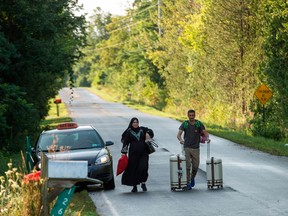
Canada’s immigration levels are disproportionate to other developed nations, taking in about four times as many immigrants as the United States on a per capita basis. To make matters worse, Ottawa’s screening is inept. Despite the staggering immigration numbers, the federal government has failed to address the shortage of skilled labour across the country by recruiting qualified tradespeople.

This push to significantly increase the population was concocted at a weekend gathering in 2011 in Muskoka, Ont., led by Dominic Barton, who served as global managing director of McKinsey and Co. before becoming Canada’s ambassador to China for a time, and former BlackRock Inc. honcho Mark Wiseman. They created a Toronto-based lobbying group called the Century Initiative, which believes Canada’s population should reach 100 million by 2100.

The group estimates that, given sagging birth rates, reaching their arbitrary goal of 100 million would require Canada to accept at least 500,000 immigrants a year, if not more. This has now become our official immigration policy, with the Trudeau Liberals targeting around 

The Century Initiative hopes to create “mega-regions,” increasing the population of the Greater Toronto Area from 8.8 million in 2016 to 33.5 million by the end of the century, the population of Metro Vancouver from 3.3 million to 11.9 million and the National Capital Region from 1.4 million to 4.8 million.

Seven years of this foolish Liberal immigration policy has placed a significant strain on the health-care system and housing market. And Canada is going to make matters worse by admitting upwards of 753,000 international students this year, which will further increase the cost of rentals.

A CIBC report last year said that the admission of huge numbers of newcomers in 2022, including an estimated 955,000 “non-permanent residents,” represents “an unprecedented swing in housing demand in a single year that is currently not fully reflected in official figures.”