Category Archives: Uncategorized

HAPPY DOMINION DAY

Posted on by

HAPPY DOMINION DAY


Dear Canada Firster:

Happy Dominion Day.

Isn’t it Canada Day, you might ask? Well, as part of the social re-engineering of our country, Parliament did proclaim July 1 – Canada’s national founding date – as Canada Day. This was part of Pierre Trudeau’s revolutionary mischief as his immigration and multiculturalism policies sought to remake the European country of our founding into a Third World mix-up. He set in place policies – loyally followed by Tory Brian Mulroney AND Stephen Harper and Liberals Jean Chretien and Paul Martin and now Justin Trudeau– which will bring about the replacement and gradual ethnic cleansing of the European founder-settler people of this country.

Dominion Day, first proclaimed a holiday in 1879 by Governor General Lord Monck highlighted a term in Canada’s motto “a mari usque ad mare” – a line from the Psalms 72:8: “Dominion from sea unto sea.”

The sentiment is enthusiastic and positive, suggesting the coming of age and sovereignty of a new nation. The European founder/settlers – the British, the French, the Germans, the UELs from the U.S., the Germans, the Russians, the Icelanders, the Ukrainians and others – were developing, expanding and claiming this land, taking Dominion (power and control) from sea to sea.

This is a dynamic vision of Canada, one we shall not abandon. This is OUR Canada, the real Canada.

.

Paul Fromm
Director
Canada First


Canada Day: A Celebration of the Destruction of Our British Heritage

by Thomas Jones


On July 1st 1867 the Dominion of Canada was created as per the British North America Act of 1867. The holiday of Dominion Day was changed to Canada Day thanks to the machinations of anti-British Liberal politicians working without public consent. The name Canada day doesn’t need to be negative and surely we patriots could make fine use of it but sadly that is not why the name was changed. It was done so to loosen ties to our British past.

As with the national days of our kindred in the United States, Australia and New Zealand, here in Canada our national day is not looked upon so kindly by a small but vocal minority of “progressives.” All of these countries are depicted now as “colonial states” which committed genocide against peaceful aboriginal groups in the name of White supremacy and imperialism. Furthermore they then welcome Chinese well-off hustlers to flood in and usurp jobs from native White workers. Thanks to the ruling elites in the political arena, the universities and, of course, the media, this immensely negative image has taking hold over the popular imagination. I think it is fair to say that many Canadians have not fallen for this propaganda, the simple anti-national day narrative, but with every year it seems as if we have to be more and more critical of our ancestors and the countries they created.

On July 1st 2013 feminist Judy Rebick spoke out against Canada day for the exact reasons laid out above. Apparently it is somehow racist for Canadians to celebrate their ancestry and country but not racist for Idle No More to attack Canada. She sounds like an internationalist socialist who has no time for nationalism, even when left-wing, but then supports Amerindian nationalist movements?

The findings of the Truth and Reconciliation Commission (TRC) have only added fuel to the fire. Influenced by their very political report and the views of individuals like Rebick, Killa Atencio wrote in 2015 that she wouldn’t celebrate Canada day because of what TRC’s views and because as of yet there is not inquiry into the case of missing aboriginal women . Being against Canada because of a there has been no commission on missing women is patently stupid, as that is something that the government, if anything, should be faulted with, not the very existence of Canada. Plus the commission will not find anything that we don’t know already.

According to the National Post, 70% of Canadians agree with the TRC that schools were a form of cultural genocide, and that a national inquiry is needed and more aboriginal studies in classrooms; though, as I said before, there is already way too much on this whole topic. If one looks through the comments of the National Post article one will see that already I have been proven correct; many are calling what happened genocide without the prefix cultural. This means that the Canadian nation is sympathetic to the non-White aboriginal ones; no need for anti-White hatred.

I think it is fair to say that most on the left disagree with Rebick and Atencio that Canada day should not be celebrated. However they don’t see it as a day to celebrate our European heritage and traditions. Many Canadians views are similar to those of Jessica Barrett who, the day before this last year’s Canada day, wrote about the TRC’s findings and of how terrible it was that aboriginals and Whites aren’t more connected. “Progressive” minded people like Barrett like to call themselves “allies” and do their best to connect LGBTQ and women to racial and religious minorities to form a broad grievance coalition with no love for the Western tradition or Europeans. For them Canada is not European and its European heritage is of no importance. Their “progressive” values are what are truly important. Any nationalism they are willing to promote is a civic one with no basis in ethnie or deep cultural traditions.

Canada Day: Celebrating the Future Faces of Canada!


I don’t know if Jessica celebrates Canada day or not, but no doubt her views resonate with a large number of Canadians. Liberals certainly consider themselves to be “allies” of marginalized groups and they would certainly make a big deal about this so as to signal to each other how accepting and tolerant they are. And they would certainly agree with her that the head tax and Komagata Maru incidents were terrible crimes against humanity instead of being part of a wider desire to protect workers and heritage. Andrew Woodbury does not attack Canada day but he does state that the national day “is one of discrimination, xenophobia, and a not-so-removed extension from Anglo, white-speak Great Britain.”.

Apparently it was evil and wrong of Britons to create a country almost exclusively inhabited by their kith and kin and then celebrate that fact. As with Barrett, Woodbury notes the refusal to open our borders to mass Chinese immigration in the 19th century as evidence of some horrible human rights violation. The article also has a seemingly compulsory attack on Stephen Harper despite the fact his government is very supportive of non-White immigration and multiculturalism. He is not the crusader for White rights the left imagines him to be.

The Huffington post recently released their top 13 favourite quotes about Canadafrom celebrities and other prominent figures. We can see from these quotes just how deracinated Canada has become, how it is viewed, to quote Trudeau, as a “post national” state which stands for whatever trends are in vogue. A few aren’t cringe worthy but a great many of them are. Here are but a few examples,

“This [Canada] is a place where you can be who you want to be and love who you want to love.” -Shay Mitchell
“Canada has always been there to help people who need it.” -Justin Trudeau (no doubt this is another way of saying we need more refugees and other migrants; come on don’t be a bigot this is what I say Canada is all about!)
“For over a century, people have been coming here [Ontario] from every part of the world to make a better life for themselves and their families. As they have pursued their dreams, they have enriched this province, and our country. Now, all of these diverse peoples live together in harmony.” -Michelle Jean
“Canada is the homeland of equality, justice and tolerance.” -Kim Campbell
“As a Canadian and a member of the LGBTQ+ community, I know that I can use my voice to speak out against hatred, racism and homophobia, and that my voice will be heard.” – Kirk DeMatas (never heard of him but apparently he is a poet. Evidently he is really edgy and brave saying such things! What rebel; what a hero)

In previous years Huffington Post has written about “great forgotten Canadians” most of whom are former slaves, feminists, gay activists, Chinese activists and the like. For the majority of the left and much of the so-called right, Canada day is the time to celebrate anything and everything but the European founders. It is a time to celebrate whatever inane sexual causes they have taken up and the vague concept of ‘equality.’

The left’s job will never be done because they fail to note that reason people stick with their own kind is because that is what is normal and natural. Moreover multicultural societies are more likely to be segregated. Nor do they care to tackle ethnocentrism amongst non-Whites. Clearly such people hate European countries such as Canada.

“Move over Whitey: Leftists told us we are the Progressive Ones!”


The “progressive” cause is taken up by ageing boomers stuck in the past and impressionable young people who don’t know any better. In my experience women are the most likely to fall for such nonsense; sad how the left has been able to manipulate the caring nature of women.

For this growing segment of the population, Canadians and Canada are meant to be bland, plastic and whatever the liberal elite wishes them to be. Dominion Day became Canada day so as to downplay our British connections and now thanks to left-wing “progressivism” our national day is not meant to reflect our Western heritage in any way shape or form. It seems Canadians (and Australians, Americans and other Europeans) are only meant to look at the past with guilt and shame. We can’t even have one day of the year to celebrate our beginnings. That is until more people wake up and say “enough is enough!” to the narrative being imposed upon them, which recent events in Europe and America seem to suggest.

Category: Uncategorized | Tags:

Islamophilia in Obama’s America

Posted on by

Islamophilia in Obama’s America

Obama’s America READ BELOW, INSANE


THIS HAS TO BE THE BIGGEST JOKE OF THE DAY!!!!

Folks, The insanity marches on. You know why I scream at the TV? This is why.
We don’t want to insult a hajib clad Muslim Woman, but it’s OK to search a nun.
Yep, makes sense to me.You cannot make this stuff up..!!

Please pass this all around the USA..!

Airport security (Detroit Metro Concourse A)… A Catholic nun being frisked by a Muslim security agent!

Excuse me? Did you say a MUSLIM security agent — in the USA – screening for suspected terrorists?


Category: Uncategorized | Tags: ,

The End of Germany: Germany Crosses the Demographic RUBICON: 20-35’s a MINORITY by 2020

Posted on by

The End of Germany: Germany Crosses the Demographic RUBICON: 20-35’s a MINORITY by 2020 

EXCLUSIVE: “Refugee” men now “students” in NB school, “hitting on 14-15 year old girls”

Posted on by
EXCLUSIVE: “Refugee” men now “students” in NB school, “hitting on 14-15 year old girls”
 
Published on Jun 27, 2016

Faith Goldy of TheRebel.media reports: After my investigation into reports that migrant children in Nova Scotia were bullying other students, TheRebel.media set up a tip line — tips@therebel.media — for parents whose children were also being bullied.

Using that tip line, a New Brunswick parents says there are migrant “children” at her child’s school as old as 22. These adult males “with full beards” are “hitting on the 14-15 year old girls.”

TheRebel.media filed a freedom of information request to get to the bottom of this — and over 2000 documents came in, and more are on the way. Emails between teachers reveal what’s going on in their classrooms, and what they say will shock you.

On Thursday, I’ll present my full report, but throughout the week, more previews like this one will be posted. MORE:http://www.therebel.media/faithgoldy

WATCH THE WHOLE SERIES HERE: http://www.therebel.media/syrian_bull…

________________________

This is what happens when you bring primitives from Third World countries with low IQ’s to Canada. [See Professor Richard Lynn’s IQ and the Wealth of Nations.]

The money should be given to white parents to have kids. Canada will become a Third World country before 2050 just as Pierre Elliott Trudeau wanted. His son is putting the last nails in the coffin.

Would you want your daughters to be in those classes? A rape waiting to happen. This is what Trudeau is hoping. No more white babies — that is the agenda. Look at what is happening in Europe. — Paul Fromm

Acadians and the Minimal Role of Immigrants Before the Conquest/1763

Posted on by

Acadians and the Minimal Role of Immigrants Before the Conquest/1763

by Ricardo Duchesne

Acadians building dykes

It has been established at CEC that the current portrayal of Canada as a nation populated from the beginning by peoples from diverse cultures and racial backgrounds should be seen as nothing more than an act of deception orchestrated by academics in wilful disregard of the historical evidence for the sake of legitimizing the leftist/global corporate goal of creating a race-mixed Canada against its European heritage.

The record shows, rather, that ninety percent of all immigrants who came to Canada before 1961 were from Britain, that it was only after the institutionalization of official multiculturalism in 1971 that immigrants from the Third World started to arrive in large numbers, that Canada was 96 percent ethnically European as late as 1971, and that immigration itself was not even the most important factor in Canada’s population history but the high fertility rates of true born Canadian pioneers.

It has also been established at CEC that the French Canadiens were practically a new people born in the soil of New France, or within lands inside present-day Quebec, driven by the “exceptionally high” fertility rates of women, 5.6 surviving children on average, coupled with honourable patriarchal respect for women with children, the hard work and self-reliance of farmers.

In this article we will show that before the conquest, from Canada’s origins up until the 1760s, immigrants played a very small role demographically in the making of Canada. Not only the Quebecois, but the Acadians as well, were a newly created people in the soil of North America. Native born Quebecois and Acadians were the main historical protagonists in the settlement of Canada for almost the first two hundred years.

Another Misleading Text about Canada’s “Diverse” History

Don’t you believe current historians who tell you that “New France was a multicultural society, with a considerable First Nations population and an African community”. This is the message advocated by one of the most widely used texts in Canadian universities, consisting of two volumes, Origins: Canadian History to Confederation, and Destinies: Canadian History since Confederation, by R. Douglas Francis, Richard Jones, and Donald B. Smith. This very successful text, now in its seventh edition, claims that it is a major improvement over “the older texts,” not only in incorporating “new historical research,” but in showing that “anyone seeking to understand our diversitytoday must first examine the pre-Confederation era” (Origins, pp. 108, viii, Fourth Edition).

The two volumes seek to imprint upon students an image of Canada as “diverse” and “multicultural” from the beginning. Needless to say, Amerindians were the first inhabitants of territories that came to be identified as “Canada” only through the establishment of French and Anglo institutions during the 1600s to 1800s. But the “first peoples,” the Hurons, Algonquins, Cree, Iroquois, and others, were organized in tribes spread over territories that can in no way be identified as part of “Canada” before Europeans arrived. They were territories actually contiguous with the United States rather than neatly located within Canada. Only in retrospect, through the European science of geography, have they been, and can be, demarcated in the continent of North America for pedagogical instruction, but not as actually existing tribal nations with definite geographical boundaries, since none of these tribes were organized as nations with marked boundaries.

European geographers, not the Amerindians, have classified the natives of Canada in terms of six cultural areas, “Northwest Coast,” “Plateau,” “Plains,”Subarctic,” “Arctic,” and “Northeast”. Indians had an intimate knowledge of the land, the soil, migration pathways of animals, weather, location of rivers, lakes, mountains, upon which the first European settlers and fur traders relied for survival. It was the Europeans, however, who mapped these territories and eventually created our modern institutions from the ground up.

It is extremely anachronistic and misleading to tell students that these tribal groups were members of a multicultural Canada. The French and English, for one, inhabited separate cultural lives, and in respect to the Natives, they inhabited totally different worlds. Their interactions with Natives are best described as interactions between separate peoples, commercial and military interactions, which affected both sides, but which essentially involved the modernizing encroachment of the Anglo-French side upon the Native cultures, leading to a situation in which, by the time of Confederation in 1867, only 1 percent of the racial population of Canada was Amerindian.

This reduction was of course tragic for the Aboriginals. But it is only by identifying them as a separate people that we can acknowledge their distinctive heritage instead of falsely assimilating them into a “multicultural Canada” as co-creators of a nation that only became multicultural in 1971 and in which, to this day, most Natives remain apart.

It is outlandish for Origins and Destinies to tell students that “in 1867” the Natives peoples were one of the three “major groups” that made up “Canada’s multicultural society” (Destinies, Third Edition, p. 1). How can one percent of the population living in “lands reserved for Indians” — to use the official designation of the British North America Act — be identified as a “major” cultural group in Canada, equal to the French and the British, which made up 99 percent of the population?

The historians of these volumes want to have it both ways: an image of a European Canada that “decimated” the Natives through diseases, and an image of “First Nations” as co-partners in the creation of Canada’s parliamentary institutions, legal system, schools and universities, churches, and modern economy. They want students to believe that the Natives were the “first peoples,” followed by the French and English, as the next two “major groups,” followed by the arrival of “non-British and non-French immigrants,” as a fourth major group. This fourth group is portrayed as a multiracial lot, even though the statistics contradict any such picture.

The facts about the ethnic composition of immigrants, which this text cannot hide altogether, show that, at the time of Confederation, the English constituted about 60 percent of the population, the French 32 percent, and the remaining “non-British and non-French immigrants” about 8 percent. The non-British and non-French were all whites from Europe and the United States.

There was no “considerable” African community in New France. The facts stated in Origins, which are the only facts that can be legitimately used, contradict this contrived interpretation: from its origins to 1759, only about 1,200 African slaves were brought to New France (p. 111). Another source says that “from 1681 to 1818 there were approximately 4100 slaves in French Canada, representing less than one per cent of the population”.

The facts Origins has to rely on, since they are the only historically documented facts, contradict not only its claim that Canada was created by diverse racial groups but also the claim that the Europeans generally were “immigrants”. In the case of New France (and let us not forget that the history of New France is basically the history of Canada up until 1763), the text offers a detailed table on the number of French immigrants “by decade” from 1608 to 1759, from which we learn that the total number of immigrants throughout this period was only 8,527 (p.93). By contrast, the population of New France in 1759 was about 60,000. These numbers are consistent with the numbers I offered in The Canadiens of New France: A People Created Through the Fecundity of the Women — Not Immigration.

Since the French were the first Canadians, and the English proportion in Canada as a whole, before the Conquest of 1763, was scattered and incidental, it behoves us to conclude, on the basis of the above numbers, that immigrants played a minimal role from the time Samuel de Champlain planted the first permanent settlement at Quebec in 1608 up until 1763.

The Acadians

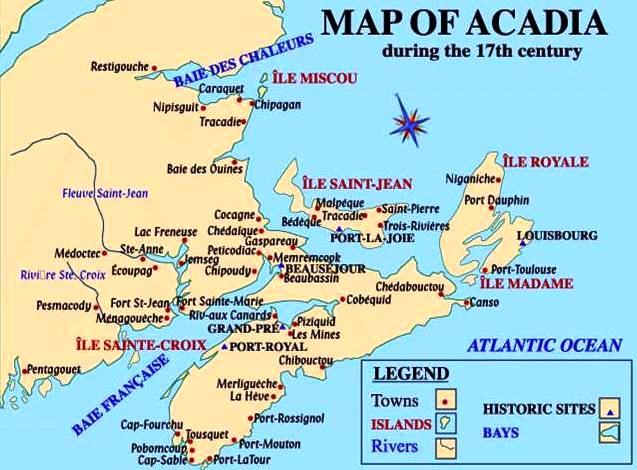
This point can be further accentuated through a consideration of the Acadians. In the calculation of the demographic history of French Canadians, the Acadians are sometimes included without a clear identification of their own demographic identity. The Acadians were another newly created people in the soil of America, not in present day Quebec, but in the maritime part of New France, or in the province of present day Nova Scotia.

The beginnings of the Acadians closely resembles that of the Quebecois; they too began as a small colony of men, or wooden buildings constructed in Port Royal in 1605 by Champlain, but these colonists were forced to return to France in 1607. In 1611, 20 new colonists, including a family, were brought back to Acadie, but this settlement failed as well.

It was only in 1651 that a demographic dynamic was set in Acadie, when about 50 families, or about 500 settlers, were brought in. After 1671, 40 more families were recruited from France, leading to a population of 800+ by 1686. By 1710, there were around 2,000 Acadians, “most of them born in North America” (J.M. Bumsted, 2003, p. 39). The text Origins likewise informs us that the “average Acadian couple usually married in their early twenties and had ten or eleven children, most of whom survived to adulthood” (p. 140).

Without any more French immigration, “the Acadian population multiplied by nearly 30 times between 1671 and 1755”. By 1750, “there were more than 10,000,” and “in 1755, more than 13,000 (excluding Louisbourg” (Origins, p. 141-44). J.M. Bumsted tells us that Louisbourg’s Acadian population was 3,500 in the 1750s (2011, p. 67).

The British gained control of Acadia in 1713, and in 1750-51 they recruited about 1,500 German Protestants, if not more, depending on the sources one examines, possibly as many as 2500, settled at Lunenburg. This population, however, has not been counted in the above Francophone numbers. We will be writing about British immigration/birth rate patterns in a future article.

In the context of a full-scale war between France and Britain, and the refusal of the Acadians to give a formal pledge of loyalty to the British rulers in Acadia, in 1755-58 the British deported about three-quarters of the Acadian population. By 1762, they had expelled another 3000. However, in 1764, the British allowed about 3000 Acadians to resettle back in Nova Scotia, and by 1800 the Acadians numbered 4000.

It should be noted that in the 1740s there were about 700 Acadians in Prince Edward Island (PEI), then known as Île St-Jean, and categorized as part of Acadia (Nova Scotia). In 1757, approximately 2,000 Acadians had fled to PIE as refugees, which increased the population to about 4,500, but the British expelled many of these Acadians in 1758. A census of 1803 showed a population of nearly 700 in PEI. In New Brunswick, a territory carved out of former Nova Scotia in 1784, there was a population of 4,000 Acadians in 1803, a “result of high birth rates rather than the return of more exiles” (Origins, p. 153; Bumsted, 2011, p. 109).

The conclusion we must reach is quite self-evidential: the Acadians began as a small group of immigrant families, only to grow into a people with blood ties firmly set in Acadia, through a very high fertility rate, with its own unique Francophone identity, with speech patterns quite different from the Quebecois, in a very harsh environment that required the harvesting of salt from the salt marshes, the clearing of forested uplands, the building of dikes to reclaim land from the Bay of Fundy’s strong tides; yet establishing themselves with a “far higher standard of living than all but the most privileged French peasants,” coupled with a spirit of independence and refusal to submit to external authorities, which led to their expulsion, though not their demise, constituting today about 11,000+ in Nova Scotia, and 25,000 in New Brunswick.

The claim that Acadians were just immigrants no less different to the making of Canada than Sri Lankan Tamils, corrupt Chinese real estate millionaires, andSomalis is patently absurd, a discreditable claim that only academics who are out of touch with historical reality, and shamelessly unburdened by their traitorous attitudes towards their ancestors, would make.

Sources

  • Bumsted, J. M. A History of the Canadian Peoples (Oxford, 2011, Fourth Edition)
  • Bumsted, J. M. Canada’s Diverse Peoples (ABC CLIO, 2003)
  • R. Douglas Francis, Richard Jones, and Donald B. Smith, Origins: Canadian History to Confederation (Harcourt, 2000, Fourth Edition)
  • R. Douglas Francis, Richard Jones, and Donald B. Smith, Destinies: Canadian History since Confederation (Harcourt, 1996, Third Edition)
  • K

    Acadians and the Minimal Role of Immigrants Before the Conquest/1763

    by Ricardo Duchesne

    Acadians building dykes

    It has been established at CEC that the current portrayal of Canada as a nation populated from the beginning by peoples from diverse cultures and racial backgrounds should be seen as nothing more than an act of deception orchestrated by academics in wilful disregard of the historical evidence for the sake of legitimizing the leftist/global corporate goal of creating a race-mixed Canada against its European heritage.

    The record shows, rather, that ninety percent of all immigrants who came to Canada before 1961 were from Britain, that it was only after the institutionalization of official multiculturalism in 1971 that immigrants from the Third World started to arrive in large numbers, that Canada was 96 percent ethnically European as late as 1971, and that immigration itself was not even the most important factor in Canada’s population history but the high fertility rates of true born Canadian pioneers.

    It has also been established at CEC that the French Canadiens were practically a new people born in the soil of New France, or within lands inside present-day Quebec, driven by the “exceptionally high” fertility rates of women, 5.6 surviving children on average, coupled with honourable patriarchal respect for women with children, the hard work and self-reliance of farmers.

    In this article we will show that before the conquest, from Canada’s origins up until the 1760s, immigrants played a very small role demographically in the making of Canada. Not only the Quebecois, but the Acadians as well, were a newly created people in the soil of North America. Native born Quebecois and Acadians were the main historical protagonists in the settlement of Canada for almost the first two hundred years.

    Another Misleading Text about Canada’s “Diverse” History

    Don’t you believe current historians who tell you that “New France was a multicultural society, with a considerable First Nations population and an African community”. This is the message advocated by one of the most widely used texts in Canadian universities, consisting of two volumes, Origins: Canadian History to Confederation, and Destinies: Canadian History since Confederation, by R. Douglas Francis, Richard Jones, and Donald B. Smith. This very successful text, now in its seventh edition, claims that it is a major improvement over “the older texts,” not only in incorporating “new historical research,” but in showing that “anyone seeking to understand our diversitytoday must first examine the pre-Confederation era” (Origins, pp. 108, viii, Fourth Edition).

    The two volumes seek to imprint upon students an image of Canada as “diverse” and “multicultural” from the beginning. Needless to say, Amerindians were the first inhabitants of territories that came to be identified as “Canada” only through the establishment of French and Anglo institutions during the 1600s to 1800s. But the “first peoples,” the Hurons, Algonquins, Cree, Iroquois, and others, were organized in tribes spread over territories that can in no way be identified as part of “Canada” before Europeans arrived. They were territories actually contiguous with the United States rather than neatly located within Canada. Only in retrospect, through the European science of geography, have they been, and can be, demarcated in the continent of North America for pedagogical instruction, but not as actually existing tribal nations with definite geographical boundaries, since none of these tribes were organized as nations with marked boundaries.

    European geographers, not the Amerindians, have classified the natives of Canada in terms of six cultural areas, “Northwest Coast,” “Plateau,” “Plains,”Subarctic,” “Arctic,” and “Northeast”. Indians had an intimate knowledge of the land, the soil, migration pathways of animals, weather, location of rivers, lakes, mountains, upon which the first European settlers and fur traders relied for survival. It was the Europeans, however, who mapped these territories and eventually created our modern institutions from the ground up.

    It is extremely anachronistic and misleading to tell students that these tribal groups were members of a multicultural Canada. The French and English, for one, inhabited separate cultural lives, and in respect to the Natives, they inhabited totally different worlds. Their interactions with Natives are best described as interactions between separate peoples, commercial and military interactions, which affected both sides, but which essentially involved the modernizing encroachment of the Anglo-French side upon the Native cultures, leading to a situation in which, by the time of Confederation in 1867, only 1 percent of the racial population of Canada was Amerindian.

    This reduction was of course tragic for the Aboriginals. But it is only by identifying them as a separate people that we can acknowledge their distinctive heritage instead of falsely assimilating them into a “multicultural Canada” as co-creators of a nation that only became multicultural in 1971 and in which, to this day, most Natives remain apart.

    It is outlandish for Origins and Destinies to tell students that “in 1867” the Natives peoples were one of the three “major groups” that made up “Canada’s multicultural society” (Destinies, Third Edition, p. 1). How can one percent of the population living in “lands reserved for Indians” — to use the official designation of the British North America Act — be identified as a “major” cultural group in Canada, equal to the French and the British, which made up 99 percent of the population?

    The historians of these volumes want to have it both ways: an image of a European Canada that “decimated” the Natives through diseases, and an image of “First Nations” as co-partners in the creation of Canada’s parliamentary institutions, legal system, schools and universities, churches, and modern economy. They want students to believe that the Natives were the “first peoples,” followed by the French and English, as the next two “major groups,” followed by the arrival of “non-British and non-French immigrants,” as a fourth major group. This fourth group is portrayed as a multiracial lot, even though the statistics contradict any such picture.

    The facts about the ethnic composition of immigrants, which this text cannot hide altogether, show that, at the time of Confederation, the English constituted about 60 percent of the population, the French 32 percent, and the remaining “non-British and non-French immigrants” about 8 percent. The non-British and non-French were all whites from Europe and the United States.

    There was no “considerable” African community in New France. The facts stated in Origins, which are the only facts that can be legitimately used, contradict this contrived interpretation: from its origins to 1759, only about 1,200 African slaves were brought to New France (p. 111). Another source says that “from 1681 to 1818 there were approximately 4100 slaves in French Canada, representing less than one per cent of the population”.

    The facts Origins has to rely on, since they are the only historically documented facts, contradict not only its claim that Canada was created by diverse racial groups but also the claim that the Europeans generally were “immigrants”. In the case of New France (and let us not forget that the history of New France is basically the history of Canada up until 1763), the text offers a detailed table on the number of French immigrants “by decade” from 1608 to 1759, from which we learn that the total number of immigrants throughout this period was only 8,527 (p.93). By contrast, the population of New France in 1759 was about 60,000. These numbers are consistent with the numbers I offered in The Canadiens of New France: A People Created Through the Fecundity of the Women — Not Immigration.

    Since the French were the first Canadians, and the English proportion in Canada as a whole, before the Conquest of 1763, was scattered and incidental, it behoves us to conclude, on the basis of the above numbers, that immigrants played a minimal role from the time Samuel de Champlain planted the first permanent settlement at Quebec in 1608 up until 1763.

    The Acadians

    This point can be further accentuated through a consideration of the Acadians. In the calculation of the demographic history of French Canadians, the Acadians are sometimes included without a clear identification of their own demographic identity. The Acadians were another newly created people in the soil of America, not in present day Quebec, but in the maritime part of New France, or in the province of present day Nova Scotia.

    The beginnings of the Acadians closely resembles that of the Quebecois; they too began as a small colony of men, or wooden buildings constructed in Port Royal in 1605 by Champlain, but these colonists were forced to return to France in 1607. In 1611, 20 new colonists, including a family, were brought back to Acadie, but this settlement failed as well.

    It was only in 1651 that a demographic dynamic was set in Acadie, when about 50 families, or about 500 settlers, were brought in. After 1671, 40 more families were recruited from France, leading to a population of 800+ by 1686. By 1710, there were around 2,000 Acadians, “most of them born in North America” (J.M. Bumsted, 2003, p. 39). The text Origins likewise informs us that the “average Acadian couple usually married in their early twenties and had ten or eleven children, most of whom survived to adulthood” (p. 140).

    Without any more French immigration, “the Acadian population multiplied by nearly 30 times between 1671 and 1755”. By 1750, “there were more than 10,000,” and “in 1755, more than 13,000 (excluding Louisbourg” (Origins, p. 141-44). J.M. Bumsted tells us that Louisbourg’s Acadian population was 3,500 in the 1750s (2011, p. 67).

    The British gained control of Acadia in 1713, and in 1750-51 they recruited about 1,500 German Protestants, if not more, depending on the sources one examines, possibly as many as 2500, settled at Lunenburg. This population, however, has not been counted in the above Francophone numbers. We will be writing about British immigration/birth rate patterns in a future article.

    In the context of a full-scale war between France and Britain, and the refusal of the Acadians to give a formal pledge of loyalty to the British rulers in Acadia, in 1755-58 the British deported about three-quarters of the Acadian population. By 1762, they had expelled another 3000. However, in 1764, the British allowed about 3000 Acadians to resettle back in Nova Scotia, and by 1800 the Acadians numbered 4000.

    It should be noted that in the 1740s there were about 700 Acadians in Prince Edward Island (PEI), then known as Île St-Jean, and categorized as part of Acadia (Nova Scotia). In 1757, approximately 2,000 Acadians had fled to PIE as refugees, which increased the population to about 4,500, but the British expelled many of these Acadians in 1758. A census of 1803 showed a population of nearly 700 in PEI. In New Brunswick, a territory carved out of former Nova Scotia in 1784, there was a population of 4,000 Acadians in 1803, a “result of high birth rates rather than the return of more exiles” (Origins, p. 153; Bumsted, 2011, p. 109).

    The conclusion we must reach is quite self-evidential: the Acadians began as a small group of immigrant families, only to grow into a people with blood ties firmly set in Acadia, through a very high fertility rate, with its own unique Francophone identity, with speech patterns quite different from the Quebecois, in a very harsh environment that required the harvesting of salt from the salt marshes, the clearing of forested uplands, the building of dikes to reclaim land from the Bay of Fundy’s strong tides; yet establishing themselves with a “far higher standard of living than all but the most privileged French peasants,” coupled with a spirit of independence and refusal to submit to external authorities, which led to their expulsion, though not their demise, constituting today about 11,000+ in Nova Scotia, and 25,000 in New Brunswick.

    The claim that Acadians were just immigrants no less different to the making of Canada than Sri Lankan Tamils, corrupt Chinese real estate millionaires, andSomalis is patently absurd, a discreditable claim that only academics who are out of touch with historical reality, and shamelessly unburdened by their traitorous attitudes towards their ancestors, would make.

    Sources

    • Bumsted, J. M. A History of the Canadian Peoples (Oxford, 2011, Fourth Edition)
    • Bumsted, J. M. Canada’s Diverse Peoples (ABC CLIO, 2003)
    • R. Douglas Francis, Richard Jones, and Donald B. Smith, Origins: Canadian History to Confederation (Harcourt, 2000, Fourth Edition)
    • R. Douglas Francis, Richard Jones, and Donald B. Smith, Destinies: Canadian History since Confederation (Harcourt, 1996, Third Edition)
    • Kenneth Donovan, “Slaves and Their Owners in Ile Royale, 1713-1760” Acandiensis, Vol. XXV, No. 1 Autumn/Automne 1995
    • Cole Harris and John Warkentin, Canada Before Confederation: A Study on Historical Geography (McGill-Queen’s Press, 2005 [1974])
    • Sally Ross, The Acadians of Nova Scotia (Hignell Printing, 1992).

    Posted at 07:32 Be the first to comment enneth Donovan, “Slaves and Their Owners in Ile Royale, 1713-1760” Acandiensis, Vol. XXV, No. 1 Autumn/Automne 1995

  • Cole Harris and John Warkentin, Canada Before Confederation: A Study on Historical Geography (McGill-Queen’s Press, 2005 [1974])
  • Sally Ross, The Acadians of Nova Scotia (Hignell Printing, 1992).


German Victimization: The Ethnic Cleaning of 16-Million Germans, 1944-1948

Posted on by

German Victimization: The Ethnic Cleaning of 16-Million Germans, 1944-1948


Inline image 1

The Loyalists Were Not Immigrants: 1763-1815

Posted on by

The Loyalists Were Not Immigrants: 1763-1815

by Ricardo Duchesne

We have seen that up until the British Conquest of New France in 1763, the vast majority of Canadians were francophones, Quebecois and Acadians, born in the soil of North America. The total number of immigrants who came to Quebec and Acadia, from the first settlements Samuel Champlain established in the first decade of the 1600s until 1763, was very small. In Quebec, only 8,527 immigrants arrived during this entire period (from 1608 to 1759). In Acadia, a few hundred settlers arrived in the first half of the seventeenth century, and thereafter it was the high fertility rates of Acadians that engendered a population of roughly 13,000 by the 1750s.

How about the role of immigrants from “diverse” places after the Conquest? Was not the English-speaking Canada that emerged after the Conquest, in Ontario and Nova Scotia, created by arrival of immigrants “from many ethnic backgrounds”, as standard college textbooks religiously inform their students today?

Don’t you believe them. The immigration time line from 1760 to 1815, which is the subject of this article, and which includes the Loyalists as the principal new settlers in Canada, can only be categorized as a period of “many new diverse immigrants” through the manipulation of words.

What this period actually witnessed was:

  1. a massive growth in the population of Quebec through the continuation of high fertility rates with zero francophone immigration, and minimal arrival of British individuals.
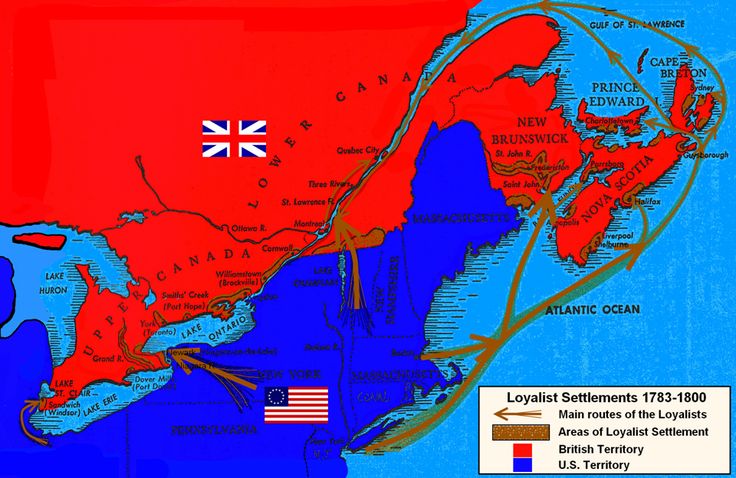
  2. an internal migration of New Englanders and Loyalists from some regions of British North America to other regions of British North America, principally to Upper Canada and Nova Scotia. Both New Englanders and Loyalists were long established native born British settlers in the American colonies, not immigrants.
  3. the arrival of immigrants from the British Isles (with the exception of some Whites from Germany) should also be identified as movement by internal migrants, from the British Isles to other British lands.

High Fertility Population Growth in Quebec 1763-1815

The English population in New France/Quebec numbered only about 500 in 1765. When the British conquered Quebec they anticipated that significant English-speaking families would move from the British American colonies to the British Canadian colonies. They hoped that in this way Quebec would be gradually Protestantized and Anglicized. But only “a few hundred English-speaking, Protestant immigrants, largely merchants” had arrived by 1774. The number of English has been estimated at 2000 in 1780.

In the 1780s, a few thousand Loyalists did arrive. There are no precise estimations as to how many Loyalists settled in Quebec proper, rather than what would become Upper Canada or Ontario, which was carved out from the western side of New France in 1791. In any case, when this partition occurred, the English population in Quebec proper, or Lower Canada, was about 10,000. Meanwhile, the total non-Aboriginal population of Quebec in 1791 had increased substantially since the Conquest from about 60,000 to about 160,000.

Now, assuming that all the English speaking inhabitants, the 10,000, were immigrants, we can safely say that Quebec’s francophone population increased by 150,000 souls solely through a high fertility rate without any immigration. It has been estimated that the English population in Lower Canada/Quebec reached 30,000 by 1812. The francophone population, meanwhile, increased to 335,000 by 1814.

Again, assuming that the 30,000 English speakers were all immigrants (hardly the case, since after the Loyalist influx of the 1780s there was little immigration from the English world), it follows that the history of one of the two founding peoples of Canada, the Quebecois, was a history without any significant immigration from 1608 up until 1814. Therefore, it is simply an act of malicious deception to identify the Quebecois as immigrants.

The Internal Migration of New Englanders and Loyalists

Between 1758 and 1762, before the arrival of the Loyalists, about 7000 to 8000 New England “Planters” settled in Nova Scotia in the lands previously occupied by the Acadians who had been expelled in the 1750s. But half of these Planters left within a few years, finding Nova Scotia too scarce in resources and good lands. These New Englanders were British-Americans who moved from one British-ethnic land (New England) to another British-ruled land (Nova Scotia), which was fast becoming Anglicized after the expulsion of Acadians.

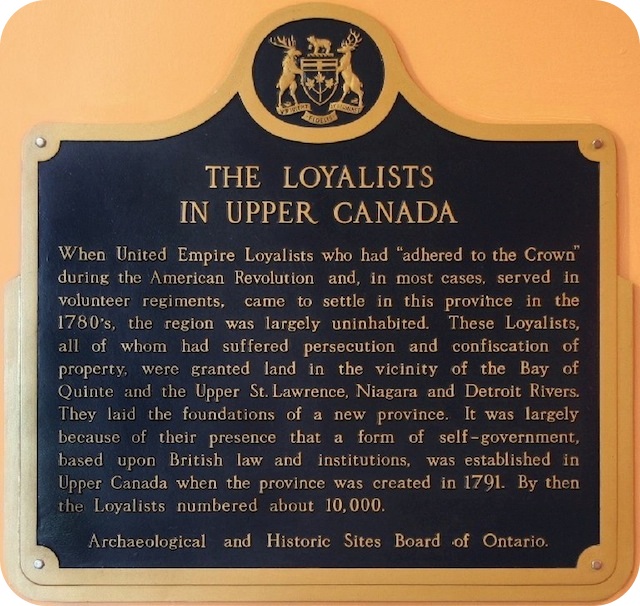
The estimated number of Loyalists who came to Canada has been estimated at 50,000. About 14,500 Loyalists went to the new territory of New Brunswick, which was partitioned from Nova Scotia in 1784. About the same number went to Nova Scotia, 400 to Cape Breton, and some 500 to PEI. Roughly about 14,000 Loyalists went to Lower and Upper Canada, mostly to the latter territory, during the 1780s and 1790s.

The popular textbook, Origins: Canadian History to Confederation, by R. Douglas Francis, et. al, refers to the Loyalists as immigrants who came “from many ethnic backgrounds” (p. 233). It notes that “as many as 500” “black Loyalists” (p. 237) were brought to Upper Canada and some 3000 to Nova Scotia). A History of the Canadian Peoples, by possibly the foremost historian of Canada, J.M. Bumsted, likewise refers to the Loyalists as “quite a disparate group” that included “well over 3000 blacks”, as well as 2000 Aboriginal “loyalists”, who settled in Upper Canada (p. 101). He notes, though, that nearly half of the Blacks soon emigrated to Africa.

There is no way around the fact that, as the text Origins eventually admits, the “overwhelming majority of the Loyalists were white”. Even if we were to accept the rather wishful claim that blacks and Aboriginals were “Loyalists” (Americancolonists who remained loyal to the British Crown during the American Revolutionary War), the total non-White proportion was only 7 percent.

Moreover, it is more accurate to identify Loyalists as “internal migrants” rather than immigrants, since they actually moved from colonies that were thoroughly British to territories rule by Britain that were becoming, Nova Scotia and Upper Canada, increasingly Anglicized. It was essentially a movement by Brits within the Anglo mainland of North America.

Some may reply that this argument only holds for the New England “Planters” but not for the Loyalists, since the Loyalists were leaving the newly independent American lands of post-1776. They were Americans rather than British. But this is not a good argument for two reasons: the Americans were indeed a new people created in the soil of North America, but they were still racially British, and the Loyalists were called “Loyalist” precisely because they remained loyal to British rule, rather than American rule in the thirteen colonies.

Immigrants from the British Isles

The texts I have examined don’t always provide consistently precise numbers, but only indicate that from 1790 to 1815 immigrants from the “British Isles” came to Upper Canada, mainly from the Scottish Highlands and Ireland. One estimate has it that between 6000 and 10 000 immigrants came in the early 1800s from the Highland to the Maritimes and Upper Canada. Another text says that in the 1760s and 1770s Nova Scotia saw some 2000 settlers arrived from Ireland, 750 from England, and, in 1773, 200 Scots.

Before these immigrants from the Isles, Nova Scotia saw the arrival of some 1500 German Protestants in the early 1750s. Taking into account these immigrants, Bumsted portrays (p. 86) Nova Scotia in the late 1760s, that is, before the arrival of the Loyalists, as a land characterized by ethnic and religious diversity. He sees the arrival of Loyalists as adding more to this diversity, with the “black Loyalists”. But we already saw that Blacks were a very small proportion of the total population, and that the Americans, both the New England “Planters” and the Loyalists, were internal migrants.

It can also be added that the immigrants from the Isles were all English-speaking, very closely related genetically and culturally, moving from the British Isles to an increasingly Anglicized Nova Scotia and a newly-created Anglicized Upper Canada. The Acadians added, and I suppose all the different groups did as well, an intra-European ethnic diversity, a French-British diversity combined with some German Aryans.

Conclusion

The most reasonable conclusion we can reach about immigration patterns in Canada’s history from 1763 to 1815 is that it was an internal migration movement within a British world in mainland North America, and across the Atlantic from the British Isles to British North America. The demographic growth that Upper Canada experienced from the 1760s, when it was barely populated by Europeans, to 1815, was quite substantial, from 14,000 inhabitants in 1791, to 70,718 in 1806, to 95,000 in 1814. The Loyalists undoubtedly played a key role in this demographic expansion. For example, in Upper Canada, in 1812, American inhabitants, or with American ancestry, made up about 80 percent of the population of 136,000. It is not exaggeration to say that the Loyalists were the original founders of Ontario, and the original internal migrants who did the most in the introduction of British culture and political institutions to Canada.

Similarly, in Nova Scotia, immigration from the British Isles, and internal migration from British/America contributed, to the demographic growth of Nova Scotia after the expulsion of the Acadians. We will see in a future article that immigration from the British Isles was to increase substantially after 1815. We will see, too, that these immigrants are best identified as pioneers or settlers. Outside the francophone communities, Anglo pioneers were creating a world of Canadian Anglo ethnicity, British rule of law, language, and religions, not a world of multiple cultures and races.

Sources

  • J.M. Bumsted, A History of the Canadian Peoples, Oxford, 2011, fourth edition
  • J.M. Bumsted, Canada’s Diverse Peoples, ABC CLIO, 2003
  • J.M.S. Careless, Canada: A Story of Challenge, St Martin’s Press, 1965
  • R. Douglas Francis, Richard Jones, and Donald B. Smith, Origins: Canadian History to Confederation, Harcourt, 2000, fourth edition
  • The Canadian Encyclopedia, Loyalists

Related posts:

Disrespecting the European Founding/Settler People Majority

Posted on by
Disrespecting the European Founding/Settler People Majority
Have your MPs begun the habit of greeting their constituencies in several languages other than the official languages of English/French?  I think this should be illegal.  I notice he didn’t send greetings in European languages such as German, Danish, etc. The picture is also offensive with whites represented by one-third implying that Canada is two-thirds non-White. It is actually only 21 per cent non-White.

image

The Komagata Maru: Stop Apologizing! Paul Fromm: The Untold Story of the Komagata Maru

Posted on by

The Komagata Maru: Stop Apologizing! Paul Fromm: The Untold Story of the Komagata Maru

https://www.youtube.com/watch?v=3ujYu-n4tyc


This interview serves as a reaction to the apology offered to the Canadian Sikh community by Justin Trudeau on May 18, 2016 for the Komagata Maru incident,

Komagata Maru: Illegal in 1914; No Apology Needed Today! CFIRC Organizes Protests in Toronto, Vancouver and Ottawa

Posted on by

Komagata Maru: Illegal in 1914; No Apology Needed Today!

CFIRC Organizes Protests in Toronto, Vancouver and Ottawa


The Canada First Immigration Reform Committee  is organizing protests in Toronto, Vancouver and Ottawa on May 18,   to protest Prime Minister Justin Trudeau announced plan to make yet another apology to Canada’s Sikhs for the expulsion of the “Komagata Maru” in 1914.

As well, the Canada First Immigration Reform Committee will hold a press conference to oppose Prime Minister Justin Trudeau’s  apology to Canada’s Sikhs for the “Komagata Maru” incident. The press conference will be held in the Charles Lynch Room (Room 130-S) on Wednesday, May 18, 2016 at 1:30 p.m.


“Prime Minister Trudeau’s apology to Sikhs for the Dominion Government’s decision 102 years ago to turn back the “Komagata Maru”, a ship carrying 376 Indians, mostly Sikhs, is humiliating and wrong,” says CFIRC Director Paul Fromm.


“We can only apologize for our own actions,” Mr. Fromm explains. “We cannot apologize for the actions takenover a century ago, nor should we. The government of the time did the right thing. The “Komagata Maru” was hired by a radical Sikh businessman to try to test Canada’s immigration laws. The Dominion Government upheld the laws; the border busters lost. No apology needed.”


“For 30 years, Canadian politicians have been bedeviled by demands by radical Sikhs for an apology. Prime Minister Harper apologized in 2008 and paid over $2-million for Sikhs to commemorate their own history,” Mr. Fromm adds. “These demands do not reflect reality. Most Sikhs clearly do not consider Canada a hostile country. Indeed, they see it as a promised land. In the past four decades, tens of thousands of Sikhs have come to Canada. Canada  has the second largest Sikh population outside of India,” he adds.


Sikhs constitute 1.5 of Canada’s population but have 4 members or 13 per cent of the Liberal cabinet. Again no apology is needed.  Canadians cannot apologize for what other Canadians did a century ago. Policies change, politics change and new people are elected. If our views today differ from our forefathers, that difference shows in new policies, not apologies.”


“If the Government wants to revisit the Komagata Maru incident, it might consider honouring, perhaps with a stamp, William  C. Hopkinson, a resourceful immigration department inspector. Born in India, he spoke several Indian languages and his duties included going under cover among Sikhs revolutionaries active in British Columbia. It was also thought that he worked for the Americans in a similar capacity. He put together the information relied on by the Dominion Government to turn back the Komagata Maru. In October, 1914, he was assassinated by Mewa Singh, a Sikh extremist inside the Vancouver Court House (now the Vancouver Art Gallery) as a direct result of his work in the Komagata Maru incident.

–30–


The Canada First Immigration Reform Committee publishes the monthly Canadian Immigration Hotline and holds meetings across the country. A recent video on our website explains our position on the Komagata Maru incident more fully: Justin Trudeau Shouldn’t Apologize to the Sikh’s on May 18th https://youtu.be/czbKQq5KWXc

[To learn the truth about the “Komagata Maru”, send $7.00 to 

C-FAR Books, 

P.O. Box 332, 

Rexdale,. ON., 

M9W 5L3

 for a copy of Robert Jarvis’s booklet The Komagata Maru Incident: A Canadian Immigration Revisited. Read about the assassination by a Sikh extremist of William Hopkinson, a Canadian immigration agent and undercover operative. The memory of this intrepid and brave man has been thrust down the memory hole by the politically correct.]

Komagata Maru Incident Fact Sheet – No Apology Needed
The Komagata Maru’s arrival challenged a 1908 regulation that denied entry to immigrants unless they had $200 and had made a “continuous journey” from their home country. … Under the policy, only 20 returning residents, and the ship’s doctor and his family were allowed to enter. The remaining passengers were confined to the ship for two months, after which the ship was forced to sail back to India.


The incursion of the Komagata Maru was organized by a radical Sikh businessman named Gurdit Singh as a test of Canada’s immigration laws. It was a business venture. Gurdit Singh, originally from the Punjab but based in Singapore, told associates in Hong Kong that, if the Komagata Maru succeeded in busting Canada’s immigration regulations, he’d bring 25,000 Sikhs to British Columbia. Remember that, in 1914, Vancouver was a city of just 70,000 souls. The passengers had to pay a hefty fare.


       Gurdit Singh was an associate of an Indian revolutionary movement called the Ghadar Party. Ghadar is Urdu for “mutiny.” Many Whites could recall the brutal massacre of men, women and children when some units of the Indian Army mutinied in 1857. The mutiny claimed over 11,000 British troops and hundreds of British women and children. Undesirables:White Canada and the Komagata Maru explains: In 1913, “the Hindustani Workers of the Pacific Coast, a revolutionary organization,  crystallized … in Astoria, Oregon. It would soon become known, after the title of its magazine, as the Ghadar Party – a provocative name, since ghadar meant mutiny. The new party … advocated the armed overthrow of the British Empire, extolling [sic] Indian soldiers to mutiny once again.”


Husain Rahim, Bhag Singh, Balwant Singh and Sohan Lal, among others were its members.” These four were key members of the Shore Committee which agitated on behalf of the Komagata Maru, raised funds and retained legal assistance. Undesirables, which is fervently for the Komagata Maru cause, adds: Immigration inspector William Hopkinson was “certain that the voyage of the Komagata Maru was part of a Ghadar Party strategy, with Gurdit Singh in on the conspiracy. Singh’s statements to the press on the arrival had confirmed [these] fears: ‘What is done with this ship load of my people will determine whether we shall have peace in all parts of the British Empire.’”


William Hopkinson’s short life would make an excellent movie plot or a gripping dramatic series dealing with undercover work and foreign revolutionaries, schemes to hoodwink the Canadian government and much, much more. Oh, yes, and many shootings and assassinations by a group of newcomers to Canada.


Instead of apologizing for a past patriotic government’s decision to expel a shipload of illegals and instead of issuing a stamp (as the Harper government did in 2014) commemorating the radicals of the unsuccessful Komagata Maru immigration incursion of 1914, the Canadian government should issue a stamp honouring William C Hopkinson. He was a gifted linguist and a daring undercover agent who ran a network of spies among Vancouver’s radical Sikh community. He developed much of the information that the Dominion Government used to expel the bulk of the Komagata Maru’s passengers in the summer of 1914. Largely due to his information and the leadership of a rookie Vancouver MP H.H. Stevens, the Canadian government met the challenge of unwanted and uninvited illegals seeking to evade our rules and sneak into Canada.


William Hopkinson would pay the ultimate price for his dedication. He was assassinated by Mewa Singh, a Ghadr party member and Sikh radical inside the courthouse in downtown Vancouver, October 21, 1914. It is now the Vancouver Art Gallery. Many of his Indian agents were also murdered by radical Sikhs. With all the boo-hooing about the government of Sir Robert Borden’s decision to expel the illegals, the toadying politicians and the servile media tell us little of the killings and violence perpetrated by the Sikh radicals within their own community in that Vancouver of a century ago.

 

The Canada First Immigration Reform Committee  is organizing protests in Toronto, Vancouver and Ottawa on May 18,   to protest Prime Minister Justin Trudeau announced plan to make yet another apology to Canada’s Sikhs for the expulsion of the “Komagata Maru” in 1914.

As well, the Canada First Immigration Reform Committee will hold a press conference to oppose Prime Minister Justin Trudeau’s  apology to Canada’s Sikhs for the “Komagata Maru” incident. The press conference will be held in the Charles Lynch Room (Room 130-S) on Wednesday, May 18, 2016 at 1:30 p.m.


“Prime Minister Trudeau’s apology to Sikhs for the Dominion Government’s decision 102 years ago to turn back the “Komagata Maru”, a ship carrying 376 Indians, mostly Sikhs, is humiliating and wrong,” says CFIRC Director Paul Fromm.


“We can only apologize for our own actions,” Mr. Fromm explains. “We cannot apologize for the actions takenover a century ago, nor should we. The government of the time did the right thing. The “Komagata Maru” was hired by a radical Sikh businessman to try to test Canada’s immigration laws. The Dominion Government upheld the laws; the border busters lost. No apology needed.”


“For 30 years, Canadian politicians have been bedeviled by demands by radical Sikhs for an apology. Prime Minister Harper apologized in 2008 and paid over $2-million for Sikhs to commemorate their own history,” Mr. Fromm adds. “These demands do not reflect reality. Most Sikhs clearly do not consider Canada a hostile country. Indeed, they see it as a promised land. In the past four decades, tens of thousands of Sikhs have come to Canada. Canada  has the second largest Sikh population outside of India,” he adds.


Sikhs constitute 1.5 of Canada’s population but have 4 members or 13 per cent of the Liberal cabinet. Again no apology is needed.  Canadians cannot apologize for what other Canadians did a century ago. Policies change, politics change and new people are elected. If our views today differ from our forefathers, that difference shows in new policies, not apologies.”


“If the Government wants to revisit the Komagata Maru incident, it might consider honouring, perhaps with a stamp, William  C. Hopkinson, a resourceful immigration department inspector. Born in India, he spoke several Indian languages and his duties included going under cover among Sikhs revolutionaries active in British Columbia. It was also thought that he worked for the Americans in a similar capacity. He put together the information relied on by the Dominion Government to turn back the Komagata Maru. In October, 1914, he was assassinated by Mewa Singh, a Sikh extremist inside the Vancouver Court House (now the Vancouver Art Gallery) as a direct result of his work in the Komagata Maru incident.

–30–


The Canada First Immigration Reform Committee publishes the monthly Canadian Immigration Hotline and holds meetings across the country. A recent video on our website explains our position on the Komagata Maru incident more fully: Justin Trudeau Shouldn’t Apologize to the Sikh’s on May 18th https://youtu.be/czbKQq5KWXc

[To learn the truth about the “Komagata Maru”, send $7.00 to 

C-FAR Books, 

P.O. Box 332, 

Rexdale,. ON., 

M9W 5L3

 for a copy of Robert Jarvis’s booklet The Komagata Maru Incident: A Canadian Immigration Revisited. Read about the assassination by a Sikh extremist of William Hopkinson, a Canadian immigration agent and undercover operative. The memory of this intrepid and brave man has been thrust down the memory hole by the politically correct.]

Komagata Maru Incident Fact Sheet – No Apology Needed
The Komagata Maru’s arrival challenged a 1908 regulation that denied entry to immigrants unless they had $200 and had made a “continuous journey” from their home country. … Under the policy, only 20 returning residents, and the ship’s doctor and his family were allowed to enter. The remaining passengers were confined to the ship for two months, after which the ship was forced to sail back to India.


The incursion of the Komagata Maru was organized by a radical Sikh businessman named Gurdit Singh as a test of Canada’s immigration laws. It was a business venture. Gurdit Singh, originally from the Punjab but based in Singapore, told associates in Hong Kong that, if the Komagata Maru succeeded in busting Canada’s immigration regulations, he’d bring 25,000 Sikhs to British Columbia. Remember that, in 1914, Vancouver was a city of just 70,000 souls. The passengers had to pay a hefty fare.


       Gurdit Singh was an associate of an Indian revolutionary movement called the Ghadar Party. Ghadar is Urdu for “mutiny.” Many Whites could recall the brutal massacre of men, women and children when some units of the Indian Army mutinied in 1857. The mutiny claimed over 11,000 British troops and hundreds of British women and children. Undesirables:White Canada and the Komagata Maru explains: In 1913, “the Hindustani Workers of the Pacific Coast, a revolutionary organization,  crystallized … in Astoria, Oregon. It would soon become known, after the title of its magazine, as the Ghadar Party – a provocative name, since ghadar meant mutiny. The new party … advocated the armed overthrow of the British Empire, extolling [sic] Indian soldiers to mutiny once again.”


Husain Rahim, Bhag Singh, Balwant Singh and Sohan Lal, among others were its members.” These four were key members of the Shore Committee which agitated on behalf of the Komagata Maru, raised funds and retained legal assistance. Undesirables, which is fervently for the Komagata Maru cause, adds: Immigration inspector William Hopkinson was “certain that the voyage of the Komagata Maru was part of a Ghadar Party strategy, with Gurdit Singh in on the conspiracy. Singh’s statements to the press on the arrival had confirmed [these] fears: ‘What is done with this ship load of my people will determine whether we shall have peace in all parts of the British Empire.’”


William Hopkinson’s short life would make an excellent movie plot or a gripping dramatic series dealing with undercover work and foreign revolutionaries, schemes to hoodwink the Canadian government and much, much more. Oh, yes, and many shootings and assassinations by a group of newcomers to Canada.


Instead of apologizing for a past patriotic government’s decision to expel a shipload of illegals and instead of issuing a stamp (as the Harper government did in 2014) commemorating the radicals of the unsuccessful Komagata Maru immigration incursion of 1914, the Canadian government should issue a stamp honouring William C Hopkinson. He was a gifted linguist and a daring undercover agent who ran a network of spies among Vancouver’s radical Sikh community. He developed much of the information that the Dominion Government used to expel the bulk of the Komagata Maru’s passengers in the summer of 1914. Largely due to his information and the leadership of a rookie Vancouver MP H.H. Stevens, the Canadian government met the challenge of unwanted and uninvited illegals seeking to evade our rules and sneak into Canada.


William Hopkinson would pay the ultimate price for his dedication. He was assassinated by Mewa Singh, a Ghadr party member and Sikh radical inside the courthouse in downtown Vancouver, October 21, 1914. It is now the Vancouver Art Gallery. Many of his Indian agents were also murdered by radical Sikhs. With all the boo-hooing about the government of Sir Robert Borden’s decision to expel the illegals, the toadying politicians and the servile media tell us little of the killings and violence perpetrated by the Sikh radicals within their own community in that Vancouver of a century ago.Maru: Illegal in 1914; No Apology Needed Today!

CFIRC Organizes Protests in Toronto, Vancouver and Ottawa


The Canada First Immigration Reform Committee  is organizing protests in Toronto, Vancouver and Ottawa on May 18,   to protest Prime Minister Justin Trudeau announced plan to make yet another apology to Canada’s Sikhs for the expulsion of the “Komagata Maru” in 1914.

As well, the Canada First Immigration Reform Committee will hold a press conference to oppose Prime Minister Justin Trudeau’s  apology to Canada’s Sikhs for the “Komagata Maru” incident. The press conference will be held in the Charles Lynch Room (Room 130-S) on Wednesday, May 18, 2016 at 1:30 p.m.


“Prime Minister Trudeau’s apology to Sikhs for the Dominion Government’s decision 102 years ago to turn back the “Komagata Maru”, a ship carrying 376 Indians, mostly Sikhs, is humiliating and wrong,” says CFIRC Director Paul Fromm.


“We can only apologize for our own actions,” Mr. Fromm explains. “We cannot apologize for the actions takenover a century ago, nor should we. The government of the time did the right thing. The “Komagata Maru” was hired by a radical Sikh businessman to try to test Canada’s immigration laws. The Dominion Government upheld the laws; the border busters lost. No apology needed.”


“For 30 years, Canadian politicians have been bedeviled by demands by radical Sikhs for an apology. Prime Minister Harper apologized in 2008 and paid over $2-million for Sikhs to commemorate their own history,” Mr. Fromm adds. “These demands do not reflect reality. Most Sikhs clearly do not consider Canada a hostile country. Indeed, they see it as a promised land. In the past four decades, tens of thousands of Sikhs have come to Canada. Canada  has the second largest Sikh population outside of India,” he adds.


Sikhs constitute 1.5 of Canada’s population but have 4 members or 13 per cent of the Liberal cabinet. Again no apology is needed.  Canadians cannot apologize for what other Canadians did a century ago. Policies change, politics change and new people are elected. If our views today differ from our forefathers, that difference shows in new policies, not apologies.”


“If the Government wants to revisit the Komagata Maru incident, it might consider honouring, perhaps with a stamp, William  C. Hopkinson, a resourceful immigration department inspector. Born in India, he spoke several Indian languages and his duties included going under cover among Sikhs revolutionaries active in British Columbia. It was also thought that he worked for the Americans in a similar capacity. He put together the information relied on by the Dominion Government to turn back the Komagata Maru. In October, 1914, he was assassinated by Mewa Singh, a Sikh extremist inside the Vancouver Court House (now the Vancouver Art Gallery) as a direct result of his work in the Komagata Maru incident.

–30–


The Canada First Immigration Reform Committee publishes the monthly Canadian Immigration Hotline and holds meetings across the country. A recent video on our website explains our position on the Komagata Maru incident more fully: Justin Trudeau Shouldn’t Apologize to the Sikh’s on May 18th https://youtu.be/czbKQq5KWXc

[To learn the truth about the “Komagata Maru”, send $7.00 to 

C-FAR Books, 

P.O. Box 332, 

Rexdale,. ON., 

M9W 5L3

 for a copy of Robert Jarvis’s booklet The Komagata Maru Incident: A Canadian Immigration Revisited. Read about the assassination by a Sikh extremist of William Hopkinson, a Canadian immigration agent and undercover operative. The memory of this intrepid and brave man has been thrust down the memory hole by the politically correct.]

Komagata Maru Incident Fact Sheet – No Apology Needed
The Komagata Maru’s arrival challenged a 1908 regulation that denied entry to immigrants unless they had $200 and had made a “continuous journey” from their home country. … Under the policy, only 20 returning residents, and the ship’s doctor and his family were allowed to enter. The remaining passengers were confined to the ship for two months, after which the ship was forced to sail back to India.


The incursion of the Komagata Maru was organized by a radical Sikh businessman named Gurdit Singh as a test of Canada’s immigration laws. It was a business venture. Gurdit Singh, originally from the Punjab but based in Singapore, told associates in Hong Kong that, if the Komagata Maru succeeded in busting Canada’s immigration regulations, he’d bring 25,000 Sikhs to British Columbia. Remember that, in 1914, Vancouver was a city of just 70,000 souls. The passengers had to pay a hefty fare.


       Gurdit Singh was an associate of an Indian revolutionary movement called the Ghadar Party. Ghadar is Urdu for “mutiny.” Many Whites could recall the brutal massacre of men, women and children when some units of the Indian Army mutinied in 1857. The mutiny claimed over 11,000 British troops and hundreds of British women and children. Undesirables:White Canada and the Komagata Maru explains: In 1913, “the Hindustani Workers of the Pacific Coast, a revolutionary organization,  crystallized … in Astoria, Oregon. It would soon become known, after the title of its magazine, as the Ghadar Party – a provocative name, since ghadar meant mutiny. The new party … advocated the armed overthrow of the British Empire, extolling [sic] Indian soldiers to mutiny once again.”


Husain Rahim, Bhag Singh, Balwant Singh and Sohan Lal, among others were its members.” These four were key members of the Shore Committee which agitated on behalf of the Komagata Maru, raised funds and retained legal assistance. Undesirables, which is fervently for the Komagata Maru cause, adds: Immigration inspector William Hopkinson was “certain that the voyage of the Komagata Maru was part of a Ghadar Party strategy, with Gurdit Singh in on the conspiracy. Singh’s statements to the press on the arrival had confirmed [these] fears: ‘What is done with this ship load of my people will determine whether we shall have peace in all parts of the British Empire.’”


William Hopkinson’s short life would make an excellent movie plot or a gripping dramatic series dealing with undercover work and foreign revolutionaries, schemes to hoodwink the Canadian government and much, much more. Oh, yes, and many shootings and assassinations by a group of newcomers to Canada.


Instead of apologizing for a past patriotic government’s decision to expel a shipload of illegals and instead of issuing a stamp (as the Harper government did in 2014) commemorating the radicals of the unsuccessful Komagata Maru immigration incursion of 1914, the Canadian government should issue a stamp honouring William C Hopkinson. He was a gifted linguist and a daring undercover agent who ran a network of spies among Vancouver’s radical Sikh community. He developed much of the information that the Dominion Government used to expel the bulk of the Komagata Maru’s passengers in the summer of 1914. Largely due to his information and the leadership of a rookie Vancouver MP H.H. Stevens, the Canadian government met the challenge of unwanted and uninvited illegals seeking to evade our rules and sneak into Canada.


William Hopkinson would pay the ultimate price for his dedication. He was assassinated by Mewa Singh, a Ghadr party member and Sikh radical inside the courthouse in downtown Vancouver, October 21, 1914. It is now the Vancouver Art Gallery. Many of his Indian agents were also murdered by radical Sikhs. With all the boo-hooing about the government of Sir Robert Borden’s decision to expel the illegals, the toadying politicians and the servile media tell us little of the killings and violence perpetrated by the Sikh radicals within their own community in that Vancouver of a century ago.