Manufacturing Heroes: The Beatification of Viola Desmond

Posted on by

Manufacturing Heroes: The Beatification of Viola Desmond

“When a man starts to hate himself the path to destruction is already open, the same is true of a nation.”
Vivekananda


So Viola Desmond’s face finally made it on Canada’s new ten dollar bill. Not a moment too soon though, because the suspense has been killing me.  Ever since the media announced two years ago that Desmond was the winner of contest to see which Canadian heroine would displace John A. MacDonald.


I recall that moment with clarity.   Global TV News had just finished talking about the achievements of the late John Glenn, when Viola’s fan club came up to the plate. The newscaster described Desmond’s refusal to move from the “whites only” area of the Roseland movie theatre as a “brave and defiant act” and a “transformative protest”. To bolster the point, interviewee Dr. Annette Henry noted that since she did it 9 years before Rosa Park, Rosa Park was the American Viola Desmond, rather than the reverse. Makes you proud to be a Canadian, doesn’t it?


Two things quickly occurred to me. Neither Global National or BC Global News used the word “brave” to describe John Glenn’s first voyage in space. In other words, it apparently took more courage to defy the seating arrangement rules of a movie theatre in Nova Scotia than it did to sit at the top end of a rocket, be propelled into space, revolve twice around the planet in a tiny capsule, re-enter the atmosphere and land in the ocean intact.


Keep in mind that as humiliating as it was for a black woman  in Nova Scotia to be denied entry to a portion of a movie theatre because of her race, there wasn’t a lynch party of Klansmen waiting outside for her when she left. Her refusal to leave her seat prompted the theatre manager and a police officer to drag her off, and in the ensuing scuffle, her hip was injured.  But still, suffering an injury of that nature, and being jailed and fined didn’t carry the risk that Glenn incurred. The repercussions that Desmond suffered were less than life-threatening. Glenn’s life in space was on the line for 5 hours. Courage? Bravery? Game-changing? My vote would go the astronaut.

The other salient fact that emerged from Desmond’s beatification is that—to use the words of the Global News reporter—“in 2018 John A. MacDonald will be bumped off the $10 bill” to make way for Desmond. That, to me, offers the most significant clue as to what this is all about. It is about an Anglo-Celtic Canadian, a member of one of two founding nations, a nation-builder, being replaced by what a social justice warrior’s idea of what a real hero looks like. . It is a statement that one symbolic blow against social injustice in a movie theatre is of greater importance than the building of the railway that actually created a nation from sea to sea. I mean, what did John A. MacDonald do—-except be instrumental in the movement to build a national railway and complete a nation?  Had there been no MacDonald, there would have no Canadian currency to exhibit Viola Desmond’s likeness. No Orders of Canada or awards to celebrate Canadian heroes because there would be no Canadians to celebrate.  (Then again, there wouldn’t have been a CBC either, so maybe it would have better if John A. had never been born.)


Ah, but you see, MacDonald the nation-builder was a racist who did much harm to native people, and racists don’t deserve to be on our currency or standing in front of Victoria City Hall for that matter. Or so goes the vindictive anti-white narrative of the social justice coalition. But the truth is, as Richard Gwynne pointed out, MacDonald was unusually liberal-minded for his time.


VIOLA DESMOND

 “Among his lifelong friends were Indians and Métis. He wasn’t in the least afraid to tell the truth about relations between native people and whites, as in: ‘We must remember they are the original owners of the soil of which they have been dispossessed by the covetousness or ambition of our ancestors’. Most remarkably, he got MPs to agree to the most imaginative reform of his time: any Indian could gain the vote while retaining all his privileges, such as freedom from taxes. Unhappily, Laurier cancelled this reform, with the measure not restored until John Diefenbaker did so in 1960, which was far too late to make any difference.”


Gwynne continued,

“His actual policy for getting food to the Indians — one his critics always avoid citing — was: ‘We cannot as Christians, and as men with hearts in our bosoms, allow the vagabond Indian to die before us . . . We must prevent them from starving, in consequence of the extinction of the buffalo and their not yet (having) betaken themselves to raising crops’ “.https://www.thestar.com/news/insight/2015/01/09/sir_john_a_macdonald_the_greatest_pm_of_all.html

The man was obviously not a saint, but then who was? Certainly not his aboriginal counterparts. Certainly not Chief McQuinna of the Nootka who had a Vancouver school named after him. MacDonald had many faults but cannibalism wasn’t one of them.  He drank whiskey, but never blood.  And the”genocide” which he was falsely accused of was not an uncommon practice of native tribes and tribal leaders in countless tribal wars across the land for millennia. European settlers did not invent ethnic cleansing.

Viola Desmond’s champions tell us that it is important for Canadians to know their history, especially young Canadians. Retired Manitoba Judge Brian Giesbrecht would concur. He wrote that it is both “proper and necessary” for children to be taught the history of Canada’s Indian Residential Schools (IRS) because “… a caring and compassionate society should know its history, warts and all.”  Then Giesbrecht added a crucial qualification. “But the history that is being taught needs to be accurate. And the IRS story entering classrooms is not accurate at all.” https://fcpp.org/2017/11/02/teaching-the-residential-school-story

As an example, Giesbrecht cited the well-known Chanie (Charlie) Wenjack story.

”He was the unhappy Indigenous boy who supposedly ran away from the Residential School he was attending after suffering physical and sexual abuse from Roman Catholic priests and nuns. This version of the Chanie story is the subject of a popular song, and appears as well in several books, CBC videos, and numerous articles. His story is very moving, and increasingly our nation’s children accept it as fact. Except that it isn’t fact. It comes nowhere close to being the truth.

The fact is that Chanie Wenjack did not attend a Residential School…(And) there is absolutely no evidence that Roman Catholic priests or nuns abused Chanie as implied in the song, books, and in the video about his life. There is no evidence that he had any contact at all with priests and nuns, much less abusive contact.

Chanie’s story is indeed a very sad one, but the fact that so many people have played fast and loose with its truth should greatly trouble Canadians.

What has been done with Chanie’s story typifies the types of distortion –– half truths, exaggerations, and misleading information –– that characterize so much of the Residential School story many Canadians now believe to be fact.”

Space does not allow for the full reproduction of Giesbrecht’s damning revelations here, but you get the gist. Most of what Canadians have been told about IRS by the social justice industry and its CBC mouthpiece is a goddamn lie.  Fake history customized to serve the far left agenda of the day.  Today it is the plight of aboriginal children or the systemic racism against blacks. Tomorrow it may be about the bullying of transgender people, or alleged wage income gap between men and women. But in every case, viewers are left to ask, “Is that the truth—or did you hear it on the CBC?”

The Viola Desmond story has now joined a pantheon of dubious narratives that form the catechism of exposes, indictments and accusations that social justice warriors ritually trot out against white settlers and their descendents, against Canada’s two founding  peoples and all Canadians of European ancestry. It sounds like a broken record.  The Chinese Head Tax. The Oriental Exclusion Act. The Komagata Maru incident. The St. Louis. Japanese Internment. The Indian Residential Schools. And from now to eternity, the Viola Desmond Story. Lest we forget, more and more days and more and more months are being dedicated to designated victim groups, to the memory of white-inflicted injuries and the celebration of their heroic and resilient victims. Repeated lies become facts. And sins become indelible.

True to form, what we have heard and seen concerning the Viola Desmond story is often contradictory.  After ploughing through the 44 minute documentary “Long Journey to Justice”, the one minute video of  the Roseland theatre incidence, plus numerous articles and interviews, one can be forgiven for feeling confused.  For example, in her song “Viola Desmond” singer Faith Nolan tells us that Desmond “sat down under a sign that said ‘no blacks allowed’, but according to Wikipedia there was no sign that informed patrons about seat segregation. Another article stated that Desmond was sold a ticket to the cheaper balcony seats without being aware of black-white seating policy. However, in the one minute video, when the Desmond character asked for “one ticket down’ she was promptly told that those seats were not available to “you people”.

Another version had Desmond walking toward the downstairs section after purchasing a ticket and being called back because she didn’t have a ticket for that section. Her ‘place’ was in the balcony with ‘her kind’.  Her heroism consisted in the spontaneous decision to turn around and find a seat there anyway. In that case her resistance did not begin until after she sat down in the forbidden seat, and at that point, she could not have been unaware of the segregation policy. All accounts agree that when the usher brought the manager over to order Desmond to leave, she was eventually dragged out by “two burly men”, arrested, sent to jail with an injured hip, and without being informed of her “right” to counsel. The trouble is, there was no “right to call a lawyer” in 1946.  Even Americans did not have Miranda rights until 1966, while Canadians had to wait for the 1962 Bill of Rights and Section 10 of the 1982 Charter of Rights and Freedoms to win a partial semblance of Miranda.

Of course, against the backdrop of racial discrimination in Nova Scotia, and Canada at large, critics would dismiss these challenges as mere nitpicking  Maybe, but they serve to illustrate that Leftist narratives must not be swallowed without a least one grain of salt. Court cases and narratives can turn on a neglected or incorrect detail.  And given their track record of misinterpreting seminal events like the Vancouver riot of 1907 and the aforementioned “pantheon” of shameful white misdeeds, one be excused for treating Leftist historiography with deep scepticism.

The ‘big picture’, as I  see  it, is not the reality of the patchy and inconsistent color bar that existed  in post war Nova Scotia, but the attempt by black activists and their allies to paint anti-black racism in Canada in the same bold and harsh terms as prevailed in the Deep South. Unbelievably, when Canadian activists are made aware of how much rougher life was for blacks in America, they say what was said in the documentary.  “At least down South, blacks knew what the rules were, but here the rules varied from place to place day to day.”  Which leads one to ask, if white Canadians were so horribly racist, why wasn’t there an underground railway in the other direction?

The point here is that our enemies are manufacturing history and manufacturing heroes, while  discrediting ours. Media outlets like the CBC are not giving us the full goods. As a consequence, a whole generation is being brought up to believe in a world that never was. Yet they accuse “the Right” of nostalgia for a past that never happened. A classic case of projection.

CBC journalists, history teachers and academics all work for the Ministry of Truth. Like Orwell’s  Winston Smith in 1984, their work consists of revising “back issues” to conform to the present narrative, in service of a globalist agenda. They have made Viola Desmond a courageous, trailblazing hero, of the same stature as a Canadian soldier dodging German bullets as he stormed their bunkers at Juno Beach.  Give us a break.


It has been often said that “Those whom the gods wish to destroy they first make mad.” In Canada it would be more appropriate to say that “Those nations the gods wish to destroy they first murder their past”.  The CBC is on a tear to revise our history.  One by one they trot out victims of white racism who overcame discrimination to achieve great things, one identity group at a time.  In one week we got Viola Desmond, Willie O’Ree and “The Grant Fuhr Story”.  I  brace myself for what is to come next month.


The CBC has also dedicated hours of programming to tell our children that their great grandparents were racists who excluded Chinese, Indians, and Jews out of pure bigotry.  As previously stated, a closer examination of the facts would indicate that much of this ‘racism’ consisted in attempt to stem the influx of cheap imported labour which was driving down the living standards of Canadian workers.  But this side of the story never gets a hearing.

The end game is to deprive old stock Canadians and their descendants of the moral authority to restrict immigration, resist quota hiring, or reverse the blatant discrimination against white male students and job applicants. Thanks to classroom indoctrination students believe that white settlers stole the land, oppressed racial minorities, and contributed nothing to their well being. So it is not “OK to be white.”

The jury has handed down its verdict. White people, the Canadians of European origin, are a blight. So why  shouldn’t they expiate their original sins by joining the mob to tear down more of their statues—and celebrate the alleged courage of manufactured heroes and the disgrace and demise of their own?

Oh, one more question.  Since we replaced John A. MacDonald with Viola Desmond on our ten dollar bill, do you think Americans would replace George Washington with Rosa Parks on their one dollar bill? Not in your life.


Tim Murray

November 29, 2018

— “There’s nothing more dangerous than a shallow-thinking compassionate person.” Garrett Hardin

JUDGING SUPREME COURT JUSTICE ROSALIE SILBERMAN ABELLA

Posted on by
 
 
JUDGING SUPREME COURT JUSTICE ROSALIE SILBERMAN ABELLA
Attention Fellow Canadian :
 
Immigration Watch Canada sends you its latest bulletin : “Judging Canada’s Supreme Court Judge Rosalie Abella”
 
In the past month, PM Trudeau announced yet another government apology, this time to Canada’s Jews. According to Trudeau, Canada had sinned greatly in 1939 by denying entry to Canada to Jews fleeing Europe aboard the ship St. Louis. According to Trudeau, those Jews were forced to return to Europe and suffer WW2’s Holocaust.
 
Before issuing any other apologies, Trudeau should do some important research. The family of Rosalie Abella, one of the judges on Canada’s present Supreme Court, survived the Holocaust and migrated to Canada after World War 2. In the mid-1980’s, ironically, Rosalie Abella , in a campaign of arrogant and sloppy research, released an “Employment Equity” report which ignited a virtual Holocaust within Canada. That Holocaust has destroyed the job-hopes and entire lives of at least hundreds of thousands of Canadians. In fact, the number of victims may well exceed the 6 million figure of Jews killed in Europe. If Canadians are to hear another apology, it should be coming from Canada’s Supreme Court Judge Rosalie Abella and the herd of “Diversity-hiring” promoters she unleashed in Canada’s public and private sectors. If Trudeau is remotely interested in performing his duty to Canadian-born, he should be demanding an apology from Abella and her herd of boot-lickers and should be ending the so-called “Employment Equity” (really “Employment Inequity”) program she started. After that, how about some Canadian-style Nurenberg Trials to deal with Abella and all those who have carried out the alleged “solution”.
 
++++++++++++++++++++++++++++++++
 ROSALIE SILBERMAN ABELLA
​
 
Dr. Martin Loney’s book, “The Pursuit of Division : Race, Gender and Preferential Hiring” documents in great detail the origins and results of Rosalie Abella’s work. In the following article, he summarizes the origins.
 
Dan Murray,
Immigration Watch Canada
 
+++++++++++++++++++++++++++++++++++++++++++++
 
Judging Supreme Court Justice Rosalie Abella
By Dr. Martin Loney
Written in 2004, following Rosalie Abella’s appointment to Canada’s Supreme Court
 
The appointment of Rosalie Abella to the Supreme Court has precipitated much celebration among the progressive chattering classes. Globe and Mail correspondent, Michael Valpy, enthused that Abella would bring ‘an unassailable and much needed expertise and vision on equality law’ to the court.
 
Well, not quite “unassailable”. I have spent many years researching and writing on employment equity, the subject of Abella’s 1984 Royal Commission Report. What stands out is how much Abella’s work is driven by feminist ideology and how little it is concerned with evidence.
 
Abella’s 1984 report made sweeping claims about labour market discrimination but found it unnecessary to back them with hard data. According to her report, women’s progress in the labour force was ‘chimerical’; ‘dramatic changes’ were needed to allow women to participate in a full range of educational opportunities.
 
This was a curious conclusion since by 1982 women were already the majority of university graduates and no less than 58 per cent of community college graduates. Today women are 40 per cent more likely to obtain an undergraduate degree than their male counterparts.
 
Much of the report reflects nothing more than the search for any evidence that will support the preconceived conclusion that women and other so-called designated groups experience disadvantage.
 
Feminists see any earnings differentials or disparity in employment as prima facie proof of injustice. What is required in contrast is the careful comparison of those with similar profiles. Comparing the earnings of men and women is meaningless unless we take into account such factors as age, hours worked, qualifications, length of service and type of employment. The Royal Commission preferred instead to make more sweeping comparisons.
 
According to the report, women, in 1982, made a mere 64 per cent of male earnings. However, the report does not say that the rapid change in female labour force participation saw large numbers of young women enter the labour force. To compare their earnings with a group which contains a large number of older men or to claim that their relative absence in senior positions is evidence of discrimination is simply polemics.
 
The inclusion of visible minorities in the Royal Commission’s mandate owed much to the American experience though the marked difference in the history of the two countries should have suggested more careful reflection.
 
In the U.S., affirmative action programs have been driven by the desire to redress the legacy of slavery. Canada, in contrast, had few slaves and largely abolished the institution of slavery by the end of the eighteenth century. The overwhelming majority of visible minorities in Canada are free migrants. It is inconceivable that the U.S would have instituted a costly and divisive preferential hiring program to address the temporary adjustment difficulties of new immigrants, but that is precisely what the Abella report ushered in.
 
 
The Royal Commission might have urged caution; after all as one of its researchers warned, the absence of any definition of ‘visible minority’ and of related data prevented any assessment of the ‘social indicators of discrimination’.
 
Abella was not to be deterred. Racism, she reported, ‘though sometimes inadvertent, is nevertheless pervasive’. The inadvertent racism was no doubt a fashionable reference to that mysterious virus ‘systemic discrimination’ which remains as widespread as it is ill defined. Pervasive racism must, however, have demonstrable consequences. It must result in visible minorities, with similar characteristics to other Canadians, earning markedly less. If those who have the same educational background, the same years of experience and the same language capacities as other Canadians fare just as well, what need is there for a costly and divisive preferential hiring program?
 
Subsequent analysis of 1986 census data by demographer Monica Boyd, an avowed feminist, found little difference in earnings of Canadian-born visible minorities and other Canadian-born workers. The famously “doubly-disadvantaged visible minority women” earned a little more than their singly-disadvantaged sisters; visible minority men earned an insignificant amount less.
 
A later analysis of Statistics Canada data by University of Manitoba economists Hum and Simpson also found little difference in the earnings of Canadian-born visible minorities.
 
Such findings have been ignored. The Abella report fuelled a growing industry of diversity trainers, preferential hirers, anti-harassment officers and others whose occupational success means the endless search for yet more evidence of discrimination. Canadian universities were hijacked by radical feminists who used federal employment equity legislation to hire others who shared their biology and ideology.
 
Today, qualified women are twice as likely to secure academic appointment as their male competitors.
 
Abella will bring to the Supreme Court a vision of equality rights rooted not in careful analysis, but radical feminism. To Abella, as she made clear in a later essay, equality does not mean being ‘chained to the civil libertarian pedestal of equal treatment of every individual’. Those with a prior claim of victim status (however dubious) are entitled to be treated differently and advantageously. This is the philosophy that Abella will bring to her new job, one that offers little chance of justice to those with no claim on the feminist conscience.
 
Martin Loney is the Author of The Pursuit of Division : Race, Gender and Preferential Hiring”

 
Dr. Martin Loney’s book, “The Pursuit of Division : Race, Gender and Preferential Hiring” documents in great detail the origins and results of Rosalie Abella’s work. In the following article, he summarizes the origins.
 
Dan Murray,
Immigration Watch Canada
 
+++++++++++++++++++++++++++++++++++++++++++++
 
Judging Supreme Court Justice Rosalie Abella
By Dr. Martin Loney
Written in 2004, following Rosalie Abella’s appointment to Canada’s Supreme Court
 
The appointment of Rosalie Abella to the Supreme Court has precipitated much celebration among the progressive chattering classes. Globe and Mail correspondent, Michael Valpy, enthused that Abella would bring ‘an unassailable and much needed expertise and vision on equality law’ to the court.
 
Well, not quite “unassailable”. I have spent many years researching and writing on employment equity, the subject of Abella’s 1984 Royal Commission Report. What stands out is how much Abella’s work is driven by feminist ideology and how little it is concerned with evidence.
 
Abella’s 1984 report made sweeping claims about labour market discrimination but found it unnecessary to back them with hard data. According to her report, women’s progress in the labour force was ‘chimerical’; ‘dramatic changes’ were needed to allow women to participate in a full range of educational opportunities.
 
This was a curious conclusion since by 1982 women were already the majority of university graduates and no less than 58 per cent of community college graduates. Today women are 40 per cent more likely to obtain an undergraduate degree than their male counterparts.
 
Much of the report reflects nothing more than the search for any evidence that will support the preconceived conclusion that women and other so-called designated groups experience disadvantage.
 
Feminists see any earnings differentials or disparity in employment as prima facie proof of injustice. What is required in contrast is the careful comparison of those with similar profiles. Comparing the earnings of men and women is meaningless unless we take into account such factors as age, hours worked, qualifications, length of service and type of employment. The Royal Commission preferred instead to make more sweeping comparisons.
 
According to the report, women, in 1982, made a mere 64 per cent of male earnings. However, the report does not say that the rapid change in female labour force participation saw large numbers of young women enter the labour force. To compare their earnings with a group which contains a large number of older men or to claim that their relative absence in senior positions is evidence of discrimination is simply polemics.
 
The inclusion of visible minorities in the Royal Commission’s mandate owed much to the American experience though the marked difference in the history of the two countries should have suggested more careful reflection.
 
In the U.S., affirmative action programs have been driven by the desire to redress the legacy of slavery. Canada, in contrast, had few slaves and largely abolished the institution of slavery by the end of the eighteenth century. The overwhelming majority of visible minorities in Canada are free migrants. It is inconceivable that the U.S would have instituted a costly and divisive preferential hiring program to address the temporary adjustment difficulties of new immigrants, but that is precisely what the Abella report ushered in.
 
 
The Royal Commission might have urged caution; after all as one of its researchers warned, the absence of any definition of ‘visible minority’ and of related data prevented any assessment of the ‘social indicators of discrimination’.
 
Abella was not to be deterred. Racism, she reported, ‘though sometimes inadvertent, is nevertheless pervasive’. The inadvertent racism was no doubt a fashionable reference to that mysterious virus ‘systemic discrimination’ which remains as widespread as it is ill defined. Pervasive racism must, however, have demonstrable consequences. It must result in visible minorities, with similar characteristics to other Canadians, earning markedly less. If those who have the same educational background, the same years of experience and the same language capacities as other Canadians fare just as well, what need is there for a costly and divisive preferential hiring program?
ROSALIE SILBERMAN ABELLA
 
Subsequent analysis of 1986 census data by demographer Monica Boyd, an avowed feminist, found little difference in earnings of Canadian-born visible minorities and other Canadian-born workers. The famously “doubly-disadvantaged visible minority women” earned a little more than their singly-disadvantaged sisters; visible minority men earned an insignificant amount less.
 
A later analysis of Statistics Canada data by University of Manitoba economists Hum and Simpson also found little difference in the earnings of Canadian-born visible minorities.
 
Such findings have been ignored. The Abella report fuelled a growing industry of diversity trainers, preferential hirers, anti-harassment officers and others whose occupational success means the endless search for yet more evidence of discrimination. Canadian universities were hijacked by radical feminists who used federal employment equity legislation to hire others who shared their biology and ideology.
 
Today, qualified women are twice as likely to secure academic appointment as their male competitors.
 
Abella will bring to the Supreme Court a vision of equality rights rooted not in careful analysis, but radical feminism. To Abella, as she made clear in a later essay, equality does not mean being ‘chained to the civil libertarian pedestal of equal treatment of every individual’. Those with a prior claim of victim status (however dubious) are entitled to be treated differently and advantageously. This is the philosophy that Abella will bring to her new job, one that offers little chance of justice to those with no claim on the feminist conscience.
 
Martin Loney is the Author of “The Pursuit of Division: Race, Gender and Preferential Hiring in Canada” (McGill-Queen’s University Press-1998).
+++++++++++++++++++++++++++++++++++++++++++++
For additional comment on significant deficiencies in Abella’s work, see

GOATS SLAUGHTERED IN WASHROOM BY NIGERIAN ILLEGALS IN TORONTO HOTEL

Posted on by

GOATS SLAUGHTERED IN WASHROOM BY NIGERIAN ILLEGALS IN TORONTO HOTEL

LEVY: ‘Irregular’ migrants continue to flock into Toronto

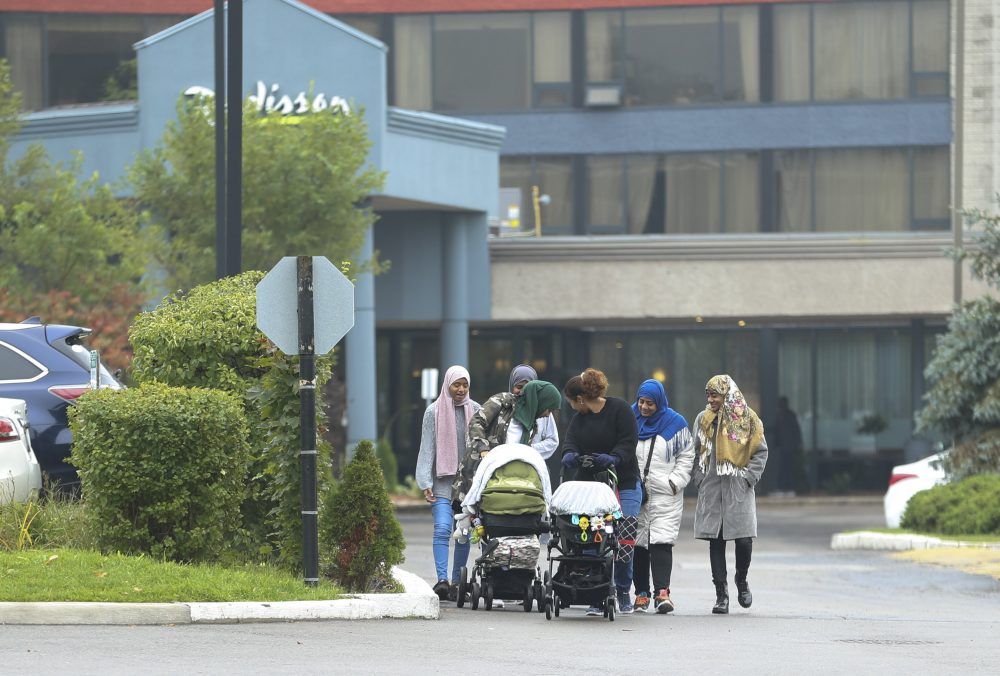
A group of women watch their children outside the Radisson hotel at Hwy 401 and Victoria Park Ave. in North York on Tuesday. (Jack Boland/Toronto Sun) 

Ottawa, we have a problem..

It’s not just that Toronto’s shelters are full — with 2,600 or 39.2% of the spaces occupied by refugees, er asylum seekers, irregular migrants (whatever we’re calling them today.)

But according to city spokesman Natasha Hinds Fitzsimmins Tuesday, some 18-20 are arriving in the city per day, mostly from Nigeria.

According to Hinds Fitzsimmins, the federal government procured two hotels in Peel and York to house the irregular (a.k.a. illegal) migrants who were placed in the Centennial and Humber college dorms earlier in the summer.

As reported by Canadian Press, the federal government has extended their hotel stay four weeks beyond the original deadline of Sept. 30 because they have yet to come up with a more long-term approach that would send the refugees to communities beyond Toronto.

There are also 1,719 irregular (illegal) migrants/refugees/asylum seekers in Toronto hotels, including  577 housed at the Radisson Toronto East hotel in 146 rooms (the hotel has 240 rooms in total).

The reputable Tripadvisor website has been inundated in the past few weeks with scathing reviews of the hotel, calling it a “zoo, filthy, noisy and dangerous” with the lobby full of loitering refugees and halls containing graffiti and garbage.

Every paying visitor on Trip Advisor has claimed they did not know and were not told that 61% of the hotel is being occupied by refugees.

On Tuesday, one visitor from Virginia —calling the three-star hotel a “disgrace” —claimed that animal services needed to be called on the second night he was there because “some goats were being slaughtered” in the public bathrooms.
The visitor said gunfire was also heard outside the hotel that same night.

(Believe me I can’t make this stuff up!)

Asked what the city has spent to date housing irregular migrants/refugees/asylum seekers, Hinds Fitzsimmins said the costs from November 2017 to the end of this year will likely be “in excess” of $64.5-million.

She said the city doesn’t know how much more at this time, although I would bet that number is being kept quiet until after the Oct. 22 election—especially considering Toronto council and the mayor helped exacerbate the problem by very publicly reaffirming (to all who would listen) in early 2017 that Toronto is a Sanctuary City.

Up to now the city has only received $11-million from the feds to help defray the costs.

SLevy@postmedia.com

Immigration and the Housing Affordability Crisis in Sydney and Melbourn

Posted on by
Immigration and the Housing Affordability Crisis in Sydney and Melbourne
By Bob Birrell and Ernest Healy,
The Australian Population Institute
Monash University, Melbourne
Executive Summary :
The housing affordability crisis in Sydney and Melbourne is close to the worst in the developed world. Only Vancouver and Hong Kong were as bad or worse on this metric.
The result is an inter-generational divide in which the younger generation have diminishing prospects of attaining the housing their parents’ generation enjoy. Property owners are feasting on extraordinary capital gains at the expense of young people who, in Sydney and Melbourne, will never experience any similar benefits because they cannot get onto even the lowest rung of the property ladder.
Why is the crisis so severe?
The answer is no secret.
First, successive Australian governments have kept in place significant tax incentives for owner-occupiers to upgrade and investors to purchase existing residential property.
Second, the Coalition government has maintained very high migration levels, with around two-thirds of the net intake currently locating in Sydney and Melbourne. Migrants are the main contributors to the growth in both cities’ populations of over 100,000 each year.
The consequences are disturbing. Most young households in Sydney and Melbourne cannot afford to buy a house in established suburban areas. The proportion renting is rising sharply. In Sydney, as home-ownership rates fell, the share of households headed by 30-34 year olds who were renting jumped from 48 per cent in 2011 to 53 per cent in 2016 (Table 1). In Melbourne the increase in this share over the same years was from 43 per cent to 48 per cent.
Many young households have been prompted to move to cheaper housing on the remote frontiers of both cities. There, they have to pay high prices for houses on tiny lots (averaging 400 square metres or less).
Both state governments are encouraging this outward movement by providing financial subsidies in the form of cash payments and stamp duty concessions to first home buyers. These incentives are also available to all migrants holding permanent visas, regardless of the migrant’s property ownership record prior to arriving in Australia.
What to do?
In Sydney, the Greater Sydney Commission (GSC) is setting the pace. It is requiring all municipal councils to prepare plans for additional medium-density dwellings.
Meanwhile the NSW State government has implemented a new medium-density planning code which will allow developers to put more than two dwellings on each detached housing site that they can procure.
This initiative has received the backing of the Grattan Institute and the Reserve Bank. Both want to see it implemented in Melbourne as well. They recommend that zoning constraints on medium density housing in Sydney and Melbourne be reduced in order to stimulate increased medium density dwelling construction.
The population factor
None of these advocates indicates how large the population factor is in the demand side of the equation. Nor do they explore whether their proposals can work given the scale of demand for dwellings in both cities. They have nothing to say about the immigration component of this demand.
The population factor is a black box. We open this box.
In Sydney, the GSC estimates that an additional 35,000 dwellings are needed each year to cope with projected population growth. In Melbourne the planning authorities are assuming a similar number of dwellings is required. The Australian Population Research Institute’s (TAPRI) projections are a little less for Sydney (around 31,000 extra dwellings needed each year) but the same as those of the planning authorities for Melbourne. TAPRI’s projections also indicate that around 19,000 to 20,000 of this need in both cities will be attributable to net overseas migration. As a result, around 64 per cent of Sydney’s need for addition dwellings each year is due to additional overseas migrants and around 54 per cent of Melbourne’s.
Our projections also reveal that, in each city, around 15,000 more dwellings each year will be occupied by the increasing numbers of older resident households. This is because of the ageing factor as the large baby boomer generation replaces the much smaller cohort born before 1950. By 2016 (Table 5) households with a household head aged 50 or older occupied 56 per cent of the detached housing stock in Sydney and 53 per cent in Melbourne. This share will increase.
It is a major contributor – rarely acknowledged – to the housing affordability crisis in Sydney and Melbourne. It in effect amplifies the demand side of the problem. This is because not only must both cities provide an additional 19,000-20,000 dwellings to meet the needs of the growing migrant population, they must do so in a context where the number of existing detached houses available is shrinking because of the ageing factor.
Will the zoning initiative work?
We do not think it will. It has already failed twice. On the first occasion, in both cities, large tracts of land in the inner city and around activity centres were rezoned for high-rise apartment blocks. Huge numbers have been constructed, yet prices for detached housing continue to rise in both cities. The reason is that most new households (including migrants) want family friendly housing. Apartments are unsuitable. Our analysis of occupants of high-rise apartments (Table 6) shows that barely four per cent of these apartments in inner Sydney and Melbourne are occupied by couples or singles with children.
The second failure concerned zoning changes introduced by the 1990s in both cities. These allowed two dwellings to be built, as of right, on most suburban housing sites. Our analysis shows that despite this zoning initiative, relatively few such dwellings have been constructed.
Why? The answer is site costs – that is the escalating price of detached houses in both cities. Developers cannot put two dwellings on most inner and middle suburban house sites for less than $1 million per dwelling.
The proposals to abolish remaining zoning constraints represent the last throw of dice for supply-side advocates. We argue that they will only have a limited impact, for much the same reason that the first zoning initiative has largely failed. The new initiative will add further pressure to site costs because developers will now have to pay even higher prices for detached houses. This is because of the extra value of the site now that more than two dwellings can be constructed on it.
To the extent that the initiative does work, it will do so by providing even less dwelling and protected external space than dual occupancy units provide. In the process, it will detract even further from the suburban ambience that most detached home owners value.
There are doubts that the state governments will be able to enforce the latest zoning initiatives once existing home owners become aware of the implications. The recent backlash in Sydney supports this expectation.
There is no easy solution to Sydney and Melbourne’s housing affordability crisis. Some relaxation of zoning restraints may help. But only if there is parallel action to remove the tax incentives referred to earlier and to reduce the competition for housing flowing from net overseas migration to both cities.

Paul Fromm in Vancouver — Immigration: The Times & Tide Are Changing

Posted on by

 Paul Fromm in Vancouver —  Immigration: The Times & Tide Are Changing

Paul Fromm

Director of the Canada First Immigration Reform Committee

Immigration: The Times Are Changing

* The polls are with us

* Push back against the invasion of illegals

* Trudeau tells a French Canadian woman she has “no place in Canada”

* The Immigration lobby goes crazy

https://www.youtube.com/watch?v=k50yLbPyllo
https://www.youtube.com/watch?v=C_Itha4qmI8

youtube.com
Hamilton Mayoral candidate discusses immigration issues in Canada.

STUDY: Increased Ethnic Diversity Making Brits Miserable

Posted on by

STUDY: Increased Ethnic Diversity Making Brits Miserable

GettyImages-80780197
GETTY

A study has found that an increase in “diversity” makes existing residents of a area feel unhappier and more socially isolated, while those leaving for more homogenous areas populated by their own ethic group often get happier.

Among the reasons for residents feeling insecure as their area diversifies, is that people tend to spend time with those they perceive as like them, and feel less secure when experiencing rapid change, the authors explained.

Already around a fifth of people in the UK are non-white or non-British. This is expected to rise to a quarter by 2025, a third by 2040, and could reach up to 38 per cent by 2050.

The large-scale sociological study, undertaken by the Cathie Marsh Institute for Social Research at the University of Manchester, drew on 18 years of data of more than 10,000 people.

“With immigration at historically high levels across many European countries, research suggesting ethnic diversity negatively impacts social cohesion has engendered alarm”, begins the paper.

However, the report found little to dispel such concerns, as it purported to “demonstrate a negative association between community ethnic diversity and indicators of social cohesion (especially attitudes towards neighbours and the community), suggesting diversity causes a decline in social cohesion.”

The only group which appeared to be unaffected by diversity was those who willingly chose to move into such areas.

Sociologist Dr. James Laurence, who co-authored the study, said: “There has long been an ‘assumption’ increasing ethnic diversity in an area undermines residents’ social cohesion.

“On one hand oucafer study supports this, for example where people report feeling happier when they move out of diverse areas and into neighbourhoods where they are surrounded by more people like them.

“However we find there are people happily moving into diverse areas who are unaffected by the presence of different ethnicities and social groups.

“Also diversity actually has a relatively weaker effect on people who stay in a community in which diversity is increasing around them.’

Speaking to the Daily Mail, he added: “Increasing diversity may reduce cohesion as people simply see their neighbours as being more different to them; that they may have different values, different interests and different norms, which can hold up contact.”

Haiti: “World’s Oldest Independent Black Republic” – Collapses into Chaos Once Again

Posted on by

Haiti – the Western Hemisphere’s oldest independent black republic – has collapsed into Third World chaos once again as its African population pillaged, burned and vandalized shops in the  capital city in ingoing violence despite the government backing down from attempts to raise the fuel price – allegedly the cause of the latest outbreak of unrest.

(The New Observer)

African rioters blocked streets using felled trees and large rocks as well as piles of tires set on fire all over Haiti on Sunday while many damaged or looted stores stayed closed for a third day.

The charred remains of cars could be seen in several spots around the sprawling capital city of Port-au-Prince, including in front of the Best Western and Oasis hotels, in the capital’s southern hilltop suburb of Petion-Ville, as well as near the offices of telecommunications company Natcom.

The U.S. embassy warned its citizens to avoid the unrest in the capital Port-au-Prince and reschedule travel plans as several airlines canceled flights.

Stay Connected With Us

At the Toussaint Louverture international airport—named after the African who led the rebellion which created Haiti and who later declared himself “Governor for life”—dozens of stranded white and foreign travelers camped out waiting for flights to resume.

Prime Minister Jack Guy Lafontant announced the temporary suspension of double-digit government hikes to prices for gasoline, diesel and kerosene on Saturday afternoon – just a day after they were announced – but the unrest continued.

Across the capital, few cars and motorcycles were moving on the rubble-strewn streets on Sunday, while broken windows and damaged buildings were a common sight.

At a shopping center in Petion-Ville, police tried to secure shops, with broken glass and merchandise scattered on the floor.

Both the Canadian and Mexican embassies in Haiti announced that they would be closed on Monday.

The decision to raise fuel prices was part of an agreement with the International Monetary Fund, which requires the impoverished country to enact measures to boost government revenue and services and strengthen the country’s economy.

“Due to continuing demonstrations, roadblocks, and violence across Port-au-Prince, as well as short staffing at the airports, embassy personnel have been instructed to re-book any flights originally scheduled for Sunday,” the U.S. embassy said in a statement.

“Telecommunications services, including Internet and phone lines, have been affected throughout Haiti,” the embassy added. “It may be difficult to reach people through normal communication methods.”

A spokesman for U.S. carrier American Airlines Group Inc said it had canceled three out of seven round trip flights scheduled to stop in Port-au-Prince on Sunday.

JetBlue Airways Corp also canceled its flights to Haiti on Sunday.

Foreign journalists saw Africans stripping shelves bare in some supermarkets that were charred from the protests. Several bodies lay among debris scattered in the streets.

At least three blacks were killed in protests Friday, and police said the bodies of four people were found Sunday in the streets of the Delmas district, though they didn’t say if that was related to the protests.

On Friday, the bodyguard of a politician was killed in an altercation with demonstrators in Port-au-Prince as he attempted to force a passage through a roadblock, with his body then burned in the road.

Burning tires continued to block major routes in the capital, while sporadic gunfire could be heard in several of its districts. Fearful of moving across the city, many decided to spend the night at their offices or businesses.

Conscious of how unpopular the announcement about the proposed price increase was, ministers held a press conference about the price increase during the World Cup soccer quarter-final match of Brazil, the side most Haitians fervently support.

Even then, only at the end of the match, in which Brazil was eliminated at the hands of Belgium, did the Africans in Port-au-Prince start rioting and looting.

Haiti received more than US$4 billion in aid from 1990 to 2003, including US$1.5 billion from the United States. Nonetheless, Haiti is one of the world’s poorest countries and the poorest in the Americas region, and dominated by poverty, corruption, poor infrastructure, lack of health care and lack of education—living proof that race, not environment, determines civilizational levels.

Category: Uncategorized | Tags: , ,

Paul Fromm on Immigration Problems in Canada

Posted on by
Paul Fromm on Immigration Problems in Canada
 
bitchute.com

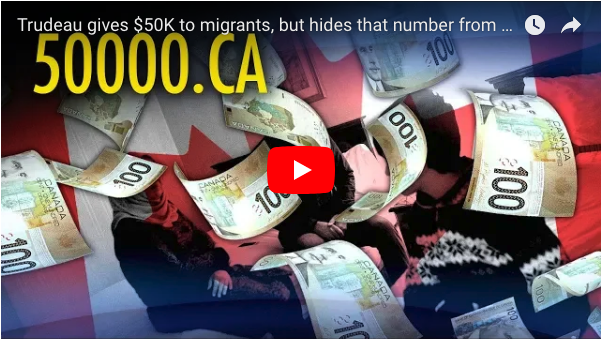
THE REBEL Exposes Bureaucratic Coverup of the $50,000 Given to “Migrant” Families

Posted on by
THE REBEL Exposes Bureaucratic Coverup of the $50,000 Given to “Migrant” Families

Former Canadian diplomat Ian Macdonald, a well-connected Ottawa critic of uncontrolled immigration for decades, adds: ”

The 50K figure is bad enough but only half the story since medical treatments can run to the hundreds of thousands per individual and in some cases would displace a potential Canadian in urgent need.(in the case of scarce organs for example).  About 20 years ago the cost of  medical care for 22,000 illegals was $33,000,000. To this add special-needs and counselling, transportation etc and it soon gets unaffordable.”

Dear Dan,
Do you know how much of your tax money Justin Trudeau gives to each migrant family that comes to Canada?
It’s $50,000 a year — not including healthcare, dental, and other benefits.
$50,000.
That number is shocking. But even more shocking is why that number isn’t public knowledge.
You see, Trudeau’s “non-partisan” bureaucrats have been instructed to keep that information a secret from Canadians.
Through access to information requests, The Rebel has exclusively obtained a memo showing bureaucrats actively covering up for Justin Trudeau.
50000.png
These bureaucrats plotted — in writing — how to evade a media inquiry about the yearly cash support that Canada provides Trudeau’s Syrians. Here’s what they wrote:
“Thanks Nancy, we have a table approved in past responses with breakdowns. Can we try to dig that up and include it here? I think the reporter is looking for numbers. We know that 50k is the new start-up cost but we haven’t used that yet. If we do can we get MINO approval? Earlier this week we opted to go with the individual cost response for the Canadian Federation of Taxpayers , but in this instance the reporter is talking about families so it may be okay to use”
Trudeau’s staff tried to hide that, by using data for individual refugees rather than for families. Shady stuff, considering that Immigration, Refugees and Citizenship Canada changed the definition of “family” to include young able-bodied men travelling together who self-identified as brothers.
The bureaucrats go on to say in the email chain that detailed info about yearly costs was only going to be given if they were pressed on it. Their default was to hide the truth from Canadians.
“let’s not mention the 50k as you say, but let’s add these details only.”
You can see the memo by clicking here.
That’s just sick.
When Trudeau is dealing with our military veterans, his Liberals are suddenly fiscal tightwads, making them share sleeping bags and backpacks and refusing to procure the jets they need. But the government chequebook swings wide open to support migrants who admitted to government workers that they were better off in Jordan, people who weren’t in immediate danger, and aren’t really refugees at all.
I hate this double standard. I want to see Trudeau treat our veterans and soldiers better than he treats economic migrants.
So, I’ve started a petition to the minister of defence, Harjit Sajjan, and to the immigration minister, Ahmed Hussen. I want them to know that thousands of Canadians are sick and tired of our veterans and Canadian forces being neglected.
You can go to 50000.ca to sign the petition and see the shocking memo.
Justin Trudeau needs to treat our soldiers better. Quit fighting them in court, and treat them like the heroes they are.
And take care of them as well as he takes care of foreigners who illegally cross the border from upstate New York.
Yours truly,
Sheila Gunn Reid
P.S. Did you know that migrant “families” get $50,000 annually in cash? I didn’t know that number because bureaucrats are actively trying to hide that information from Canadians. Please help expose the Trudeau Liberals and forward this email to your friends and family. Then post www.50000.ca on Facebook and Twitter.

Former

Hate Crime Investigated in Quebec

Posted on by
Hate Crime Investigated in Quebec
For your information, Immigration Watch Canada is sending you its latest bulletin: “​​​​​ CBC reports hate crime in Quebec””
Respectfully,
Dan Murray
+++++++++++++++++++++++++++++++++++
According to eye witnesses, a lion at the Granby zoo in Quebec suddenly grabbed the collar of a young girl’s jacket as she was leaning into the lion’s cage. As the lion tried to pull her inside, her screaming parents called for help. To their everlasting relief, a motorcyclist nearby came to the rescue.
The biker jumped off his Harley, ran to the cage, and hit the lion square on the nose with a powerful punch. Whimpering from the pain, the lion jumped back, letting go of the girl. The biker grabbed the girl and brought her to her terrified parents, who thanked him endlessly. A CBC reporter watched the whole traumatic event : A horrifying spectacle that, thanks to the intervention of a brave hero, came to a wonderful end.
The reporter rushed toward the biker to extend her congratulations. “Sir, that was the most gallant and brave thing I’ve seen a man do in my whole life.”
The Harley rider replied, ‘It was nothing, really. The lion was behind bars. I just saw this little kid in danger and reacted without pausing to think about my safety.
The reporter replied, ‘Well, I’ll make sure this won’t go unnoticed. I’m a journalist, you know, and our online paper, cbcnews.ca will make it a front page story. You have my guarantee of that. So, to provide the readership with some background information, I would like to ask you a few questions.”
“Go ahead”, the biker replied.
“What do you do for a living, and what does it say on the back of your leather jacket? What are your political affiliations?”
Without hesitation or shame, the biker immediately replied. “I am a patriot and a nationalist. I’m backing Maxime Bernier and I am a member of La Muete, a grass-roots group of patriots dedicated to fighting globalism, recovering Canadian sovereignty and control of our borders. La Muete’s emblem is on the back of my jacket, as you can see.”
The following morning the biker logged into the Internet in search of cbcnews.ca.
Sure enough, the story about his heroic deed was on the front page. It’s title was
 “WHITE SUPREMICIST ASSAULTS AFRICAN IMMIGRANT AND STEALS HIS LUNCH….. POLICE HATE CRIME DIVISION INVESTIGATING INCIDENT.
 +++++++++++++++++++++++++++++++++++++++++++
Note: The foregoing is a joke, but the real joke is the CBC, and it comes at taxpayer’s expense—over a billion dollars a year in fact. That’s quite a price to pay for shameless propaganda and continuous lies of omission. Not only does the CBC slant stories, they often don’t even cover them. Significant stories and facts that matter are simply left out. And the frequent presentation of revisionist history in the form of short documentaries is designed to induce white guilt, all to serve one goal : To discredit the contribution of Canadians of European origin to nation building and thus deprive their descendants of any moral authority to restrict immigration to a country their ancestor’s allegedly stole. We can make light of their treachery, but it cannot and must not detract from the damage that this state-owned mouthpiece for the immigration lobby has inflicted upon Canadians. By misrepresenting our past and lying about the present, the CBC is sabotaging our future.