
Maxime Bernier will STOP Mass Migration in Canada. A powerful discussion of mass immigration, the Truckers’ Freedom Convoy and the Rouleau whitewashing of Trudeau’s invocation of the Emergencies Act.
Chrystia Freeland’s Anti-White & Anti-White Male Budget
Chrystia Freeland’s budget is woke by stealth
[The Liberals and, to a lesser extent, the Conservatives are committed to the replacement and displacement of the European founding/settler people of Canada via mass immigration — the Liberals are now aiming for 500,000 immigrants a year, over 85% from the Third World. Finance Minister Chrystia Freeland’s recent budget escalates the anti-White campaign. Her budget includes many measures to dispossess Whites, using our money to actively discriminate against Whites, especially White males. — Paul Fromm]
The words ‘diversity,’ ‘equity’ and ‘inclusion,’ do not appear in the budget but they are very much apart of it Author of the article: Jamie Sarkonak Published Apr 03, 2023 • Last updated Apr 03, 2023 • 5 minute read 416 Comments 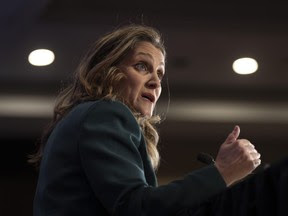 Deputy Prime Minister and Finance Minister Chrystia Freeland speaks during a news conference before delivering the federal budget, Tuesday, March 28, 2023 in Ottawa. Photo by Adrian Wyld /The Canadian Press
Identity-based hiring for the coast guard, tens of millions for Black employees in the public service and mandatory diversity reporting at Canadian banks were some of this year’s identity-politics-infused budget measures.

Instead of diversity, marketing for this year’s budget has focused on infrastructure, jobs and the idea of “balance” — despite the whopping $493 billion in total spending, $59.5 billion in new spending, a $43 billion deficit, and $34.5 billion to be spent on interest (rising to $50.3 billion in 2027).
The words “diversity,” “equity” and “inclusion,” do not appear at all in Finance Minister Chrystia Freeland’s budget speech; feminism was mentioned, but only in the context of Canada’s record-high labour force participation for women. It was an interesting retreat for a party that regularly champions diversity, equity and inclusion (DEI).
Perhaps it’s a sign that some communications strategists in Ottawa are starting to realize that DEI doesn’t have universal appeal. DEI is unavoidable though, since identity-based spending has been enshrined in Canadian law with the Canadian Gender Budgeting Act.
Another $55 million for housing was added to the National Housing Strategy. On top of housing need, the program prioritizes projects by identity.
The federal Student Work Placement program was given $197.7 million for 2024-25. The feds noted that the program will be aimed specifically at “students with disabilities, Black and racialized students, Indigenous people, and/or women in science, technology, engineering, and mathematics.” This isn’t surprising — the program already discriminates by providing greater wage subsidies for students who check off the diversity box, so we’re getting more of the same.
The Canadian Coast Guard is getting $120 million over the next five years to reinforce the fleet and hire more personnel. It’s a great initiative, considering the job implications for Atlantic Canada and the assistance it will give to the defence against illegal fishing. However, hiring will have “distinct considerations for Black and racialized people” — an unnecessary consideration that undercuts merit.
A grant program for Canadian colleges was expanded with $108 million over the next three years. Another important investment, but the grant program has a DEI component which asks applicants to demonstrate how projects will affect various identity groups.
The Canadian Media Fund received $40 million over two years “to make funding more open to traditionally underrepresented voices” by supporting the creation of jobs and content for “equity-deserving” communities. The Canadian Media Fund already offers numerous programs with preferential treatment to women, disabled persons, Indigenous people, visible minorities and sexual minorities.
Similarly, $160 million was allocated to “organizations in Canada that serve women.” It looks like another boost to non-profits and charities to balance out the budget measures that the government deems to benefit primarily men.
The budget also created a new Anti-Racism, Equity and Inclusion Secretariat, which is getting $1.5 million over the next two years. The role is that of an ideological commissar, ensuring that DEI is taken into account when crafting federal policy. It appears to be similar in size and scope to two identity positions created in last year’s budget: the Special Envoy on Combatting Antisemitism and the Special Representative on Combatting Islamophobia.
What makes these positions objectionable is that representation of citizens should happen on the floor House of Commons. The people should choose who represents them in government, not the Liberal Party of Canada.
Spending on a planned Action Plan to Combat Hate, as well as continuing Canadian Heritage’s Anti-Racism Strategy, was $75 million (interestingly, less than the $85 million allocated last year). The trouble with these plans is that they tend to use very expansive definitions of “racism” and “hate” that aren’t shared by the general public.
This year, the feds are spending the anti-hate money on things like security upgrades for places of worship, which isn’t objectionable if all religions get equal treatment. However, the development of an Action Plan to Combat Hate has been troubled: the Department of Canadian Heritage was caught biasing the results of feedback surveys to favour voices that agreed with Liberal policy goals. Meanwhile, the department’s Anti-Racism Action Program (one of the “arms” of the larger Anti-Racism Strategy) has funded an anti-racism tool kit that labelled Canada’s old flag, the Red Ensign, a hate symbol. It also funded a series of consultations carried out by Laith Marouf, an anti-racism activist known for his antisemitism.
The budget has some race-specific lines as well. One initiative set aside $25 million specifically for “Black-led and Black-serving” community organizations. Another initiative set aside $45.9 million for Black federal public servants to have a dedicated mental health fund and career development program — last year, $3.7 million was set aside to make a mental health fund for Black federal public servants, so the program has increased more than 10 times in size.
Regarding government procurement, $80 million has been dedicated to “social procurement.” The Liberals are increasingly tying federal contracts to diversity; this latest batch of funding will go towards the collection of demographic data of potential contractors to assist with the project.
Finally, the budget will also expand requirements for corporations to disclose the diversity of governance boards. In 2020, amendments to the Canada Business Corporations Act from Bill C-25 took effect, requiring federally-incorporated distributing corporations to disclose the demographic composition of governing boards and senior management. The 2023 budget requires federally regulated financial institutions to make the same disclosures. Amendments will be made to the Bank Act, Insurance Companies Act, and Trust and Loan Companies Act accordingly.
Diversity disclosures are quick to come with strings attached. In 2020, Navdeep Bains (then-Minister of Innovation, Science and Industry) told tech news website BetaKit that companies that achieved greater diversity would have preferential access to government contracts and programming.
Canadians should be skeptical of the feds picking and choosing favourites based on identity, like they’ve done with this budget. It distracts from what the real goal should be: improving the quality of life for all Canadians, no matter who they are.
National Post
Chrystia Freeland’s Anti-White & Anti-White Male Budget
Chrystia Freeland’s budget is woke by stealth
[The Liberals and, to a lesser extent, the Conservatives are committed to the replacement and displacement of the European founding/settler people of Canada via mass immigration — the Liberals are now aiming for 500,000 immigrants a year, over 85% from the Third World. Finance Minister Chrystia Freeland’s recent budget escalates the anti-White campaign. Her budget includes many measures to dispossess Whites, using our money to actively discriminate against Whites, especially White males. — Paul Fromm]
The words ‘diversity,’ ‘equity’ and ‘inclusion,’ do not appear in the budget but they are very much apart of it Author of the article: Jamie Sarkonak Published Apr 03, 2023 • Last updated Apr 03, 2023 • 5 minute read 416 Comments Deputy Prime Minister and Finance Minister Chrystia Freeland speaks during a news conference before delivering the federal budget, Tuesday, March 28, 2023 in Ottawa. Photo by Adrian Wyld /The Canadian Press
Identity-based hiring for the coast guard, tens of millions for Black employees in the public service and mandatory diversity reporting at Canadian banks were some of this year’s identity-politics-infused budget measures.
Instead of diversity, marketing for this year’s budget has focused on infrastructure, jobs and the idea of “balance” — despite the whopping $493 billion in total spending, $59.5 billion in new spending, a $43 billion deficit, and $34.5 billion to be spent on interest (rising to $50.3 billion in 2027).
The words “diversity,” “equity” and “inclusion,” do not appear at all in Finance Minister Chrystia Freeland’s budget speech; feminism was mentioned, but only in the context of Canada’s record-high labour force participation for women. It was an interesting retreat for a party that regularly champions diversity, equity and inclusion (DEI).
Perhaps it’s a sign that some communications strategists in Ottawa are starting to realize that DEI doesn’t have universal appeal. DEI is unavoidable though, since identity-based spending has been enshrined in Canadian law with the Canadian Gender Budgeting Act.
Another $55 million for housing was added to the National Housing Strategy. On top of housing need, the program prioritizes projects by identity.
The federal Student Work Placement program was given $197.7 million for 2024-25. The feds noted that the program will be aimed specifically at “students with disabilities, Black and racialized students, Indigenous people, and/or women in science, technology, engineering, and mathematics.” This isn’t surprising — the program already discriminates by providing greater wage subsidies for students who check off the diversity box, so we’re getting more of the same.
The Canadian Coast Guard is getting $120 million over the next five years to reinforce the fleet and hire more personnel. It’s a great initiative, considering the job implications for Atlantic Canada and the assistance it will give to the defence against illegal fishing. However, hiring will have “distinct considerations for Black and racialized people” — an unnecessary consideration that undercuts merit.
A grant program for Canadian colleges was expanded with $108 million over the next three years. Another important investment, but the grant program has a DEI component which asks applicants to demonstrate how projects will affect various identity groups.
The Canadian Media Fund received $40 million over two years “to make funding more open to traditionally underrepresented voices” by supporting the creation of jobs and content for “equity-deserving” communities. The Canadian Media Fund already offers numerous programs with preferential treatment to women, disabled persons, Indigenous people, visible minorities and sexual minorities.
Similarly, $160 million was allocated to “organizations in Canada that serve women.” It looks like another boost to non-profits and charities to balance out the budget measures that the government deems to benefit primarily men.
The budget also created a new Anti-Racism, Equity and Inclusion Secretariat, which is getting $1.5 million over the next two years. The role is that of an ideological commissar, ensuring that DEI is taken into account when crafting federal policy. It appears to be similar in size and scope to two identity positions created in last year’s budget: the Special Envoy on Combatting Antisemitism and the Special Representative on Combatting Islamophobia.
What makes these positions objectionable is that representation of citizens should happen on the floor House of Commons. The people should choose who represents them in government, not the Liberal Party of Canada.
Spending on a planned Action Plan to Combat Hate, as well as continuing Canadian Heritage’s Anti-Racism Strategy, was $75 million (interestingly, less than the $85 million allocated last year). The trouble with these plans is that they tend to use very expansive definitions of “racism” and “hate” that aren’t shared by the general public.
This year, the feds are spending the anti-hate money on things like security upgrades for places of worship, which isn’t objectionable if all religions get equal treatment. However, the development of an Action Plan to Combat Hate has been troubled: the Department of Canadian Heritage was caught biasing the results of feedback surveys to favour voices that agreed with Liberal policy goals. Meanwhile, the department’s Anti-Racism Action Program (one of the “arms” of the larger Anti-Racism Strategy) has funded an anti-racism tool kit that labelled Canada’s old flag, the Red Ensign, a hate symbol. It also funded a series of consultations carried out by Laith Marouf, an anti-racism activist known for his antisemitism.
The budget has some race-specific lines as well. One initiative set aside $25 million specifically for “Black-led and Black-serving” community organizations. Another initiative set aside $45.9 million for Black federal public servants to have a dedicated mental health fund and career development program — last year, $3.7 million was set aside to make a mental health fund for Black federal public servants, so the program has increased more than 10 times in size.
Regarding government procurement, $80 million has been dedicated to “social procurement.” The Liberals are increasingly tying federal contracts to diversity; this latest batch of funding will go towards the collection of demographic data of potential contractors to assist with the project.
Finally, the budget will also expand requirements for corporations to disclose the diversity of governance boards. In 2020, amendments to the Canada Business Corporations Act from Bill C-25 took effect, requiring federally-incorporated distributing corporations to disclose the demographic composition of governing boards and senior management. The 2023 budget requires federally regulated financial institutions to make the same disclosures. Amendments will be made to the Bank Act, Insurance Companies Act, and Trust and Loan Companies Act accordingly.
Diversity disclosures are quick to come with strings attached. In 2020, Navdeep Bains (then-Minister of Innovation, Science and Industry) told tech news website BetaKit that companies that achieved greater diversity would have preferential access to government contracts and programming.
Canadians should be skeptical of the feds picking and choosing favourites based on identity, like they’ve done with this budget. It distracts from what the real goal should be: improving the quality of life for all Canadians, no matter who they are.
National Post
Trudeau Foundation president, board resign, citing ‘politicization’ of China-linked donation
Social Sharing
Charity’s leadership cites controversy over Beijing-linked donor to explain the move
Richard Raycraft · CBC News · Posted: Apr 11, 2023 6:51 AM PDT | Last Updated: 5 hours ago

The Pierre Elliott Trudeau Foundation’s president and board of directors have resigned en masse, citing the charity’s entanglement in the ongoing foreign interference controversy.
In a statement, the foundation said that a $200,000 donation in 2016 from a businessman linked to the Chinese government “has put a great deal of pressure on the foundation’s management and volunteer board of directors, as well as on our staff and our community.”
The charity announced last month that it would return the donation. The Conservatives criticized the government over the matter, saying the donation compromised a government report on the integrity of the 2021 federal election.
“The circumstances created by the politicization of the foundation have made it impossible to continue with the status quo, and the volunteer board of directors has resigned, as has the president and CEO,” the statement said.
WATCH | Trudeau reacts to CEO, board resignations at Trudeau Foundation

Trudeau reacts to CEO, board resignations at Trudeau Foundation
7 hours agoDuration 0:55Prime Minister Justin Trudeau says the foundation will continue to make a positive impact on academic institutions across the country.
The foundation is independent and Prime Minister Justin Trudeau has no involvement with it.
“The Trudeau Foundation is a foundation with which I have absolutely no intersection,” Trudeau told a news conference Tuesday.
“It is a shame to see the level of toxicity and political polarization that is going on in our country these days, but I am certain that the Trudeau Foundation will be able to continue to ensure that research into the social studies and humanities at the highest levels across Canadian academic institutions continues for many years to come.”
The charity, established in 2001 to honour former prime minister Pierre Elliott Trudeau, funds scholarships, mentorships and fellowships.
Last month, Prime Minister Trudeau appointed former governor general David Johnston as a special rapporteur to investigate foreign interference in Canadian elections and institutions, including alleged meddling by the Chinese government.
The Conservatives have questioned Johnston’s impartiality, in part by pointing to Johnston’s former role as a member of the Trudeau Foundation. Foundation members are responsible for appointing the board of directors.
Johnston resigned from the foundation following his appointment as special rapporteur. Trudeau has defended the choice, citing Johnston’s long career in public service.
The statement said three directors will remain on an interim basis to continue the charity’s work while a new board is appointed. The foundation’s website currently lists six members of the board of directors.
Its president and CEO, Pascale Fournier, had been in the position for almost five years.
Poilievre calls for investigation
Reacting to news of the resignations Tuesday morning, Conservative Leader Pierre Poilievre called for an investigation into the charity.
“We need to investigate the Beijing-funded Trudeau Foundation,” Poilievre tweeted.
“We need to know who got rich, who got paid and who got privilege and power from Justin Trudeau as a result of funding to the Trudeau Foundation.”https://platform.twitter.com/embed/Tweet.html?dnt=false&embedId=twitter-widget-1
Bloc Québécois Leader Yves-François Blanchet said the resignations make the 2016 donation look more suspicious. He called on Johnston to step down as special rapporteur and for the government to call a public inquiry into foreign interference.
“Nothing else will do,” Blanchet said in a French statement.
NDP Leader Jagmeet Singh said he won’t comment on the Trudeau Foundation specifically. He repeated his calls for a public inquiry.
WATCH | Singh repeats call for public inquiry after Trudeau Foundation president, board resign

Singh repeats call for public inquiry after Trudeau Foundation president, board resign
6 hours agoDuration 0:57During a press conference at St. Clair College in Windsor, Ont., NDP Leader Jagmeet Singh is asked about the resignation of the president and board of directors of the Pierre Elliott Trudeau Foundation. A statement from the foundation said ‘the circumstances created by the politicization of the foundation have made it impossible to continue with the status quo.’
“What we’ve seen from both the Liberals and the Conservatives, they’re more interested in scoring political points, pointing fingers at each other,” Singh told a news conference.
“When it comes to something as serious as our democracy, the goal shouldn’t be to score points … We’ve been saying we need a public inquiry to get to the truth, to give Canadians confidence.”
Canadian Politicians Sign Letter to CCP Official Pledging to Promote Beijing’s Image in Fighting COVID-19: Report
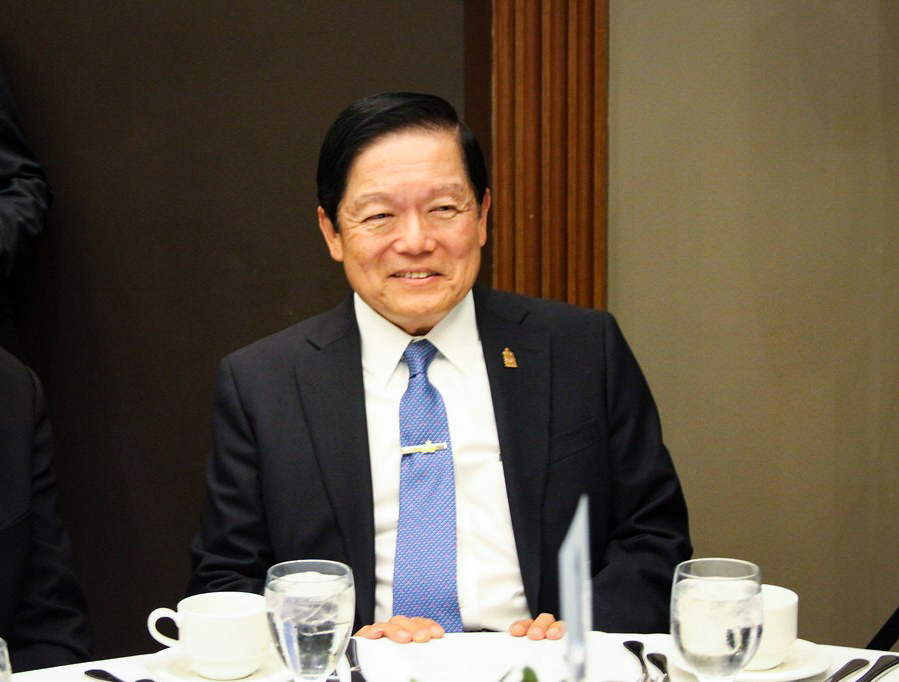
Conservative Sen. Victor Oh in a file photo. (Becky Zhou/The Epoch Times)
By Andrew ChenApril 8, 2023Updated: April 9, 2023 biggersmallerPrint 0:006:49
Senator Victor Oh and former Ontario cabinet minister Michael Chan were signatories among those who signed a 2020 letter from an Ontario-based Chinese-Canadian business association to a Chinese Communist Party (CCP) official saying the association has been promoting China’s image in fighting COVID-19 and pledges continuing support of the “great motherland.”
Oh signed as the association’s honorary president as well as a Canadian senator and “chair” of the Canada-China Legislative Association (CACN). Oh’s biography on the Senate of Canada website indicates he is the “Vice-Chair” of CACN, though his name currently is not on the members page of the association.
Chan, for his part, signed as CACN’s honorary president as well as a former minister of international trade of Ontario and an honorary citizen of Jiangsu Province. https://fb9aa48ced4f4ea33ff145de51fa2d12.safeframe.googlesyndication.com/safeframe/1-0-40/html/container.html
The correspondence was in response to a letter issued by the CCP official to Jiang Rui, president of Richmond Hill-based Jiangsu Commerce Council of Canada (JCCC), as reported in April 2020 by the Chinese-language media ccmedia.news, and first reported in English by the Found in Translation newsletter on Substack. The ccmedia.news website includes copies of the two letters.
The March 27, 2020, letter by the CCP official, Lou Qinjian, former secretary of the Jiangsu provincial committee, bears the letterhead of the Jiangsu Provincial Committee of the CCP. It is addressed directly to Jiang as well as all overseas Chinese from Jiangsu in Canada. It is co-signed by another CCP official, Wu Zhenglong, then-governor of Jiangsu. Jiangsu is a province on China’s east coast, north of Shanghai.
Neither Oh nor Chan responded to requests for comment from The Epoch Times.
‘Telling China’s Story Well’
In what Jiang described as a “letter from home,” CCP official Lou’s letter expressed care and concern toward the overseas Chinese in Canada amid the COVID-19 pandemic and said they will “resolutely implement [Chinese] President Xi Jinping’s instructions and requirements, and make the utmost effort to provide help and support for the health and safety of all overseas compatriots.”
Meanwhile, the letter also urged the JCCC to take advantage of its connections as a Chinese diaspora association to promote to Canadians a positive image of Beijing’s pandemic response.
“[We] hope that you will make use of overseas Chinese as a bridge to convey confidence, actively tell well the story of the fight against the pandemic at home [in China], promote the image of the motherland as a responsible major country, and demonstrate the good citizenship of overseas Jiangsu people,” the letter said.
“Telling China’s story well” is a phrase introduced by Chinese leader Xi in 2013, encapsulating his approach of messaging on the world stage to promote the image of the communist regime.
Response Letter
The ccmedia.news article included images of the three pages of Jiang’s response letter, dated April 10, 2020, addressed only to Lou and bearing Jiang’s signature on the second page and the signatures of Oh, Chan, and over a dozen other senior JCCC members on the third page.
In the response letter, Jiang expressed gratitude for the “special letter from home,” saying that following that lead, other Jiangsu government departments have also reached out to show their care and concern, including the Jiangsu Provincial United Front Work Department (UFWD). The UFWD functions as the CCP’s “primary foreign interference tool” working to co-opt international politicians and facilitate espionage, among other activities that endanger national security, says a 2020 report by Public Safety Canada citing research by think tanks.
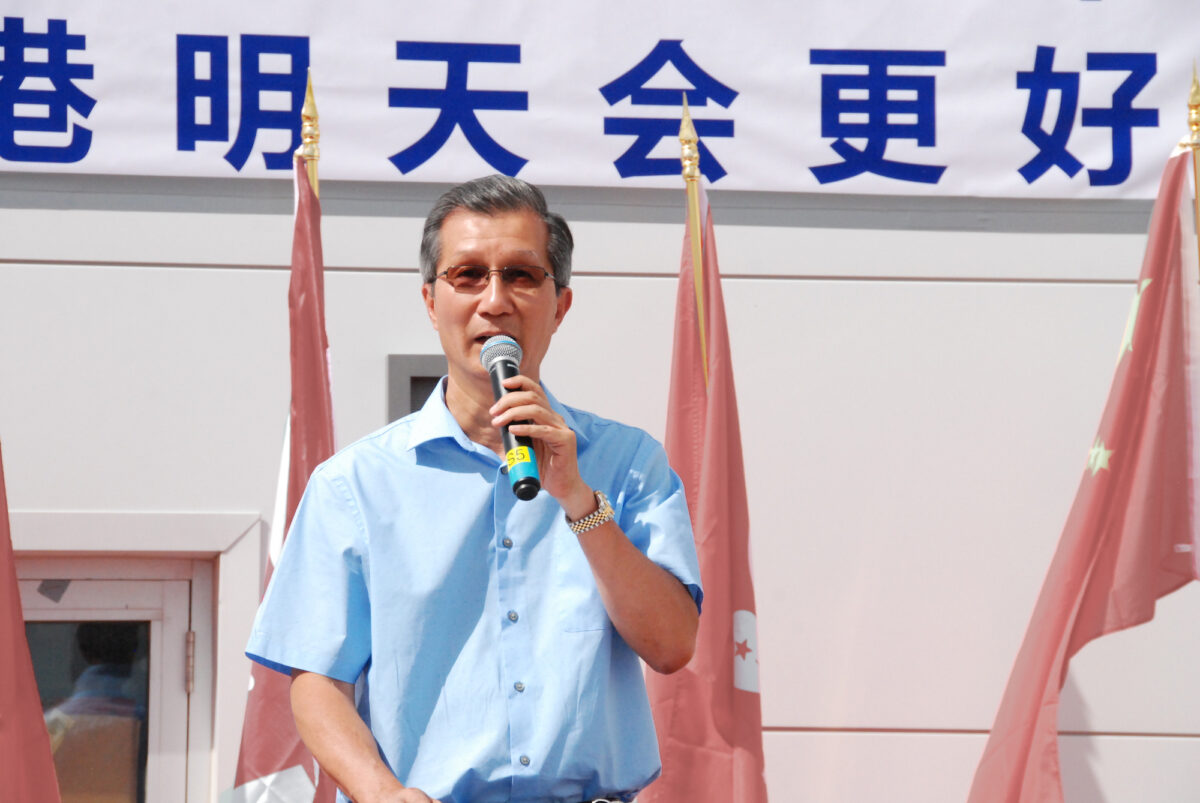
Jiang also said his group has been committed to the cause of promoting China’s image in Canada since early in the pandemic.
“Since the early days of China’s fight against the pandemic, we’ve made use of the special resources and channels of many JCCC members to tell the story of China’s fight against the pandemic to the Canadian government and people,” Jiang wrote.
“Through extensive and in-depth publicity, China’s demeanour [image] as a responsible, courageous, competent, and cooperative great power … is receiving more and more understanding, support, and appreciation from the Canadian government, people, and overseas Chinese!”
The ccmedia.news article included photos of Oh and Chan signing the letter.
Oh, a Conservative senator representing Ontario, was appointed to the Senate in 2013.
Chan, who was a cabinet member in the previous Liberal government in Ontario, is now deputy mayor of Markham, Ont., a city that is part of the Greater Toronto Area. At the time of the signing of the letter, he was not a public office holder.
The Ontario provincial government was reportedly warned by CSIS in 2010 about its fear that Chan was under the influence of China, according to the Globe and Mail. Chan has said he is taking legal action against the Globe for its reporting.
As reported previously by The Epoch Times, Chan has spoken against anti-Beijing protests in Hong Kong, and supported the regime’s national security law for the region. Canada and other democratic countries have condemned the new law as suppressing freedoms.
Affiliation
The JCCC, established in 2002, says its goal is to promote trade and business collaboration between Ontario and Jiangsu. It has over 1,000 members, including elites in the business, government, and academic communities, according to its website.
Jiang Rui, who began serving as JCCC president in 2018, has also held positions in organizations associated with the CCP, according to reports in local Jiangsu media and state media in China.
Apart from being JCCC president, Jiang is also an overseas representative of the provincial-level Chinese People’s Political Consultative Conference, a political advisory body in the People’s Republic of China, and also a key body of the CCP’s UFWD, according to ourjiangsu.com, a Chinese website directly owned by the Jiangsu provincial branch of the UFWD.
The Epoch Times reached out to Jiang for comment via the JCCC but didn’t hear back.
According to a January 2021 JCCC report, Jiang was also elected vice-president of the Jiangsu branch of the China Council for the Promotion of Peaceful National Reunification (CCPPNR), a China-based organization directly supervised by officials in the Politburo, the CCP’s highest decision-making body.
The report included photos taken at a conference on the establishment of the Jiangsu CCPPNR, held on Jan. 9, 2020, in Nanjing City, Jiangsu Province. A number of senior CCP officials, including the vice governor of the province, members of the Jiangsu Provincial Committee of the CCP, and the head of the UFWD, attended the conference, according to an article posted on the Jiangsu provincial government website.
The CCPPNR has branches in many countries, including two in Canada and at least 20 in the United States. In October 2020, the U.S. State Department designated a CCPPNR branch, the Washington, D.C.-based National Association for China’s Peaceful Unification, as a foreign mission of the Chinese regime, describing it as a front organization of the UFWD.
Open in app or online Justin Trudeau, Jagmeet Singh And Sikh Nationalism: The Untold Story Canadians are being kept in the dark regarding the degree to which Sikh Nationalism has permeated our political environment. Brad Salzberg Apr 5 Open in app or online Justin Trudeau, Jagmeet Singh And Sikh Nationalism: The Untold Story Canadians are being kept in the dark regarding the degree to which Sikh Nationalism has permeated our political environment. Brad Salzberg Apr 5    Save ▷ Listen  Pictured, Canadian prime minister, with one of his 3rd world priority communities. Share “The head of an Indo-Canadian organization in British Columbia has complained to local law enforcement about receiving death threats from Khalistani radicals after he organised a reception last month in honour of India’s High Commissioner to Ottawa.” Due to media obfuscation, Canadians are being kept in the dark regarding the degree to which Sikh Nationalism has permeated our political environment. Cultural Action Party liken it to a secret pact. As buried by CBC and corporate media, PM Justin Trudeau and political partner Jagmeet Singh are quietly backing Khalistani state independence in India. New Democratic Party leader Singh is so deep in the mud that the government of India has banned his turbaned-self from entering their country. Lucky for him that Canadian media has successfully covered up the radical nature of the NDP leader, whose family emigrated from India a generation ago. To place the situation in context, one must understand the nature of contemporary Canadian politics. The first lesson to learn is that the phenomenon is fervently non-Canadian. In our era of globalism, the needs of Canadian-born citizens take a back seat to the desires of globalist forces such as Sikhism, China and the nation of Islam. “What did the promptness of NDP leader Jagmeet Singh, MP Sonia Sidhu, and others in tweeting about the Punjab situation after Amritpal Singh’s incident and ban on Internet services, say? It was done at the behest of radical votebanks,” says a Brampton Sikh entrepreneur, requesting anonymity.” Picking up on the vibe, fellow Canadian patriots? In basic terms, both Trudeau and Singh are leveraging support of Khalistan independence to win the Sikh-Canadian vote. We stand aghast as irony drips from the brow of astute Canadians: Justin Trudeau and Jagmeet Singh are fully dedicated to independent Khalistan nationhood. Given the zealotry involved– not to mention the militancy– it is obvious that nothing less than a Sikh-dominated social and political environment is the intended outcome. As in– no immigration, no multiculturalism, as well as monolithic religious identity. In other words, an independent state devoid of every fundamental Trudeau and Singh are forcing down the throats of Canadians.. Media say nothing. Not a drop of the inherent irony flows from the pens of our country’s leading journalists. There you have it– the press in Canada are: Pro-communist China, pro-Sikh nationalism, pro-Islam. The only thing they are not is pro-Canada. In 2023, this is the condition of PM Trudeau’s “no core identity” society. Trudeau is using Khalistani independence to win the support of Sikh communities from coast-to-coast. According to Statistics Canada, Sikhism represents 1.4% of the Canadian population— in contradistinction to accumulated political power: Premier of Yukon, Ranj Pallai. Leader of NDP, Jagmeet Singh. Liberal Cabinet Members– Harjit Sajjan, Kamal Khera, . Liberal MPs: Anju Dhillon, Bardish Chagger, George Chahal, Iqwinder Gaheer, Mahinder Sindu, Randeep Sarai, Ruby Sahota, Sonia Sidhu, Sukh Dahliwal, Parm Bains. Mayor of Calgary, Jhoti Gondek. Mayor of Edmonton, Amarjeet Singh. Again, just 1.4% of our population is Sikh. Talk about GIANT over-representation in government. Media speak not a word about this reality. Put it all together in a blender, shake and stir, and what is the final outcome? Sikh political power in Canada, including bi-lateral Liberal-NDP federal party support for an independent Sikh nation to be located halfway around the world. Sensible Canadians know how to summarize the situation: this is Canadian politics in 2023. Let us think back to the founding of the international state of “Canadastan.” CAP attribute this gem to none other than ex-Liberal PM, Pierre Trudeau. Communist in political orientation, this individual began our transition to a globalist nation-state. Or better put, a “non-state,” as communist philosophy advances. Beginning with an opening of our national doors to the communist government of China, we note an affinity by which current PM Justin Trudeau runs our country. In 2015, Trudeau Jr. began to integrate Islam and Sikhism into the fabric of our nation. Is it overly simplistic to state that more than any force in Canadian history, it is the Trudeau family who destroyed Canadian nationalism? Is it not this communist-admiring Quebecois duo who transformed society into a condition no citizen ever asked for, or approved of? “When events such as the arrest of Amritpal Singh happen, Khalistan supporters bombard the offices of mayors, MPs, MPPs and Ministers with messages, forcing them to issue hasty statements or tweet,” says an Indo-Canadian restaurant owner in Toronto.” Which MPs, Mayors and Ministers? The ones listed above, in a political effort completely devoid of Canadian content? Does Canada now exist for the benefit of the Punjab? Sadly, this is the case. Jagmeet Singh, golden boy of the Canadian press, is one privileged individual. While he prances around in Vaisakhi parades pushing Khalistan independence, CBC and corporate media have not a negative word to say about the man. Working his buns off for Khalistan while branding Canadians racist is par for the course. “Not a worry, Mr. Singh. Justin Trudeau is paying our salaries, and we tow the globalist line accordingly.” “Politicians must stop playing identity politics. A criminal is a criminal — not a Sikh or a Hindu or a Muslim. By supporting these elements, ministers and MPs are playing dangerous games and harming Canada which needs India more than ever now.” Forget about it, buddy-boy. Woke liberalism specializes in carving up communities into distinct silos, only to get them fighting each other within general society. See Marx, Karl for details. What this person is describing is not some fringe element of Justin Trudeau’s post-modern society. It is contemporary Canada, and thanks to the family Trudeau and traitorous politicians like Jagmeet Singh, it is here to stay. Save ▷ Listen Pictured, Canadian prime minister, with one of his 3rd world priority communities.Share“The head of an Indo-Canadian organization in British Columbia has complained to local law enforcement about receiving death threats from Khalistani radicals after he organised a reception last month in honour of India’s High Commissioner to Ottawa.”Due to media obfuscation, Canadians are being kept in the dark regarding the degree to which Sikh Nationalism has permeated our political environment.Cultural Action Party liken it to a secret pact. As buried by CBC and corporate media, PM Justin Trudeau and political partner Jagmeet Singh are quietly backing Khalistani state independence in India.New Democratic Party leader Singh is so deep in the mud that the government of India has banned his turbaned-self from entering their country. Lucky for him that Canadian media has successfully covered up the radical nature of the NDP leader, whose family emigrated from India a generation ago.To place the situation in context, one must understand the nature of contemporary Canadian politics. The first lesson to learn is that the phenomenon is fervently non-Canadian. In our era of globalism, the needs of Canadian-born citizens take a back seat to the desires of globalist forces such as Sikhism, China and the nation of Islam.“What did the promptness of NDP leader Jagmeet Singh, MP Sonia Sidhu, and others in tweeting about the Punjab situation after Amritpal Singh’s incident and ban on Internet services, say? It was done at the behest of radical votebanks,” says a Brampton Sikh entrepreneur, requesting anonymity.”Picking up on the vibe, fellow Canadian patriots? In basic terms, both Trudeau and Singh are leveraging support of Khalistan independence to win the Sikh-Canadian vote. We stand aghast as irony drips from the brow of astute Canadians:Justin Trudeau and Jagmeet Singh are fully dedicated to independent Khalistan nationhood. Given the zealotry involved– not to mention the militancy– it is obvious that nothing less than a Sikh-dominated social and political environment is the intended outcome.As in– no immigration, no multiculturalism, as well as monolithic religious identity. In other words, an independent state devoid of every fundamental Trudeau and Singh are forcing down the throats of Canadians..Media say nothing. Not a drop of the inherent irony flows from the pens of our country’s leading journalists. There you have it– the press in Canada are:Pro-communist China, pro-Sikh nationalism, pro-Islam. The only thing they are not is pro-Canada. In 2023, this is the condition of PM Trudeau’s “no core identity” society. Trudeau is using Khalistani independence to win the support of Sikh communities from coast-to-coast.According to Statistics Canada, Sikhism represents 1.4% of the Canadian population— in contradistinction to accumulated political power:Premier of Yukon, Ranj Pallai. Leader of NDP, Jagmeet Singh. Liberal Cabinet Members– Harjit Sajjan, Kamal Khera, Anita Anand.Liberal MPs: Anju Dhillon, Bardish Chagger, George Chahal, Iqwinder Gaheer, Mahinder Sindu, Randeep Sarai, Ruby Sahota, Sonia Sidhu, Sukh Dahliwal, Parm Bains.Mayor of Calgary, Jhoti Gondek. Mayor of Edmonton, Amarjeet Singh. Again, just 1.4% of our population is Sikh. Talk about GIANT over-representation in government. Media speak not a word about this reality.Put it all together in a blender, shake and stir, and what is the final outcome? Sikh political power in Canada, including bi-lateral Liberal-NDP federal party support for an independent Sikh nation to be located halfway around the world.Sensible Canadians know how to summarize the situation: this is Canadian politics in 2023.Let us think back to the founding of the international state of “Canadastan.” CAP attribute this gem to none other than ex-Liberal PM, Pierre Trudeau. Communist in political orientation, this individual began our transition to a globalist nation-state. Or better put, a “non-state,” as communist philosophy advances.Beginning with an opening of our national doors to the communist government of China, we note an affinity by which current PM Justin Trudeau runs our country. In 2015, Trudeau Jr. began to integrate Islam and Sikhism into the fabric of our nation.Is it overly simplistic to state that more than any force in Canadian history, it is the Trudeau family who destroyed Canadian nationalism? Is it not this communist-admiring Quebecois duo who transformed society into a condition no citizen ever asked for, or approved of?“When events such as the arrest of Amritpal Singh happen, Khalistan supporters bombard the offices of mayors, MPs, MPPs and Ministers with messages, forcing them to issue hasty statements or tweet,” says an Indo-Canadian restaurant owner in Toronto.”Which MPs, Mayors and Ministers? The ones listed above, in a political effort completely devoid of Canadian content? Does Canada now exist for the benefit of the Punjab?Sadly, this is the case. Jagmeet Singh, golden boy of the Canadian press, is one privileged individual. While he prances around in Vaisakhi parades pushing Khalistan independence, CBC and corporate media have not a negative word to say about the man.Working his buns off for Khalistan while branding Canadians racist is par for the course. “Not a worry, Mr. Singh. Justin Trudeau is paying our salaries, and we tow the globalist line accordingly.””Politicians must stop playing identity politics. A criminal is a criminal — not a Sikh or a Hindu or a Muslim. By supporting these elements, ministers and MPs are playing dangerous games and harming Canada which needs India more than ever now.”Forget about it, buddy-boy. Woke liberalism specializes in carving up communities into distinct silos, only to get them fighting each other within general society. See Marx, Karl for details.What this person is describing is not some fringe element of Justin Trudeau’s post-modern society. It is contemporary Canada, and thanks to the family Trudeau and traitorous politicians like Jagmeet Singh, it is here to stay. |
China Foreign Ownership and BC Resources by Kevin Hinton and Ryan McKenzie – Date not provided https://www.bcbusiness.ca/china-foreign-ownership-bc-resources Does allowing non-B.C. enterprises to buy increasing chunks of the companies producing our resource commodities result in a loss of control over how those resources are developed?
B.C.’s natural resources are being gobbled up by foreign entities at a record pace. Increasingly, those entities are controlled by governments, such as China’s, that may have motives beyond mere profits.
Former B.C. Premier Bill Bennett said in 1979 that B.C. was not for sale. He made that famous declaration in reaction to news that Canadian Pacific Investments Ltd., the Montreal-based subsidiary of the railway company, was seeking to increase its already large ownership position to a controlling interest in MacMillan Bloedel Ltd., the province’s number one forest products company.
That was too much for Bennett. At the time, CP was already a major player in the province and gaining control of MacMillan Bloedel would make it by far the biggest, with headquarters in Central Canada. Bennett vetoed the deal using the provisions of the B.C. Forest Act, which required government approval for any transfer of forest leases from one corporation to another.
“We’re clarifying government policy in declaring there is a point at which a company can be too large in a certain area,” Bennett told the legislature on June 25, 1979. “That’s the policy of this party and this government . . . that is public policy from the premier of the province of British Columbia.”
Fast forward a couple of decades and many would argue that the province is not only for sale, but large pieces have been sold – and this time with government acquiescence, if not approval. Consider the following:
• With the provincial government’s blessing, MacMillan Bloedel was bought for $US 2.45 billion in 1999 by Weyerhaueser Inc., a huge U.S. forest products company. There was nary a ripple of comment.
• In 2002, North Carolina-based Duke Energy Inc. paid $US 8 billion for control of Westcoast Energy Inc., the company that runs the natural gas pipeline system from northeast B.C. gas fields to the rest of the province, and to export markets in the U.S. There was little public comment.
• Kelowna-based Inland Natural Gas, having just picked up BC Hydro’s natural gas distribution network and the Trans Mountain pipeline system, was bought in 2005 by U.S.-based Kinder Morgan and twice renamed, first BC Gas Inc., then Terasen Gas Inc. Kinder Morgan soon spun Terasen’s natural gas assets off to Fortis Inc., a Canadian company headquartered in Newfoundland. But Kinder Morgan kept the piece it wanted: Inland’s ownership stake in Trans Mountain Pipeline, the company that ships crude oil and refined products to Vancouver from Edmonton. There was no public outcry over this either.
• In a transaction still mired in controversy, the B.C. government in 2004 completed the sale of debt-ridden B.C. Railway Co. to Canadian National Railway Co. for $1 billion. As it is now structured, CN is as much an American company as it is Canadian. There is significant and ongoing public comment on this transaction, although the controversy has less to do with foreign control than it does with politics.
Globalization has expanded the reach of “national” companies everywhere, with many now taking on the more accurate “multinational” moniker. Of course nationalist sentiment still exists – witness the American reaction to a disastrous oil spill in the Gulf of Mexico and the British company, BP Petroleum, that was responsible for it. But governments now seem satisfied that they can control foreign-owned private companies through regulation.
Today, the focus of the debate has shifted from concern over a private-sector change in share ownership to concern over acquisitions and investments by state-owned enterprises and sovereign wealth funds. While a private-sector move is transparent – they all want to make more money – a state-controlled enterprise may have additional agendas that are contrary to the host nation’s interests. Increasingly, these state-owned enterprises are from the People’s Republic of China.
In the last two years, Chinese state investments in Canada have included a $1.9-billion investment by PetroChina Co. Ltd. in Athabasca Oil Sands Corp., a $4.65-billion investment by Sinopec Corp. in oilsands producer Syncrude Canada Ltd., a $1.25-billion investment by China Investment Corp. in Calgary-based Penn West Petroleum Ltd. and a $679-million takeover of Vancouver-based Corriente Resources Inc. by a Chinese consortium.
In addition, it was announced in January 2011 that Sinopec Corp. is among a group of investors providing $100 million to jump-start Enbridge Inc.’s proposed $5.5-billion Northern Gateway pipeline project, designed to carry oilsands crude from Alberta to a tanker port in Kitimat and on to Asian markets.
These kinds of investments are taxing Canada’s foreign investment rules and have already sparked a review. At issue is whether or not the country needs to use different criteria in assessing the benefits of a state-owned company’s investment as opposed to a straightforward private-sector investment.
While there has been some debate on the question of ownership of Canada’s natural resources, nary a word was uttered by any of the political candidates running for office in the May 2 federal election. And very little work has been done to help explain to the general public what the issues are and why they should care.

Image: Peter Holst
John Bruk broke with the Asia Pacific Foundation,
arguing that investments from Chinese state-
controlled companies must be better regulated.
The growing number of Chinese investments
In January 2011, Pascale Massot, a doctoral student in UBC’s political science department, prepared a paper for Vancouver’s Asia Pacific Foundation of Canada looking at the growing number of investments made by state-owned Chinese enterprises. She recommended that governments provide clarity around how such investments should be treated.
“Since the summer of 2009, at least five Chinese state investments in Canada in the energy and mining sectors have totaled more than $10 billion,” wrote Massot. “Those investments were completed unhindered (most did not meet the minimum requirements for a review under the Investment Canada Act). Confirming a sustained interest in investing in Canada, the China Investment Corporation (a sovereign wealth fund) unveiled plans to open its first overseas corporate location in Toronto on January 12, 2010.”
Massot went on to call for changes to Canada’s review process to better reflect the new investment environment: “It is important for the Investment Canada Act to remain up to date in the face of the rapid evolution of state-owned investments globally. It is also particularly important to get this right, in light of the growing importance for Canada of Chinese state-owned and private investment.”
For B.C., there are three such investments that illustrate the debate. In July 2009, China Investment Corp. put $1.74 billion into Vancouver-based Teck Resources Ltd. for a 17.5 per cent equity stake. Then, in February 2011, PetroChina announced it was investing $5.4 billion in one of EnCana Corp.’s prolific shale gas properties in northeastern B.C.; rather than making an equity investment in EnCana, China elected instead to go the joint-venture route. The third investment, announced in the spring of 2011, has a private-sector consortium of Chinese companies putting up $1 billion to develop metallurgical coal from B.C.’s northeast. Although not a pure example of a state-owned enterprise, there is some state involvement, and the deal seems designed to do an end run around mining companies and lock up the coal supply for China’s steelmaking industry.
Whether or not all these investments from China are a good thing for B.C. is an open question. Is the $5.4-billion investment in EnCana’s shale gas designed to maximize returns from the sale of the gas to the highest bidder, or is it designed instead to lock up the supply of gas, at a relatively low price, and move it to China via a liquid natural gas plant in Kitimat? Only a month after announcing the Chinese investment, EnCana said it would acquire a 30 per cent interest in that LNG export terminal, now in its final planning stages.
It’s that potential for conflict of interest that has a few people worried. Jock Finlayson, executive vice-president of the Business Council of B.C., appreciates the “investment renaissance” that B.C. is now experiencing, but recommends a cautious approach.
“Canada needs to look at this,” he says. “I don’t know what the right answer is, but I do agree that the private-sector rules don’t apply to state-owned organizations, and it’s not just the Chinese. It requires an explicit look. Do we hold them to a higher test? They are going to have to do it sooner rather than later.”
John Bruk, who 27 years ago co-founded and headed the Asia Pacific Foundation, pulls no punches on this topic. He sees a need for some concerted action before too many horses have fled the barn. Bruk has prepared a comprehensive analysis of the track record of the foundation; he believes the government-funded organization needs to be re-energized in part because of China’s growing economic influence, and believes it needs to do much more to help Canada address an unsustainable trade deficit with China. (Disclosure: I provided editing services for Bruk on this paper.)
“Is trading our ownership and control of core assets for more consumer goods, resulting in unsustainable trade deficits, good for Canada?” Bruk asks in his report. “Are we jeopardizing prosperity for our children and grandchildren while putting at risk our economic independence? In my view, this is exactly what is happening.”
Bruk describes the EnCana investment as a good case in point: “It is just the latest in a series of investments by China that should spark a serious debate in this country about Canada’s willingness to accept what appears to be an asset purchase by an agency of a foreign government. It is perhaps the first transaction in which a sale of a natural resources asset is dressed up in the sheep’s clothing of a joint venture with a view to neutralize any opposition.”
Bruk has similar problems with the Teck investment, questioning why it was necessary to seek Chinese investment for a Canadian mining company (one of the few that hasn’t been taken over outright) when there is plenty of investment capital within our borders.
“Considering that Teck produces base metals and coal, commodities in great demand by China, was Canada in such a desperate state that Teck had to accept money from the China Investment Company to find the needed bridge financing? A number of our public employees’ pension funds had plenty of capital for such a promising investment. How promising? CIC bought 101.3 million Teck class B shares at $17.21; in less than two years, those shares increased to $53, a return of over 200 per cent. Instead, our public pension fund managers are going abroad seeking investments as if there were no opportunities in Canada. Is it any wonder foreigners would like to acquire more of our resource assets?”
Bruk is at odds on this topic with his old employer, the Asia Pacific Foundation. Kenny Zhang is a senior research analyst with the foundation and sees no cause for concern here.
“It doesn’t matter where [the investment] comes from – it always has positive and negative effects. We should treat [state-owned investors] equally as with any investment. They have to follow Canadian law. The state-owned company wants the high return for the investment, and also has a strategic need for resources. We must clear up the message. We are an open economy. The Chinese are watching this very closely.”
Foundation officials are sensitive to this topic, and worry about the public perception out there around investments from China. After the Harper government’s very high-profile rejection last fall of a bid by Australia-based BHP Billiton to take over Saskatchewan-based Potash Corp., the foundation commissioned Pascale Massot’s review of state-owned enterprises and their interest in Canada. Prime Minister Harper rejected the takeover bid on “national security” concerns, but only after the governments of Alberta, Saskatchewan and Manitoba all argued strongly that the takeover was not in the national interest. (B.C. took no position on this transaction.) One of Massot’s findings was that politics played a large role in Harper’s decision, and that that needs to change.
[pagebreak]
In April, the foundation released the results of a survey it had commissioned to assess Canadians’ comfort level with investment from a number of countries, including China. The results were unsettling for those who see Chinese investment in Canada’s resource sector as a good thing. It showed that more Canadians see China as a threat (57 per cent) than an opportunity (43 per cent), and that such sentiment is growing. More than 75 per cent said they were opposed to a Chinese state-owned company taking a majority position in a Canadian company.
“There is a yawning discrepancy between the sentiments that Canadians have for Asian countries and the role that they see Asia playing in Canada’s economic future,” said Yuen Pau Woo, the foundation’s president and CEO, in a press release accompanying the poll results. He went on to castigate federal politicians, in the middle of campaigning, for not paying enough attention to the issue: “In an election campaign that has largely been devoid of discussion on international issues, the poll findings suggest an urgent need for political leadership on a Canadian response to the shift in global power towards Asia. It is not enough to give lip service to the notion that Canada is an Asia Pacific nation. There is an urgent need for improved awareness, greater activity and better policy. We need a national conversation on Asia to better equip Canadians to respond to the rise of Asia, and to make Canada more fully a part of the Asia Pacific region.”
Whether people agree with the APF’s strong promotion of a green-light policy for state-owned investments or follow the more cautionary approach recommended by the Business Council of B.C., there is little help coming from federal politicians. They are largely silent on the issue.
Former federal industry minister Tony Clement was asked in April to comment on the Conservative government’s current thinking on how to treat investments from state-owned enterprises. The government in fact created a Competition Policy Review Panel in 2007 and published its recommendations in 2008. None of the recommendations have been implemented, including one calling for better communication on how the government makes decisions about these kinds of investments. Clement declined the interview request; he too was busy campaigning for re-election.
B.C.’s newly appointed energy minister, Rich Coleman, on the other hand, doesn’t hesitate to offer his opinion on Chinese state-owned investment in the energy sector. Asked if he has any concerns, Coleman responds, “I don’t think so. These companies, like China National Oil Corp., have established partnerships with industrial players here and elsewhere. They will advance development of our resources, and they’ll follow our rules and environmental regulations. We haven’t said to one company you’re not welcome, and another is.”
Coleman sees no conflict in a Chinese state-owned enterprise holding a large piece of a B.C. shale gas field: “Well, they would make the investment at the best price they could so they could get access to the gas at the best price they can. I don’t think state-owned corporations versus private ones have any other goal than that.” Coleman points out that the price paid for natural gas in China is three times higher than the North American price and that the province’s royalty take would increase with sales to China.
James Brander, Asia-Pacific Professor of International Business in UBC’s Faculty of Commerce, shares Coleman’s view of the investments in general and the EnCana deal in particular. But he also has some cautionary notes.
“Of course there is a potential conflict. But strictly speaking, the terms on which they enter this agreement, under Canadian law, would require them to operate in the interests of the shareholders,” he says. “It’s not legal in Canada for a foreign government to, either directly or by proxy, own an asset and use it for the explicit benefit of the foreign country at the expense of the shareholders.
“But it’s not as though we have investment police looking into every single investment,” he continues. “They could exercise some pressure. But at this level I wouldn’t be concerned. We are talking about [with EnCana] a 50 per cent ownership. I’d be more concerned about majority ownership. It is important to keep our eye on that conflict of interest. We do have laws to prevent it, but we need to keep an eye on it.”
While John Bruk disagrees with the APF’s current position on Chinese state-owned investors, he agrees there’s a need for a national discussion on the topic. And he believes there’s some urgency for it. Canada’s trade deficit with China skyrocketed from $1.1 billion in 1995 to $31.2 billion in 2010, making it our largest by far. During those 16 years, exports to China have grown by a factor of less than four while China’s exports to Canada have grown by a factor of almost 10. This trend, says Bruk, is “a recipe for impoverishment of our country.”
“Is it any surprise that President Hu expressed China’s desire to double its bilateral trade with Canada by 2015?” Bruk asks. “Assuming that both exports and imports double, which is optimistic from a Canadian point of view, considering the above ratios, our trade deficit would grow from $31.2 billion last year to $62.4 billion by 2015 – a boon for China, not for Canada.”
Over the next decade, B.C. is pinning its hopes on a resurgence of interest from Asian nations looking for commodities – whether it’s coal for steel, natural gas and oil or forest products. But the province faces the same dilemma it has faced for most of its existence: Does allowing non-B.C. enterprises to buy increasing chunks of the companies producing our resource commodities result in a loss of control over how those resources are developed?
Premier Bennett, nearly 35 years ago, decided that allowing out-of-province control of our economic engine was too great a risk to take – and back then, the out-of-province player in question was Canadian and privately owned. With state-owned enterprises now threatening to lock up those resources with perhaps a different agenda in mind, is there enough consideration being given by governments to all the ramifications? The simple answer, it would appear, is no.
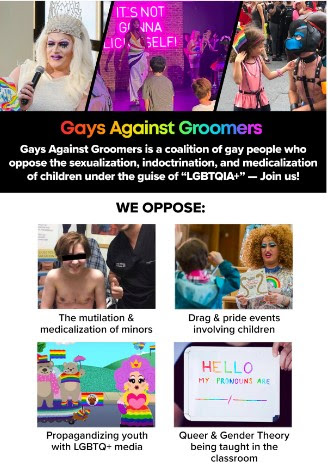
Drag Queen storytime events are being held in public spaces such as libraries and funded directly or indirectly by all levels of government across the country.
 |
There are now many books available in the library targeting children of a young age.
 |
Drag is not for kids!
We need to start protesting these events to defend children whose parents do not and who can’t defend themselves from being introduced and indoctrinated to the Drag Queen lifestyle and confusion of Gender Identity Theory.
Even many from the LGBTQ community have spoken out against Drag Queen storytime events.
Drag Queen Kitty Demure says Drag Queen culture is not for kids!
Watch “DRAG QUEEN RESPONSE TO DRAG QUEEN STORY BOOK HOUR” on YouTube
The “Gays Against Groomers” group is against Drag and Pride events involving children.
 |
If you are interested in participating in a Canadian Nationalist Party protest of Drag Queen storytime please contact me.
Anyone concerned about being anonymous will be encouraged to wear balaclava mask if necessary.
Other ways to help is by sharing this email or donating.
The Party is deregistered with Elections Canada right now so we can’t issue tax receipts.
You can etransfer to:
or send cash and cheque to:
Gus Stefanis PO Box 55588 Cedar Heights Scarborough, On M1H 3G7
I can also accept credit card here:
https://donorbox.org/gus-stefa…
Thank you,
Gus Stefanis
Leader
Canadian Nationalist Party
Canadians Will Be Told to Celebrate Sikh Heritage Month in April
by Dan Murray, Immigration Watch Canada – March 28, 2023 https://immigrationwatchcanada.org/
Most Canadians are probably not aware that on April 1 of this year, they will be told to celebrate “Sikh Heritage Month”. The following is a list of reasons why Parliament should have never even considered the celebration of a “Sikh Heritage Month” (the result of a law passed by Canada’s Parliament.). (1)
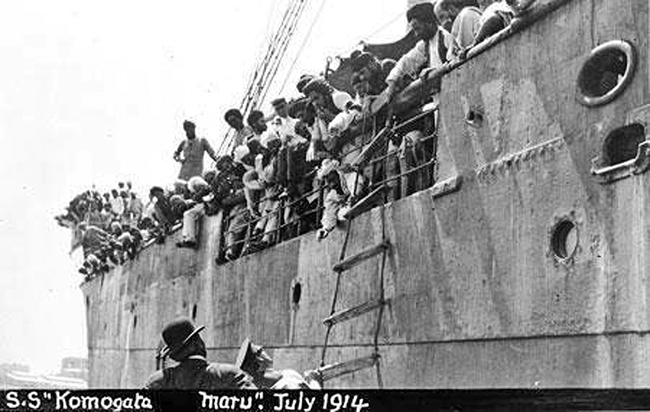
The behaviour of some of the earliest Sikhs to arrive in Canada in 1914 was a foreshadowing and a warning. It demonstrated Sikh willingness to use fraudulent documents. It also showed their arrogant attitude. They believed that they had a right to enter Canada and that Canada had no right to oppose their entry. Current NDP leader Jagmeet Singh has the same arrogant attitude. That 1914 incident helps to explain much of what happened later. Sikhs repeatedly use that event to proclaim victim status. They omit many facts including the fact that Sikhs assassinated a Canadian immigration agent. They also omit the fact that the leader of the 1914 Sikh expedition boasted that if he succeeded in landing his passengers, he would bring 25,000 more Sikhs soon after. This threat would have alarmed Canadians because if it had come true, it would have greatly changed Vancouver’s entire cultural make-up. To show some context, consider this: around 1914, the City of Vancouver had a population of about 60,000. For details of the entire 1914 incident, see https://immigrationwatchcanada.org/2008/05/22/the-voyage-of-the-komagata-maru-a-review-and-a-short-summary/ (2)
Although many years of Sikh immigration peace followed, the Singh Decision of 1985 signaled the beginning of Sikh-caused refugee and immigration chaos in Canada. In doing so, Sikhs helped to turn Canada’s refugee system into a quasi-judicial body which soon became mired in tens of thousands of claims (most of them illegitimate). For details see: https://immigrationwatchcanada.org/2005/03/23/the-1985-singh-decision-disaster-vs-the-1985-air-india-disaster/ According to reliable sources, those claims have cost Canada billions of dollars and saddled Canada with people who have contempt for Canada. Is this supposed to be an example of the “Sikh Heritage” that Canadians are expected to celebrate every April? (3)
The Sikh bombing (the murder of 329 people about an Air India plane in 1985) should have moved Canada to place severe restrictions on Sikh immigration. But it did not. That bombing incident (which originated in Vancouver where Sikhs placed bombs on two planes) was the largest mass murder in Canadian history. Instead for years, Trudeau has groveled to the Sikhs. Most important, none of the Sikh ringleaders of the 329 murders has been sentenced for that crime. https://immigrationwatchcanada.org/2016/04/25/dont-apologize-sikhs/ We repeat, Is this another example of the “Sikh Heritage” that Canadians are supposed to celebrate every April? (4)
A major reason why the Sikh bombers have never been held to account is the culture of intimidation by militant Sikhs of other Sikhs. The identities of the Sikh perpetrators are quite likely known even by the Sikh members of Trudeau’s cabinet, not to mention Trudeau himself and hundreds of other Sikh politicians and professionals. As a result, hundreds of the relatives of the 329 murdered victims have never received justice. Until the Sikh criminals are behind bars, the word “Sikh” will be a dirty word to those relatives and to millions of other Canadians. Most Canadians want nothing to do with those Sikhs – let alone celebrate “SIKH HERITAGE”. (5)

Worse still, young and older male Sikhs have become significantly involved in drug industry criminality in Canada. However, when drug incidents are reported, our treacherous CBC and other media make a point of not disclosing the names of the Sikh murderers or Sikhs murdered. Most Canadians have come to expect that when the CBC or other media begrudgingly do reveal the names of the criminals, those names will be ones such as Parvinder, Balwinder or some other Sikh first name. In Metro Vancouver, Sikhs have complained that they needed more police to deal with drug-dealing and drug gang killings. Ironically, the truth is that many people in Metro Vancouver think that Metro Vancouver does not need more police. Instead, it needs fewer Sikhs and less Sikh immigration. In fact, Metro Vancouver residents have also thought that Sikh parents had to finally accept a “Canadian” cultural trait, that of being responsible for their delinquent offspring. Those parents should not be expecting the “gum’mint” to do that job for them. Again, is this very visible Sikh cultural defect what corrupt Sikhs want all Canadians to celebrate every April? (6)
Canadians have become incredibly fed up with aggressive immigrants (both Sikhs and others) who demand that Canada adapt to immigrant customs. So far, no group has made as many demands for exemptions from Canadian laws as the Sikhs. In fact, Sikh demands to wear their turbans and their kirpans have been endless. If Sikhs really want to retain their customs, why are they here? Why would Canada want to create (A) another political mess such as India’s Punjab here and (B) an environmental disaster such as India in Canada through relentless Sikh immigration? (7)
Sikhs have grossly abused Canadian PM Chretien’s naive decision to create an additional Canadian consulate in India’s Punjab. That consulate has become notorious for being the fraud capital of all of Canada’s consulates and embassies in the world. Tens of thousands of Sikhs have entered Canada as a result of fraud there. In other words, tens of thousands, if not hundreds of thousands, of Sikhs have entered Canada illegally. Why would Canada want to celebrate being defrauded by these people? The numbers are not an exaggeration. At recent Sikh festivals in the Vancouver and Toronto areas, some Sikh leaders have boasted that up to 500,000 Sikhs attended. Who else besides corrupt Liberal leader Trudeau and equally corrupt NDP leader Jagmeet Singh would want to celebrate a heritage of political sodomy and shameless fraud? (8)
Political accommodation to the Sikhs has reached new levels of degradation under Trudeau. It is incredible that not a single MP voted against or abstained from voting when the “Sikh Heritage Month” bill was introduced in Parliament. To summarize: Is it sane to accept Sikh political degradation as part of Canada’s “heritage”? This list could be ten times as long. To put the matter bluntly but truthfully, the passing of the Sikh Heritage Act in 2015 is an example of how Canada’s Parliament has descended into the most degrading acts of political sodomy and boot-licking.
Our CBC and many politicians are proud to engage in such activity, but to recover Parliament’s dignity, here is what Parliament should do immediately : REPEAL THE “SIKH HERITAGE MONTH” BILL . IN ITS PLACE, INTRODUCE NEW BILLS TO PROTECT CANADA’S FRENCH AND UK HERITAGE AND PROTECT CANADA’S BORDERS !! For details about Jagmeet Singh’s involvement in Sikh violence, see https://www.reddit.com/r/metacanada/comments/hen2eb/reminder_jagmeet_singh_is_banned_from_india_for/ Dan Murray, Immigration Watch Canada \
Also see: https://en.wikipedia.org/wiki/Air_India_Flight_182
JOHNSTON’S AFFECTION FOR [RED] CHINA RUNS DEEP
- National Post
- 23 Mar 2023
- Terry Glavin
There are so many crazy things the Trudeau government has been expecting Canadians to believe about the partisan advantage the Liberals have accrued to themselves owing to their cosy relationships with China’s agents of influence in this country that it’s really difficult to decide which is the most objectively unbelievable and easily disprovable.
It’s a target-rich environment, as military tacticians would say. But I’m going to lay out the evidence against just one howler, which is Prime Minister Justin Trudeau’s proposition that “horrific, partisan attacks against a man of extraordinary integrity” is anything like a reasonable way to characterize doubts about former Governor General David Johnston’s independence in the matter of Beijing’s influence-peddling operations in Canada.
In the muddle of the playby-play coverage of House of Commons committee manoeuvres and the fate of a resolution calling for a public inquiry into Beijing’s well-documented interference operations in the 2019 and 2021 federal elections, there are two key things to keep your eye on.
The first is that Beijing’s influence operations in Canada went into hyperdrive after the Trudeau government came to power in 2015, and Beijing’s United Front Work Department undertook extraordinary clandestine measures in 2019 and 2021 to keep the Trudeau government in power. The second is that Trudeau has enlisted Johnston as his “independent special rapporteur” in the matter in order to avoid answering these straightforward questions: What did Trudeau know about what Beijing was up to, when did he know, and what did he do about it?
For argument’s sake, let’s set aside the relevance of the intimate relationship between the Johnstons and the Trudeaus — their neighbouring cottages in the Laurentians, the childhood ski trips the Trudeau boys and Johnston’s daughters went on together, and so on. You can even set aside Johnston’s role as one of the governing members of the Pierre Elliott Trudeau Foundation, even though the foundation has been directly caught up in the scandal, owing to the clandestine donations the Foundation recently chose to return to a certain superrich Chinese benefactor following disclosures that the money was part of a Beijing-directed grooming operation targeting Trudeau himself, going back to 2013.
The unreported and unarguably pertinent facts to take into account involve Johnston’s own half-century of participation in Beijing’s strategy to draw Canada into its orbit of influence, and his own personal and ongoing association with figures deeply compromised by their collaboration with Chinese government institutions and by their own vested interest in the catastrophe of the Canada-china collaborations that were spun into high gear after the Trudeau Liberals came to power in 2015.
In the 1980s Johnston was laying the foundations of the Canada-china universities exchange program. Later, as president of the University of Waterloo, he oversaw the establishment of the Confucius Institute, a scandal-shredded arm of the Chinese Communist Party’s propaganda and espionage operations in western countries. Widely known in Chinese establishment circles by his nickname “Jiangshan,” Johnston was awarded an honorary doctorate by Nanjing University in 2012, by which time he’d already made more than a dozen visits to China.
Three of Johnston’s daughters attended university in China — one at Zhejiang University, Nanjing University and the Chinese University of Hong Kong, another at the Beijing Language and Culture University and Hangzhou University, and the third at Fudan University in Shanghai. During a luncheon speech to the Canada-china Business Council in 2013, Johnston said it would be “wonderful” if all Canadians learned to speak Chinese.
While the federal government has been recently forced to issue strict guidelines to Canadian universities regarding the threat of technology transfers and intellectual-property accommodations with Chinese institutions, as recently as 2017 Johnston attended a conference on “science, technology and innovation” at Chongqing University where he professed a “profound Chinese complex” and boasted that even his grandchildren teach him things about China.
It’s a multi-generational “complex” the Johnston family shares with the Trudeaus, going back to Pierre Trudeau’s service to Mao Zedong during the 1960s as one of the regime’s most valued propagandists in the west. Back then, Trudeau Senior co-authored a book with his friend Jacques Hébert about their time as the regime’s invited guests during the Great Leap Forward and the famine that killed perhaps 70 million people. Trudeau and Hébert sneered at western journalists’ efforts to report on the famine and claimed to have noticed nothing more than “controlled distribution of foodstuffs.” The pair dined well during their entire time in the country.
But set aside the Pierre Elliott Trudeau Foundation entirely. The board of directors of Johnston’s own Rideau Hall Foundation — a “parting gift” from Justin Trudeau’s government upon his departure from the Governor General’s office — is a snapshot who’s-who of Beijing’s best friends and business partners in Canada.
A Rideau Hall Foundation director emeritus is Paul Desmarais III, from the Desmarais family, which founded the Canada-china Business Council. Then there’s Dominic Barton, who served as an adviser to several Chinese state-owned enterprises and whose Mckinsey and Company consulted with Chinese corporations involved in the construction of militarized islands in the South China Sea while Barton was chair of Trudeau’s blue-chip Advisory Council on Economic Growth. Barton was appointed Canada’s ambassador to China following the firing of the disgraced John Mccallum.
There’s John Manley, the Telus director and former deputy prime minister from the exuberantly Beijing-compliant Chrétien era. Manley’s contribution to the debates about Xi Jinping’s kidnapping of Michael Kovrig and Michael Spavor was to suggest the Canada Border Services Agency should have surreptitiously allowed Huawei chief financial officer Meng Wanzhou to evade a U.S. Justice Department extradition request.
There’s Beverley Mclachlin, who has refused to step down from her position on Hong Kong’s highest court despite Beijing’s evisceration of Hong Kong’s rule-of-law system. There’s John Montalbano, chief executive officer of the Royal Bank’s Global Asset Management arm, which manages Beijing’s global natural-resources acquisitions through China’s National Council for Social Security Fund, one of the world’s largest pension funds. On it goes like this.
Believe as much as you like that there is nothing untoward about Johnston’s appointment. And to be fair, he did a wonderful job as Governor General. A Governor General’s job is to make Canadians feel good about themselves, despite everything, and to make a convincing case that no matter how bad things look, everything’s OK.
And that is the job he’s been asked to do for Justin Trudeau in the matter of Beijing’s long and sinister reach into Canada’s democratic political institutions, and it should not be surprising if he does the job well.
WHAT DID TRUDEAU KNOW ABOUT WHAT BEIJING WAS UP TO?
Throne, Altar, Liberty
The Canadian Red Ensign

Thursday, March 16, 2023
15 Minutes to Save the World?
The expression “15 minute city” is a little under ten years old. It was about four to five years ago that it first began to circulate significantly and it really took off during the time when people everywhere proved themselves to be incredibly stupid by their willingness to submit to the all but total elimination of their most basic freedoms because of their naïve faith in medical experts who told them that they needed to stop living in order to avoid dying from the bogeyman of the bat flu. Last month, however, 15 minute cities became big news as mainstream media outlet after mainstream media outlet began running op-ed pieces about how critics of the concept were engaged in “conspiracy theory”. At the start of the last week in February I typed the words “15 minute cities” into Google and pressed the search button. The top results, both on the news tab and the main Google page, were articles of this sort from sources like CNN, The Guardian, and even the Weather Network. Indeed, the only one of the highlighted stories not to include the word “conspiracy” in the title was a piece from Bloomberg entitled “No, 15-Minute Cities Aren’t a Threat to Civil Liberties”, which, of course, was yet another denial of the “conspiracy theory” about 15 minute cities. At the time I did this search these stories and many more were all fresh, having been released in the previous two days, most in the previous twenty four hours.
Now, if someone wanted to convince people to take seriously the idea that there is some sort of nefarious international plot behind the latest buzzword expression in urban planning, one way to go about doing so would be to get the entire mainstream media to issue a denial in lockstep like this. When media companies all begin saying the same thing like a horde of brainwashed cult members chanting a mantra it is usually best to consider the exact opposite of what they are saying to be the truth. Indeed, if people like our Prime Minister, that contemptible lowlife Captain Airhead and J. Brandon Magoo, that creep who gives off the strong impression of someone who wandered off from the geriatric ward of an asylum for the criminally insane only to find himself in the White House were to start using their state pulpits to denounce anyone opposed to 15 minute cities as fringe extremists we would know with a certainty from this the supporters of 15 minute cities are up to no good.
So what are 15 minute cities? Are they part of a sinister plot to rob us of our freedom of motion and imprison us all within our own neighbourhoods? Or is the idea behind them an innocent one, aimed at renewing neighbourhoods and reducing traffic congestion, upon which unfair suspicion has been thrown by the unsavoury associations of those promoting and defending it?
Back in the 1960’s the term “walkability” entered the vocabulary of those with an active interest in revitalizing big cities or at least hindering them from dropping to a lower circle of Dante’s abyss. Making a city walkable meant making it as friendly and accessible to pedestrians as possible. The opposite of walkability was urban planning aimed at maximizing the ease and speed with which one could get around a city by car which was one aspect of the “urban renewal” movement that had influenced much or most of the city planning of the previous few decades. The 15 minute city is an adaptation of this concept of walkability or, to be more precise, a variation of an older adaptation the 20 minute city. The basic idea of a 15 minute city is that of a city in which people have access to everything they would need on an ordinary day in their own neighbourhoods within a 15 minute walk or bicycle ride from where they live. As with many ideas that generate heated controversies the heat comes more from the implications than from the basic concept. If it were possible to transform a city into a 15 minute city where everyone has everything he needs within such a small radius from his home without in any way altering anything else about the city and the lives of its inhabitants this would undoubtedly be an improvement and a very good one at that. If quality of life in a city were measured strictly in terms of convenience it would be an exponential improvement. The problem is that it is not possible to transform a city in this way without making many other changes. Since the advocates of 15 minute cities seem to be largely motivated by environmental concerns it would be appropriate here to cite Dr. Garrett Hardin’s First Law of Human Ecology “We can never do merely one thing.” It is those other things that would need to be done to transform cities into 15 minute cities that have a lot of people’s dander up.
Take, for example, the plans for low traffic neighbourhoods which Oxford, the city in Oxfordshire, England that is home to Oxford University, recently announced its intention to implement on a trial basis starting next year. A low traffic neighbourhood is a concept that is related to that of a 15 minute city and often promoted together with it, so much so that the two are sometimes mistaken as being synonymous with each other. The difference is that a low traffic neighbourhood is designed to keep something out of the neighbourhood – traffic congestion due to through traffic – whereas a 15 minute city is designed to put something in the neighbourhood – the necessities of everyday life easily accessible by walking or cycling. The Oxford city council has announced its intention, beginning next year, of dividing the city in to six districts and placing a limit of 100 on the number of times residents can drive from one district to the next, through certain routes between 7 am and 7 pm, to be enforced by licence-plate camera and fines. Residents would be able – for a fee – to apply for an additional allotment of trips through the limited routes.
Now this does not amount to locking Oxford residents within their districts. If Oxford goes ahead with this – and does not take it any further – Oxford residents will be able to pass between districts any time they wish and as many times as they wish if they do so on foot or by bike, and even by automobile if they take routes other than the more direct ones upon which the limits are being placed. This whole thing does, however, give off too much of a vibe of a high-tech, updated, version of “show us your papers, comrade” and so it is not surprising that the Oxford announcement was met with a large and vehement protest, especially since people were already fed up with this sort of thing from the three years of public health emergency tyranny. These measures do carry the potential for evolving into the permanent confinement of people within their own neighbourhoods through mission creep much like “14 days to flatten the curve” evolved into two and a half years of lockdowns, forced masking, and vaccine passports and mandates. Indeed, not only do they have the potential for evolving in this direction there is a very high probability that they will do so.
One reason for this is because those who are promoting low traffic neighbourhoods based on the 15 city model are openly motivated by the goal of getting people to drive less. When the earlier, more general, concept of walkability was conceived it was part of a response to several decades of urban planning based on utilitarian principles. The kind of urban planning that involved houses, small businesses, parks and playgrounds, local schools, libraries, hospitals and the like being torn down, often through the means of entire city blocks being seized by governments and handed over to developers, to make way for large apartment complexes, office buildings, malls, and the like. While large-scale urban planning on utilitarian principles went back to the nineteenth century, it had exploded around the middle of the twentieth century due to mass production’s having made motor vehicles increasingly available and affordable. This factor also, of course, affected the way the designs of these planners as utility now included such things as parking lots and freeways. A backlash against this sort of thing began in 1961 when Jane Jacobs published her The Death and Life of Great American Cities, which documented the negative side of “urban renewal”. Jacobs did not just write about the subject but was also an activist who fought against this sort of urban planning both in New York where she lived when she wrote her book and Toronto where she moved about a decade later, in both cities fighting against the construction of freeways or expressways. Among her criticisms of this kind of planning was that it was making cities into places for cars rather than for people. Those who began to promote the concept of walkability owed much of their inspiration to Jacobs. The promoters of the 15 minute city model would like us to think that they are following in these earlier footsteps and perhaps in a limited sense they are. Their primary objection to automobiles, however, is very different.
Jacobs and those whom she inspired in the 1960s objected to tearing down houses and digging up parks to make way for freeways and parking lots because these actions uprooted and dissolved communities and razed the neighbourhoods in which they had lived in order to replace these with dead, concrete, spaces made for machines rather than men. The promoters of the 15 minute city model, such as Anne Hidalgo, mayor of Paris, France, and her Columbian born advisor, Carlos Moreno, the professor at Sorbonne University who seems to be the one who came up with the concept, by contrast, don’t want people driving cars because they want to see a radical reduction in the amount of carbon dioxide released into the atmosphere. People like this think that the drastic reduction in carbon dioxide emissions they want is necessary to save the world. People who think that the world is at stake are not people likely to accept or respect limitations on their efforts nor are they people likely to listen to reason coming from those who disagree with them. If, therefore, placing limits on the daytime use of high density routes fails to achieve a reduction in car use and simply diverts heavy traffic to other routes, the planners will be likely to revise the model – and keep revising it until they achieve their goal. Such revisions will move the model closer and closer to something resembling people being permanently locked into their own neighbourhoods.
There is another difference between the original pushback against the large building/parking lot/freeway type of urban planning and the advocacy of the 15 minute city today which supports the conclusion that the concept is inherently flawed in such a way that its implementation, however, good the intentions of those behind it may be, would inevitably lead to urban life becoming more tightly controlled. Prior to the invention and mass production of the automobile every city was a city in which every neighborhood had its local store, school, etc. so that there was no necessity for long daily commutes that were impractical before motorized transportation. Transforming cities that were like this into cities where many if not most people live in one district, work in another, and do all their shopping in yet another and where the city’s infrastructure is designed to facilitate the fast motor vehicle transportation that makes such an arrangement feasible required city governments to expropriate private property and spend massive sums of money in imposing a redesign upon their cities dreamed up by engineers who had been given an unprecedented amount of centralized control over what their cities would look like. In other words, the kind of urban transformation to which people like Jane Jacobs’ objected, in which older, traditional, more organic communities were bulldozed down and paved over to make way for concrete and asphalt edifices designed for machines rather than the people the machines were themselves built to serve, required government to insert itself far more actively and visibly in the everyday lives of urban inhabitants than it had before, which meant that this was a step away from a more free mode of life and towards a more controlled mode of life.
Any serious attempt to transform a city into a 15 minute city would require a further step in the same direction. This is because the model calls for all necessities to be available to people within a 15 minute walk or cycle ride from their home. Obviously, if a city has to be transformed into a 15 minute city then these necessities are not already available this close. Therefore, to remake a city according to this model would involve moving businesses and services into neighbourhoods that don’t already have them. A government that wants a certain type of business in a neighbourhood has to do a lot more to achieve its goal than a government that wants to keep a certain kind of business out of a neighbourhood. If a city, for example, does not want strip bars and casinos next to elementary schools, then all it has to do is pass a zoning restriction. If, however, a city decides that it wants a bakery in a neighbourhood that does not have one, a simple change to zoning laws would not in itself accomplish this. Somebody has to put the bakery in there. Either the city would have to build and operate a bakery itself or, if it was dead set on having one, it would have to lure a private baker in with some sort of incentive. A bakery is only one type of business. To turn a city into a 15 minute city its government would have to do this not merely with bakeries but with every sort of business and service it deems essential, and in every neighbourhood.
While those promoting the 15 minute city model claim to be the heirs of Jane Jacobs they are in spirit far closer to the city planners she fought against in New York and Toronto. As different as the two kinds of urban planners are in their attitude towards automobiles, they are united by a common belief that if you get the right urban engineers, with the right ideas, and sit them down together in a drawing room, they will be able to come up with a design for a city which if enacted would produce maximum happiness for the maximum number of the city’s inhabitants. If, however, freedom is essential to human happiness, and it is, then this sort of thinking is counterproductive because it can only move cities in the direction of being more planned and less free. Those who make pitches for the 15 minute city concept like to try and sell it to us as a restoration of an older, simpler, way of life. That way of life, however, belonged to traditional communities which possessed at least one quality that was more conducive to happiness than that in modern cities and which cannot be reproduced artificially by planning. That quality is that of being organic. This is a quality that comes about in a community naturally, when families live together in the same place, working in the same businesses, shopping in the same stores, worshipping in the same churches, for several generations over the course of which a sense of social oneness grows. This cannot be reproduced artificially by planning and attempts to do so will only produce ugly caricatures of natural, traditional, communities.
One does not have to speculate about sinister motives behind the 15 minute city concept – and without such speculation you do not have a “conspiracy theory” – to have serious misgivings about the idea. Urban planning of this nature cannot recreate true organic communities, inevitably requires an increase in government control and a decrease in human freedom no matter how benign the motivation, and, being wedded to an environmentalist ideal of eliminating carbon emissions that has in recent years taken on the characteristics of a cult of fanatics is set on course to evolve into something far more unpleasant. — Gerry T. Neal